


[DAILY TRADING] USDCNH Analysis 17 August 2026 – Slips to 6.7410 as PBOC Fixing Firms, Fed Hike Bets Ease
 Updated Updated Mon, 2026 August 17 07:39
![[DAILY TRADING] USDCNH Analysis 17 August 2026 – Slips to 6.7410 as PBOC Fixing Firms, Fed Hike Bets Ease](https://www.vantagemarkets.co.id/en/wp-content/uploads/sites/22/2026/08/usdcnh-daily-analysis-17-august-2026-featured.webp)
USDCNH traded at 6.74099 on the Vantage USDCNH CFD as of 02:17 (UTC) / 10:17 (GMT+8) on 17 August 2026, sitting near the offshore yuan’s strongest level against the dollar since February 2023. It rarely makes headlines, but it’s the setup anyone searching for a USDCNH forecast or USDCNH news should be watching. Educational purposes only, not financial advice.
USDCNH, also written as USD/CNH, represents the U.S. dollar against the offshore Chinese yuan (CNH); the inverse quotation, Chinese yuan to USD or CNH to USD, is written CNH/USD. Traders searching USD to CNH, USD to Chinese yuan, US dollar to Chinese yuan, USD vs Chinese yuan, USD Chinese yuan, American dollar Chinese yuan, dollar to Chinese yuan, or a USD CNH forecast are typically looking at this same USDCNH chart.
This piece reads the 15-minute chart below without calling the next leg.
What the chart is showing
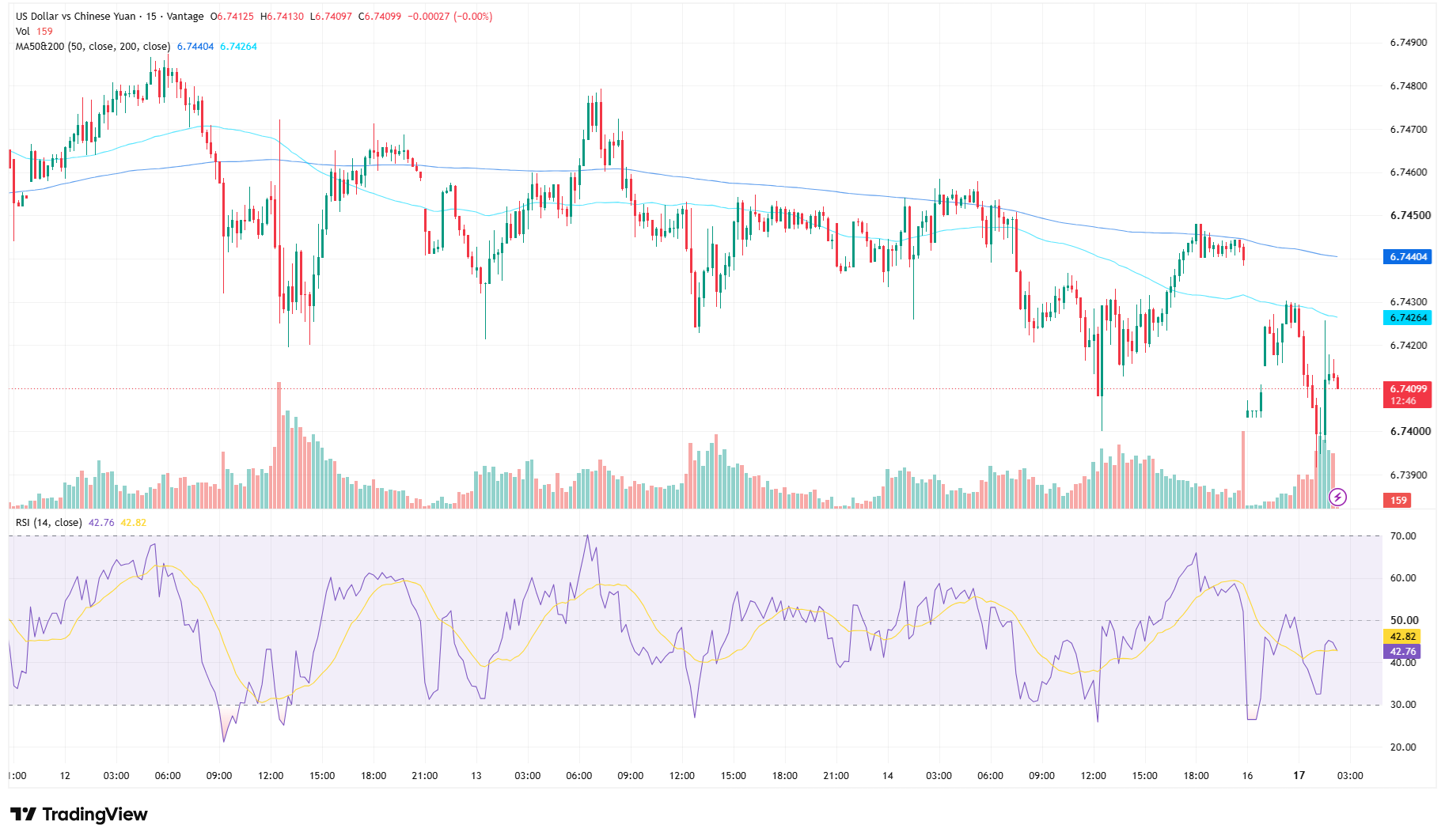
USDCNH opened at 6.74125, reached a high of 6.74130 and a low of 6.74097, with the latest candle at 6.74099 and the chart showing a 0.00027 decline, with a volume reading of 159 on the Vantage feed. The pair has drifted lower since printing highs near 6.7480 last week and tested the 6.7390 area before steadying, a gradual decline rather than a sharp directional move.
Price is trading below both the 50-period and 200-period moving averages on this timeframe, which sit at 6.74404 and 6.74264 respectively, according to the TradingView setup used for this analysis. The 50-period average still holds above the 200-period, so the two lines have not crossed, but price has already broken beneath both. The RSI (14, close) reads 42.76 alongside its moving-average overlay at 42.82, both below the neutral 50 midline: softer, but not oversold.
Why USDCNH has moved lower this week
Two threads have pulled on USDCNH this week. First, the People’s Bank of China set its daily yuan fixing at 6.7878 per dollar on 14 August, the strongest midpoint since 8 February 2023, Reuters reported.[1] A firmer fixing can signal greater tolerance for yuan strength, although the fixing is also used to manage the pace of currency appreciation; this print still came in weaker than market models had estimated. FRED’s USD/CNY spot series recorded 6.7474 on 7 August, providing a recent onshore reference point.[2]
Second, US data has been paring back rate-hike odds rather than building a case for cuts. Three FOMC members dissented in favour of raising rates when the Federal Reserve held at 3.50% to 3.75% on 29 July,[3] after Fed funds futures had briefly priced material odds of a September hike as oil prices climbed.[4] A weak July jobs report, with nonfarm payrolls falling by 23,000,[5] and a July CPI print in line with forecasts have since pulled those odds down.[6]
July producer prices echoed that: the headline figure was flat, though the narrower measure stripping out food, energy and trade rose 0.4%.[7] The latest data have reduced September hike expectations without ruling out further tightening later in the year. Chair Kevin Warsh called the decision a rigorous review rather than a pause,[8] and the next FOMC meeting takes place on 15-16 September, with the policy decision due on 16 September.[9] The U.S.-China trade arrangement reached in 2025 also keeps the suspension of heightened U.S. reciprocal tariffs on Chinese imports in place until 10 November 2026.[10]
Levels traders are watching
With price beneath both averages, market participants are watching whether USDCNH holds above 6.7390, tested earlier this week, or slides toward the round-number zone near 6.7300. On the upside, the averages near 6.7426 and 6.7440 are levels traders are watching for stabilising, ahead of last week’s highs near 6.7480. These are reference points from the chart, not signals.
What to watch this week
- The PBOC’s daily fixing is the most immediate event for USDCNH.
- Fed commentary ahead of the Jackson Hole Economic Policy Symposium, scheduled for 27-29 August, will be closely watched.[9]
- Further US data could keep adjusting September hike-versus-hold pricing.
Given how quickly USDCNH has moved between the moving averages this week, market participants often review stop-loss placement relative to the levels above, since a stop-loss limits losses to a planned size rather than preventing them. Exposure across other yuan-linked positions is worth reviewing too, given the pair’s sensitivity to both PBOC and Fed signals.
Leverage is a double-edged tool that can magnify gains and losses on a CFD position, and position sizing is worth revisiting ahead of the next PBOC fixing and September’s Fed meeting. For more USD CNH news, USD news and forex news, check back for the next update.
RISK WARNING: CFDs are complex financial instruments and carry a high risk of losing money rapidly due to leverage. You should ensure you fully understand the risks involved and carefully consider whether you can afford to take the high risk of losing your money before trading.
Disclaimer: The information is provided for educational purposes only and doesn’t take into account your personal objectives, financial circumstances, or needs. It does not constitute investment advice. We encourage you to seek independent advice if necessary. The information has not been prepared in accordance with legal requirements designed to promote the independence of investment research. No representation or warranty is given as to the accuracy or completeness of any information contained within. This material may contain historical or past performance figures and should not be relied on. Furthermore estimates, forward-looking statements, and forecasts cannot be guaranteed. The information on this site and the products and services offered are not intended for distribution to any person in any country or jurisdiction where such distribution or use would be contrary to local law or regulation.
References
[1] “Chinese Yuan – Quote, Chart, Historical Data, News – TradingEconomics (Reuters)” https://tradingeconomics.com/china/currency Accessed on 17 August 2026.
[2] “Chinese Yuan Renminbi to U.S. Dollar Spot Exchange Rate (DEXCHUS) – FRED, Federal Reserve Bank of St Louis” https://fred.stlouisfed.org/series/DEXCHUS Accessed on 17 August 2026.
[3] “Federal Reserve issues FOMC statement, 29 July 2026 – Federal Reserve Board” https://www.federalreserve.gov/newsevents/pressreleases/monetary20260729a.htm Accessed on 17 August 2026.
[4] “Odds of Federal Reserve rate hike surge as oil prices rip higher – CNBC” https://www.cnbc.com/2026/07/23/fed-interest-rate-odds-oil-jobless-claims.html Accessed on 17 August 2026.
[5] “Employment Situation Summary – July 2026 Results – U.S. Bureau of Labor Statistics” https://www.bls.gov/news.release/empsit.nr0.htm Accessed on 17 August 2026.
[6] “Consumer Price Index Summary – July 2026 Results – U.S. Bureau of Labor Statistics” https://www.bls.gov/news.release/cpi.nr0.htm Accessed on 17 August 2026.
[7] “PPI for final demand unchanged in July; services advance 0.2%, goods fall 0.7% – U.S. Bureau of Labor Statistics” https://www.bls.gov/news.release/ppi.nr0.htm Accessed on 17 August 2026.
[8] “Fed meeting recap: July 2026 – CNBC” https://www.cnbc.com/2026/07/29/fed-meeting-today-live-updates.html Accessed on 17 August 2026.
[9] “July FOMC: Fed holds interest rates steady – Fox Business” https://www.foxbusiness.com/economy/federal-reserve-interest-rate-decision-july-29-2026 Accessed on 17 August 2026.
[10] “US-China Tariff Rates – What Are They Now? – China Briefing” https://www.china-briefing.com/news/us-china-tariff-rates-2025/ Accessed on 17 August 2026.