

Wild day with JPY intervention and huge Tech stock rebound

Jamie Dutta >
Jamie Dutta >
Jamie Dutta is a Market Analyst for Vantage. He comes with extensive experience as a full-time trader and financial market commentator, having worked as a trader in top tier investment banks and trading houses.
 Updated Fri, 2026 July 31 04:30
- US launches fresh airstrikes against Iran, two-week plan to escalate
- BoE holds rates in split vote as war clouds inflation outlook
- BoJ confirms yen intervention, Fed conducted ‘rate check’
- Wall Street ends sharply higher, lifted by soaring Microsoft and tech
Forex
USD dumped for a second day, with sharp moves seen after the huge USD/JPY move lower. Markets were still digesting the FOMC meeting, with new boss Warsh failing to clearly explain why the committee didn’t already take action now or at least what concrete further developments are needed for the Fed to act. The market then gradually started to question the strength of the Fed’s inflation commitment. The odds of a September hike have remained around 40%, but these were virtually fully priced before the meeting. Improved risk sentiment and steadier crude prices also likely precipitated some selling of the greenback. Core PCE and Q2 GDP came in below expectations.
EUR shot higher to 1.1536 before paring some gains, chiefly due to the dollar weakening and JPY intervention. The euro makes up around 56% of the weighting in the Dollar Index, with the yen around 13%. Yield spreads have been supporting the single currency in recent days, as we have written previously. ECB rate hike expectations for September remain firm, with around a 75% chance predicted by money markets.
GBP underperformed most of its peers after the BoE meeting left rates on hold and overall leaned more dovish. Granted, the 6-3 vote split was more hawkish than expected, but it seems the MPC seems more confident that higher energy prices won’t spill into broader inflation. That means the bar is higher for a rate hike and money markets have reined in their bets for policy tightening. The implied chance of a September hike fell below 40% (vs over 60% previously) with 32bps predicted by year-end. That said, cable did move higher on the back of yen intervention and the weaker dollar. The major is now above the 100-day and 200-day SMA at 1.3395.
JPY strengthened sharply on intervention by the Japanese authorities with its biggest one-day rise since December 2023. US monetary authorities conducted a ‘rate check’ too. That means that Japan and the US worked together to curb the yen’s depreciation. The major plunged by more than 3% around the US open after consolidating near 40-year highs in recent days. See below for more.
US stocks: The S&P 500 added 1.66% to close at 7,438, the Nasdaq closed up 3.36% at 28,106 and the Dow Jones settled higher by 1.19% at 5`2,213. Tech surged over 5%, supported by better-than-expected Microsoft (+15.5%) earnings on strong Azure & CoPilot growth, leaving shares having their best day in around 18 years. Multiple industries related to AI gained, with the SOXX semi index up 8.2%. Samsung Electronics, Lam Research and ARM posted earnings beats, helping sentiment in the space. On the flip side, Meta dragged Communications Services lower, while Consumer Staples and Healthcare gave back July gains. Zuck’s tech megacap saw profit miss in Q2, with concerns increasing surrounding free cash flow and increasing spend and expenses. Despite the strong performance, breadth was poor with Tech hugely outperforming all other sectors. Two Mag 7 stocks reported after the close – Apple slid 7.6% as sales disappointed in China and the services business. Amazon jumped 10% after it beat estimates for quarterly cloud revenue which grew 37%.
Stocks
Asian Stocks: Futures are green. APAC stocks were broadly lower after the Fed and tech megacap earnings. The ASX 200 sold off on softness in gold miners though tech strength bolstered the index. The Nikkei 225 was boosted by tech stocks front running advances. The Kospi swung between green and red amid Samsung Electronics earnings. The Hang Seng and Shanghai Comp were muted with Hong Kong rangebound.
Gold rose for a second straight day as markets reined in Fed rate hike bets. The falling trendline from the record highs comes in around $4141, with the 50-day SMA at $4207.
Day Ahead – BoJ Meeting, Eurozone Inflation
The Bank of Japan is widely expected to keep its policy rate unchanged at 1%. With the economic and inflation outlook broadly evolving as expected, there seems to be little urgency for further policy normalisation at present. Given the proximity of the last rate hike in June, it is very unlikely that the central bank will be so quick to move again. Indeed, a recent source report noted that the BoJ sees little need for consecutive rate rises, but is likely to raise its growth forecast for this year from the current 0.5% view, and officials may revise their downside-risk assessment as AI-related demand supports exports, profits and incomes, while faster cost increases keep underlying inflation risks elevated above the 2% target.
Consensus sees eurozone headline inflation ticking up one-tenth to 2.9%, and core remaining steady at 2.4%. Focus will be on the sharp rebound in energy prices through July and if any ex-energy metrics are impacted.
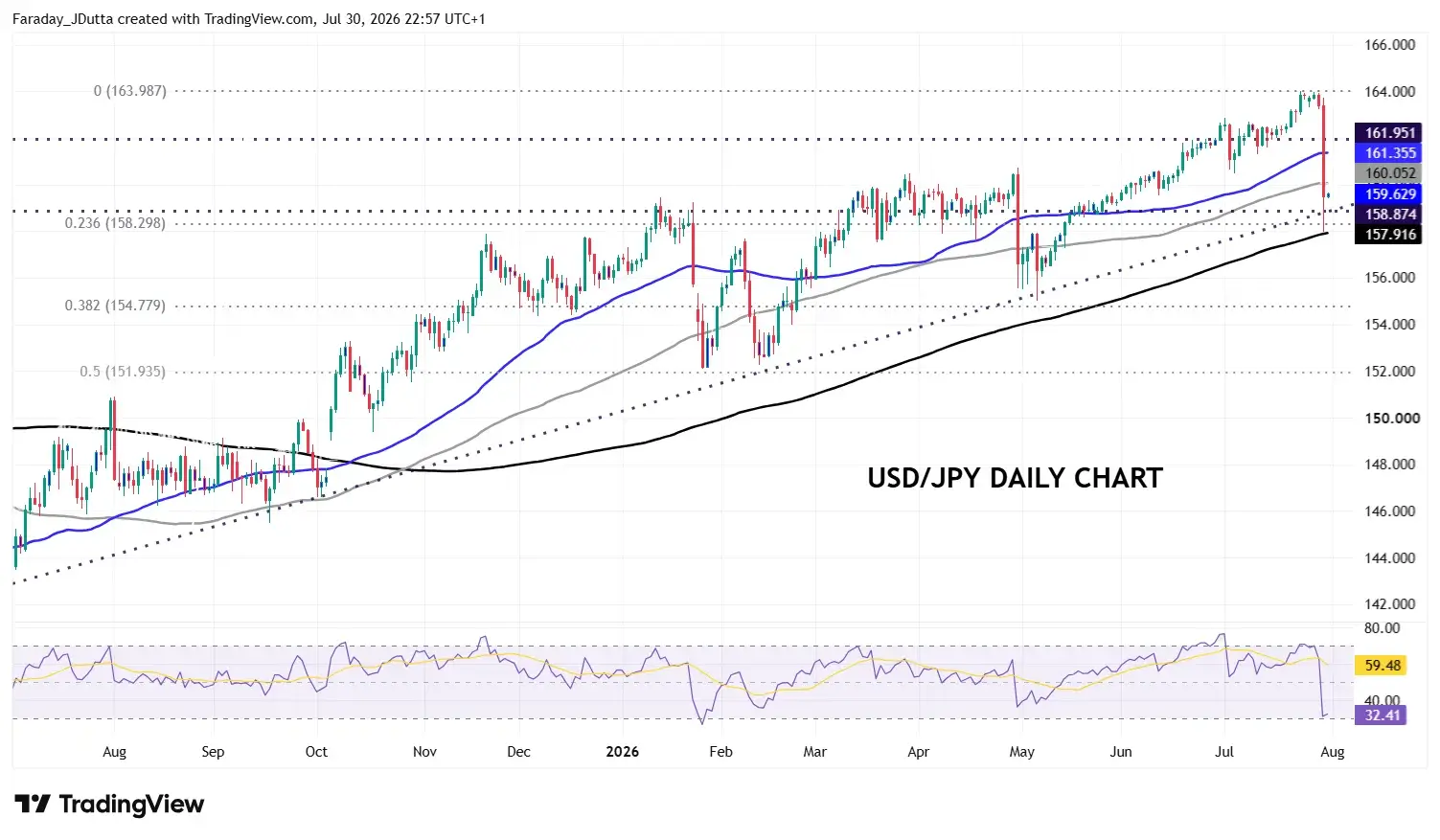
Chart of the Day – USD/JPY plunges on intervention
Summer markets so less liquidity – tick. Fed seen less hawkish so falling US yields – tick. We could go on but confitions ripe for yen intervention were brweing for sure. A surrpise BoJ rate hike? That’s going too far, but the MoF finally intervened in USD/JPY causing it to drop from a high yesterday at 163.73 to an intraday 157.96. In our experience, technical analysis during these types of moves and price action are key. The first minor fib level (23.6%) of the April 2025 low to the recent multi-decade high sits at 158.30. Below here is the 200-day SMA at 157.91 which the major more or less touched, while the January swing high is at 158.87. There is also an upward trendline form the April 2025 low coming in around Thursday’s close.