


[DAILY TRADING] EURUSD Analysis 30 July 2026 – Euro Jumps After Fed Holds Rates
 Updated Updated Thu, 2026 July 30 07:54
![[DAILY TRADING] EURUSD Analysis 30 July 2026 – Euro Jumps After Fed Holds Rates](https://www.vantagemarkets.co.id/en/wp-content/uploads/sites/22/2026/07/EURUSD_hero_8Jun2026-1-1.webp)
Euro to USD traders got a jolt on Wednesday. EURUSD spiked hard, tore straight through a level that had capped it for the better part of a week, and is holding most of those gains as of 01:17 (GMT+0) on 30 July 2026, attributed to the Vantage EURUSD CFD feed. The pair sits at 1.14578, having touched an intraday high in the upper 1.1470s before settling back a touch.
Some traders type it EURUSD, others EUR/USD, EUR to USD, or even eur / usd. Same pair, and this week it actually has a story behind it.
The move traces to Wednesday’s Federal Reserve decision, and it’s a slightly odd one: the Fed held rates, three of its own policymakers wanted to hike, and the dollar sold off anyway. That’s less a contradiction and more a reminder that what markets had priced in going into the meeting mattered more than what the Committee actually did. This EURUSD forecast walks through the chart, the Fed story behind it, and the levels worth watching from here. It reads the market. It does not call the trade.
Key Points
- EURUSD trades at 1.14578 as of 01:17 (GMT+0) on 30 July 2026, holding most of Wednesday’s spike to an intraday high in the upper 1.1470s.
- The Federal Reserve held its benchmark rate at 3.50%–3.75%, even as three regional presidents dissented in favour of a hike; markets read the decision as removing hike risk rather than confirming a hawkish stance.
- The pair sits above both its 50-period moving average (1.13941) and 200-period moving average (1.14293), while the 14-period RSI at 55.35 trails its RSI moving average of 64.42, a sign the initial burst of momentum has eased even as the broader picture holds up.
EUR/USD technical analysis: what the chart is showing
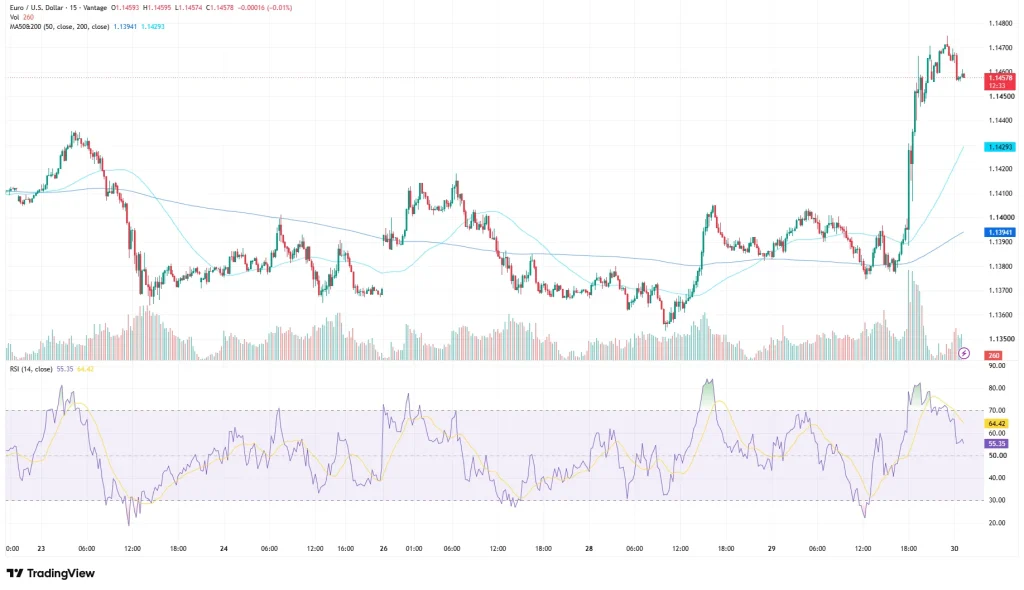
On the 15-minute EURUSD chart used for this analysis, the pair opened the current candle at 1.14593, ranged between 1.14595 and 1.14574, and closed at 1.14578, a decline of 0.00016, or 0.01%, on the Vantage EURUSD CFD feed. Volume on the candle read 260, attributed to the Vantage CFD feed.
Zoom out and the story is less about a single candle and more about the week. EUR to USD had been stuck broadly around 1.1360 to 1.1420, with brief moves outside that range, for the better part of five sessions, chopping either side of both moving averages without much conviction. Wednesday broke that stalemate. The pair rallied decisively above the prior trading range and pushed through 1.1450 into the upper 1.1470s before pulling back toward 1.1460.
The 1.1460 area is now the first near-term pivot worth watching following Wednesday’s breakout. Whether it holds as support on a pullback, or gives way again, says a fair amount about how much conviction is actually behind Wednesday’s move, versus how much of it was simply a reaction to a single Fed headline.
Both moving averages, the 50-period at 1.13941 and the 200-period at 1.14293, sit below the current price, which lines up with a market that has just pushed higher rather than one that is rolling over. The 14-period RSI, attributed to the TradingView setup used for this analysis, reads 55.35 against its RSI moving average of 64.42. RSI easing back from the overbought territory touched during Wednesday’s spike, while price itself holds steady, is a fairly normal pattern after a sharp move: the initial burst of momentum cools even as price remains well above its pre-breakout range.
The Fed story behind today’s EUR/USD forecast

Here’s the part that makes this week’s EUR/USD price action more interesting than the average Fed hold. The Federal Open Market Committee voted 9–3 to keep the federal funds rate at 3.50%–3.75%. Three regional presidents, Beth Hammack of Cleveland, Neel Kashkari of Minneapolis and Lorie Logan of Dallas, dissented in favour of a quarter-point hike.1 On paper, that reads hawkish. In practice, the currency market shrugged the hawkish framing off entirely.
The reason traces back to what was already priced in before the meeting started. Markets had assigned roughly a one-in-three chance to a surprise hike, and the dollar had been sitting near a one-month high, with EURUSD pinned near 1.1386 on broad dollar strength tied to safe-haven flows from the same Middle East conflict the Fed’s statement later referenced.1,2 Once the hold was confirmed and that hike risk came off the table, the dollar did not just fail to rally on the hawkish dissent. It fell.
The Bloomberg Dollar Spot Index dropped around 0.3% on the day, its steepest decline since 15 July and the sharpest single-day drop following a Fed hold in two years.3 That is the kind of detail that makes a rate decision genuinely worth writing about: three policymakers wanted tighter policy, and the dollar sold off anyway, because the market had spent the prior week bracing for something worse.
From here, the calendar does the talking. The next scheduled FOMC meeting is 15–16 September 2026, and Fed Chair Kevin Warsh is expected to speak at the Jackson Hole symposium in August.4 Both are reasonable points to revisit whether Wednesday’s move holds or fades.
EUR/USD price forecast: levels to watch this week
The table below sets out the zones worth keeping an eye on for EUR/USD after Wednesday’s move. Read these as reference levels traders are watching, not an EUR/USD trading signals service or a set of price calls.
| Zone | Level | What’s happening |
| Near-term pivot | 1.1460 | Near-term post-breakout pivot; first zone watched on any pullback |
| Support | 1.1394 / 1.1365 | 50-period moving average and the week’s earlier range low |
| Session high | Upper 1.1470s | Intraday peak reached after the Fed decision |
| Broader resistance | 1.1500 | Round-number level above the current range |
Table 1: EURUSD reference levels. Source: Vantage EURUSD CFD feed, TradingView. As of 01:17 (GMT+0), 30 July 2026. Levels are indicative and can shift intraday.
What to watch next:
- US GDP, 30 July 2026: Second-quarter growth data lands a day after the Fed decision and could add to dollar-pair volatility.
- US PCE Inflation / Personal Income and Outlays for 30 July 2026: The Fed’s preferred inflation gauge, released alongside GDP. Together they are the next real test for this EUR/USD price forecast.
- Next FOMC, 15–16 September 2026: The Committee’s next scheduled opportunity to revisit today’s divided vote.
- Jackson Hole Symposium, August: Fed Chair Kevin Warsh is expected to speak, per Fox Business.
With EURUSD reacting quickly to Fed-related headlines this week, standard intraday range assumptions may be less reliable than usual. The 1.1460 and 1.1394 zones set out above may warrant closer attention during periods of elevated headline-driven volatility, alongside overall account exposure.
Leverage remains a double-edged consideration in trading CFDs, magnifying both gains and losses in either direction. Position sizing relative to account equity is worth revisiting ahead of this week’s GDP and PCE inflation releases, particularly for traders holding correlated USD exposure.
For further EURUSD news and analysis following the upcoming GDP and PCE releases, see:
EURUSD News | Federal Reserve News | GDP News | Technical Analysis
For background reading: A Guide to Trading EURUSD | What Is Leverage in Forex Trading? | EUR/USD Live Rate & Charts | Forex Trading with Vantage
RISK WARNING: CFDs are complex financial instruments and carry a high risk of losing money rapidly due to leverage. You should ensure you fully understand the risks involved and carefully consider whether you can afford to take the high risk of losing your money before trading.
Disclaimer: The information is provided for educational purposes only and doesn’t take into account your personal objectives, financial circumstances, or needs. It does not constitute investment advice. We encourage you to seek independent advice if necessary. The information has not been prepared in accordance with legal requirements designed to promote the independence of investment research. No representation or warranty is given as to the accuracy or completeness of any information contained within. This material may contain historical or past performance figures and should not be relied on. Furthermore estimates, forward-looking statements, and forecasts cannot be guaranteed. The information on this site and the products and services offered are not intended for distribution to any person in any country or jurisdiction where such distribution or use would be contrary to local law or regulation.
References
[1] “Federal Reserve issues FOMC statement” – Federal Reserve – https://www.federalreserve.gov/newsevents/pressreleases/monetary20260729a.htm. Accessed on 30 July 2026.
[2] “Dollar holds steady as Fed decision looms” – Reuters via CNBC – https://www.cnbc.com/amp/2026/07/29/dollar-holds-steady-as-fed-decision-looms.html. Accessed on 30 July 2026.
[3] “Dollar Drops to Lowest in Nearly a Week as Fed Holds Steady” – Bloomberg – https://www.bloomberg.com/news/articles/2026-07-29/dollar-drops-to-lowest-in-nearly-a-week-as-fed-holds-steady. Accessed on 30 July 2026.
[4] “July FOMC: Fed holds interest rates steady” – Fox Business – https://www.foxbusiness.com/economy/federal-reserve-interest-rate-decision-july-29-2026. Accessed on 30 July 2026.