

Mild risk-off as Middle East escalation worries rise

Jamie Dutta >
Jamie Dutta >
Jamie Dutta is a Market Analyst for Vantage. He comes with extensive experience as a full-time trader and financial market commentator, having worked as a trader in top tier investment banks and trading houses.
 Updated Tue, 2026 August 18 04:30

- Iran threatens escalation; Trump doubts Iran will make deal ‘necessary’
- Brent rises to $91 as Iran rules out interim deal extension
- Bargain hunters, AL bets and CEO confidence: Navigating the final wave of Q2 earnings
- Dollar slips to lowest since early June as Fed rate hike bets fade
Forex
USD dipped to kick off the week, posting a near 10-week low at 99.29 before paring losses through the day. A key fib level (38.2%) of this year’s low to high sits at 99.41. The 200-day SMA is below at 99.17. There were mixed messages about the end of the MOU between Iran and US. The recent soft US data has seen September Fed rate hike bets ease to around 30%, with now less than 35bps priced over the next year. In this environment, investors seem happy to continue targeting long carry trade and long commodity stories.
EUR posted a fresh cycle high at 1.1614, with the same Fib at that level and the 200-day SMA at 1.1627 before paring gains. Remember the Dollar Index is dominated by the heavy euro weighting of around 56%, so this major is kind of a mirror image of the DXY. Aside from some ECB officials speaking, there’s not much on the eurozone data calendar until Friday’s PMI figures.
GBP was mid-pack as cable pushed up to levels last seen in mid-May. It’s the middle of the month so this week sees the usual UK data dump, with jobs and CPI the key releases. There are just over two 25bps rate hikes priced in, and that will need stronger than expected data to cement this, which we think could be unlikely. We are also watching EUR/GBP which is currently trading around near-term support, with last week’s low being key support at 0.8513.
JPY remains around the long-term upward trendline around 159.45. Any dips are being bought at present as market test Tokyo and continue to put on yen shorts. Japan CPI on Friday should be interesting for BoJ watchers ahead of its meeting next month.
Stocks
US stocks: The S&P 500 lost 0.52% to close at 7,745. The Nasdaq closed down 0.17% at 29,995. The Dow Jones settled lower by 0.51% at 5`3,465. Only Energy was positive while Communication Services and Consumer Staples led the laggards. This week sees a bunch of retail earnings that will provide a timely check on the health of the US consumer. Investors want to know if spending remains resilient across income groups and whether the Iran conflict is beginning to weigh on household budgets. Walmart, Home Depot, Target, Lowe’s and Deere could offer the clearest read yet on how higher energy prices and geopolitical uncertainty are affecting demand. Walmart and Target may reveal whether households are shifting spending towards essentials as fuel and transportation costs remain high. Home Depot and Lowe’s could show whether inflation and borrowing costs are curbing home-improvement spending, while Deere may signal how rising energy and input costs are affecting farmers. Are these pressures manageable headwinds or a growing threat to margins and demand?
Asian Stocks: Futures are mixed. APAC stocks were mixed amid mixed geopolitical and earnings signals. The ASX 200 was muted as gains in miners and materials were offset by financials and consumer discretionary weakness. The Nikkei 225 was choppy after disappointing GDP numbers. The Hang Seng and Shanghai Comp were positive amid lots of earnings and news that Alibaba’s AI model hit 3 billion downloads.
Gold moved higher as yields steadied and prices neared recent highs at $4,449. The 200-day SMA resides at $4,491.
Day Ahead – UK Jobs
This week’s UK data dump starts with job market data. Earnings are seen easing to 4% from 4.3% and ex-bonus to 2.8% from 2.9%. The unemployment rate is predicted to fall two-tenths to 4.7%. This comes from a peak of 5.2% at the start of the year, though there have been reliability issues with this data. The last series sparked modest GBP strength, as while the main components were broadly in-line, the overall series pointed to a relatively steady market. For the BoE, the wage data remains the main point to watch, as it could provide a somewhat an indicator of any early second round effects from the Middle East shock. Ultimately, more labour market stabilisation wis forecast.
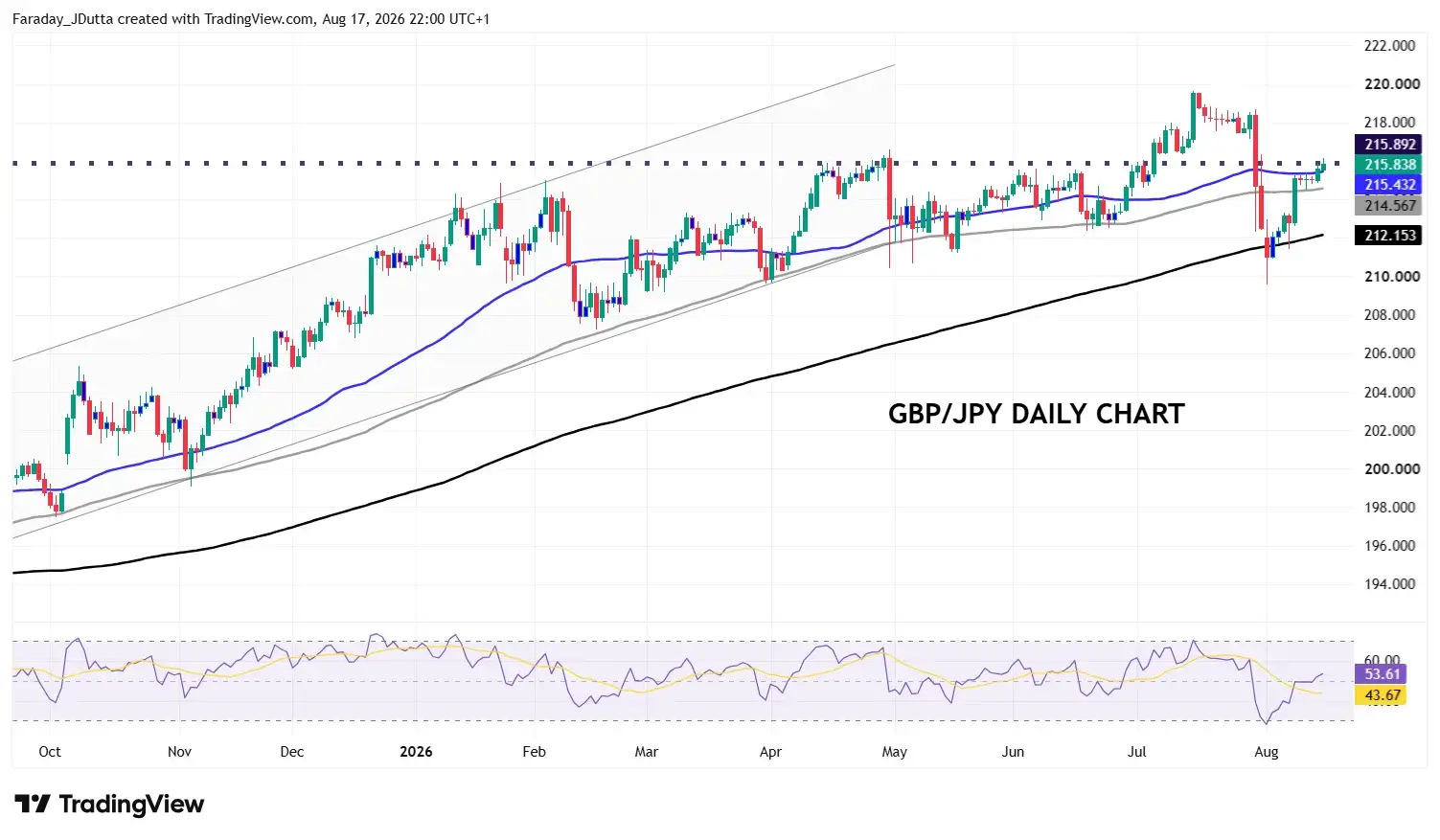
Chart of the Day – GBP/JPY rising
After making fresh multi-decade highs at 219.60 in mid-July, this popular cross tracked sideways briefly before falling sharply below the long-term resistance/support swing high from 2008 at 215.89. The historic joint intervention by Japan and the US caused that yen appreciation. But prices found support at the 200-day SMA, now at 212.53. The pair is now back to that long-term 2008 swing high and also the 50-day SMA at 215.43. Bullish momentum is picking up so a break of 215.89 targets the July top just below 220.