

Eyes on US CPI as FX volatility plunges

Jamie Dutta >
Jamie Dutta >
Jamie Dutta is a Market Analyst for Vantage. He comes with extensive experience as a full-time trader and financial market commentator, having worked as a trader in top tier investment banks and trading houses.
 Updated Wed, 2026 August 12 04:44
- Iran says Strait of Hormuz closed until conditions met; Houthis strike Saudi ship
- US CPI report first test for an increasingly hawkish Fed
- Gold holds a bullish structure despite pressure from real yields
- Wall Street closes lower as US-Iran peace optimism fades
Forex
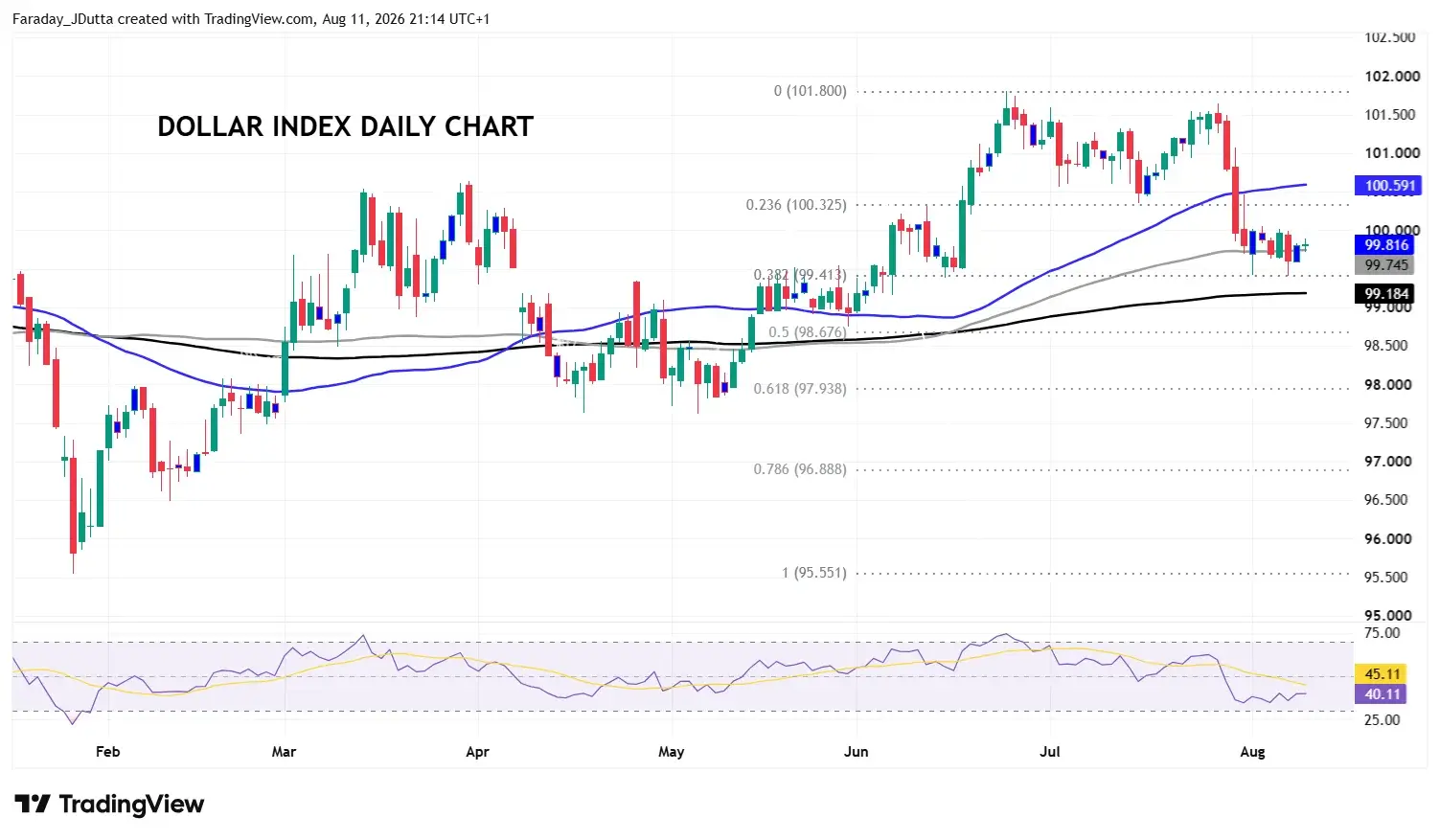
USD further consolidated above recent lows after its breakdown at the end of July. The Dollar Index is trading around the 100-day SMA at 99.74. Oil prices moved higher for a fifth straight day but pulled back from bigger gains as hopes were again raised with Iran-Oman talks potentially opening up a Hormuz shipping channel. But a broader agreement still seems some way off. Realised FX volatility has fallen dramatically, which is not that surprising in mid-summer. We are watching 10-year US Treasury yields, which retraced from hitting fresh highs above 4.74%. This is a key market to direct other markets over today’s US inflation release.
EUR printed a tiny doji as it extended its tight consolidation in the mid-1.15s. Last week’s high sits at 1.1580, a near 10-week peak that needs to be beaten to see 1.16 and above. The 200-day SMA still resides at 1.1626. The broader tone is key with the greenback driving FX at the moment, though volatility is (summer) suppressed.
GBP was quiet with few domestic drivers amid summer markets. Rate differentials have moved a small amount in favour of sterling, after last month’s pullback. Resistance in cable sits at the mid-July high around 1.3557.
JPY printed a tiny day as prices in the major held just near Monday’s top. A long-term upward trendline from the April 2025 low comes in around 159.30. We note that local media have reported that US involvement in recent currency intervention was specifically tied to discussions around the BoJ’s tightening plans and Governor Ueda’s strong signalling of a September hike.
AUD was the marginal outperformer on the day as Governor Bullock proved modestly hawkish at her press conference, after keeping rates on hold at 4.35%, as expected. The RBA sees inflation risks as skewed to the upside and she admitted that officials did discuss the possibility of a rate hike at today’s meeting. This came after the statement was amended to describe policy as ‘somewhat descriptive’, meaning the bank could be less likely to hike rates in the future.
Stocks
US stocks: The S&P 500 lost 0.32% to close at 7,728, the Nasdaq closed down 0.33% at 29,525 and the Dow Jones settled lower by 0.34% at 5`3,797. Only three sectors were positive with Utilities, Energy and Industrials were the leading sectors, while Communication Services was the big laggard, with Real Estate and Consumer Discretionary the next big underperformers. Alphabet closed lower by 3.8%, dragging on Communication Services, due to a shake-up at DeepMind, the heart of Goggle’s AI empire. Hims & Hers Health slid 4% as it reported a much deeper-than-expected loss per share, and pressure on margins from its shift towards branded weight-loss drugs and international expansion. This outweighed a raised revenue guidance.
Asian Stocks: Futures are mixed. APAC stocks were mixed following a muted Wall Street clouded by higher oil prices and Japan market closure. The ASX 200 rose on mining and energy strength, as the RBA kept rates unchanged and kept its moderately hawkish bias. The Hang Seng and Shanghai Comp were muted amid reports China issued new consumption vouchers aimed at boosting spending.
Gold made fresh 2-month highs before retracing its gains and trading just below the 100-day SMA at $4,395. All eyes are on today’s CPI. The People’s Bank of China increased its gold reserves by the largest monthly addition since October 2023. Official reserves have now risen for 21 consecutive months as China continues to diversify reserves and strengthen its position in the global bullion market.
Day Ahead – US CPI
Consensus looks for headline CPI to rise by 0.1% m/m and 3.4% y/y in July (previously -0.4% and 3.5%), and the core rate to rise by 0.2% m/m and 2.5% y/y (previously 0% and 2.6%). That would be the equal lowest core print since March 2021. Core goods prices are expected to rise by 0.18%, which would be the largest monthly gain since September, driven partly by Apple’s decision to raise prices on most of its hardware from late June. This is expected to be partly offset by declines in services components.
We note that economists caution that the range of plausible outcomes is unusually wide in July and that August’s inflation data is more likely to have a greater bearing on the FOMC’s September decision. That report comes just ahead of the Fed meeting next month so unless again there is a big miss, markets could partially look through this data.
Chart of the Day – Dollar Index consolidating near lows
A benign inflation report should push down Fed rate hike bets for next month’s meeting. The odds are currently around 47%, having dipped to the lows 40s after Friday’s NFP, but a rate rise was fully priced in before the latest FOMC meeting. There’s now around 30bps in 2026, from 34bps pre-NFP. Typically, the FOMC would only change the Fed Funds rate when markets thought there was a very good chance of them doing so ie above 70%. Technically, prices have been tracking sideways for several days just above recent lows around 99.50 and a major Fib level (38.2%) of this year’s high to low at 99.41. Much weaker data could challenge these, with the 200-day SMA at 99.18. Stronger figures need to see bulls push above 100 and then 100.25, a long-term top from a year ago.