


 Updated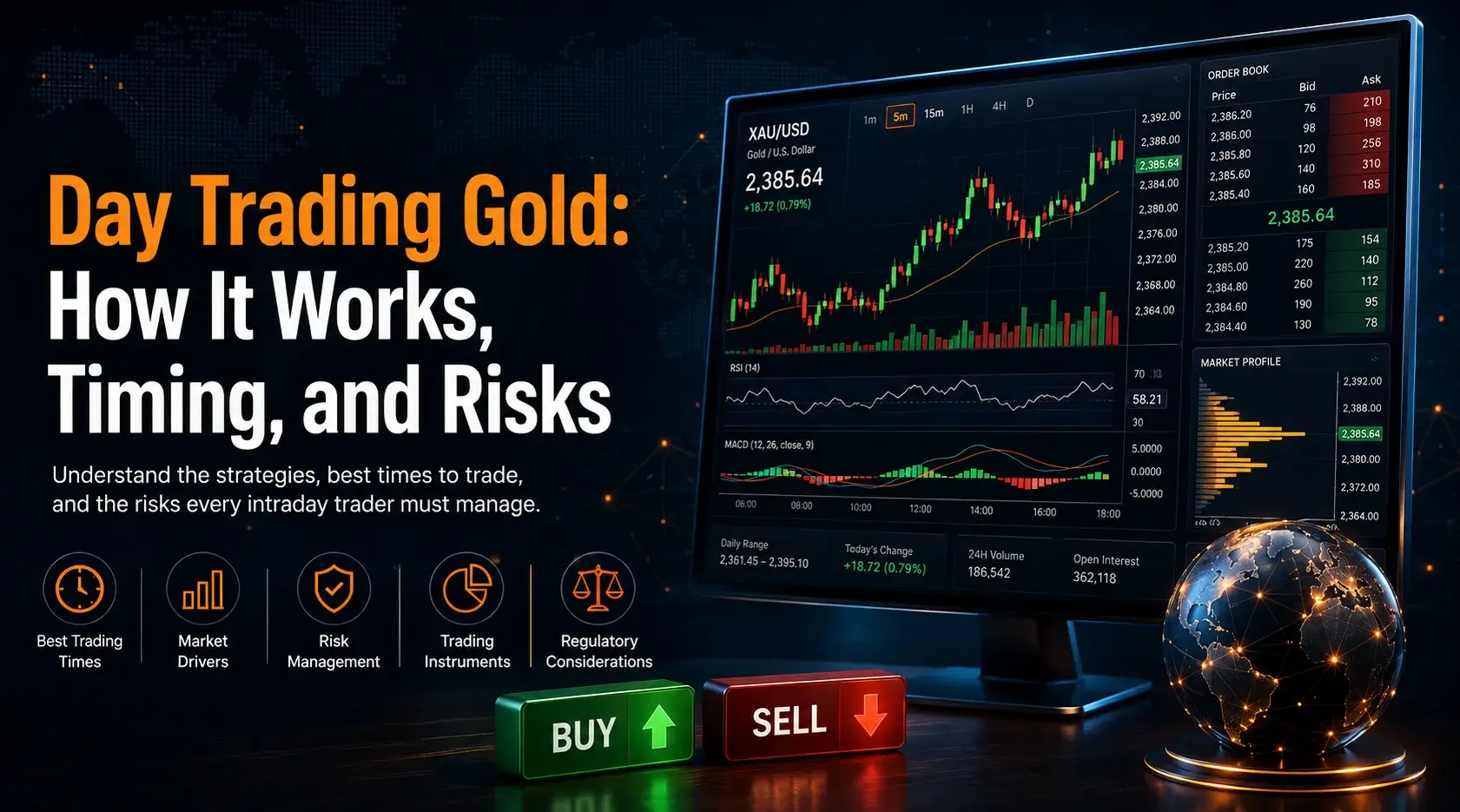
Day trading gold has drawn growing interest as the metal has become one of the most volatile major markets of the decade. Spot gold traded around US$4,200 an ounce in early July 2026, after reaching record highs above US$5,400 earlier in the year before a sharp correction [1].
That kind of movement is exactly what intraday traders look for — but it cuts both ways, and the same swings that open opportunities can produce fast losses.
This guide explains how day trading gold works, the instruments involved, when the market is most active, what tends to move prices during a session, and how traders approach risk. It also outlines how regulatory requirements for day trading gold can differ across jurisdictions.
Key Points
- Day trading gold means opening and closing gold positions within the same trading day to seek gains from short-term price moves; it is a high-risk activity, because the volatility that creates opportunity can equally deepen losses.
- Gold is usually most active during the London–New York session overlap — roughly 13:00–16:00 GMT, or about 18:30–21:30 India Standard Time (IST) — when liquidity is deepest and spreads tend to be tightest.
- Intraday gold speculation is available mainly through SEBI-regulated MCX gold futures and options and gold exchange-traded funds (ETFs); trading spot gold (XAU/USD) via offshore contracts for difference (CFD) platforms may be subject to applicable laws and regulations, including FEMA. Residents should verify the current regulatory position and seek independent advice before trading.
What Is Day Trading Gold?
Day trading gold is the practice of opening and closing positions on gold within a single trading day, aiming to profit from short-term price movements rather than owning the metal. Traders enter and exit one or more positions during a session and typically close everything before the day ends, so they are not exposed to overnight gaps or rollover costs.
Gold appeals to intraday traders for two main reasons. It is highly liquid, so positions can usually be entered and exited without large gaps between the bid and ask price. And it moves — gold reacts quickly to the US dollar, interest-rate expectations, and geopolitical headlines, which can create the intraday ranges that short-term traders work with. The trade-off is that this same reactivity can turn against a position just as fast.
Is gold good for day trading? There is no universal answer. Gold’s deep liquidity and frequent movement are often cited as advantages for active traders, but its sensitivity to news means sudden reversals are common, and no instrument removes the risk of loss. What matters more than the asset itself is a trader’s preparation, timing, and risk control.
Ways to Trade Gold Intraday
There are several instruments used to speculate on gold’s intraday price, and they differ in how you access them, their costs, and how they are regulated. The three most relevant for short-term trading are gold CFDs, gold futures and options, and gold ETFs. Physical bullion and gold certificates are ownership vehicles rather than intraday trading instruments, so they fall outside the scope of day trading.
| Instrument | How it is accessed | Common use | Key consideration |
| Gold CFDs (XAU/USD) | Over-the-counter through a CFD broker, on margin | Short-term speculation on gold’s price without owning it | Leverage magnifies both gains and losses; availability varies by jurisdiction |
| Gold futures & options | Exchange-traded (for example, MCX), on margin | Intraday and hedging positions with standardised contracts | Contract sizes are large; margins can rise during volatile periods |
| Gold ETFs | Bought and sold as units on a stock exchange | Tracking gold’s price with the flexibility of exchange trading | Subject to fund fees; intraday moves are usually smaller than leveraged products |
Gold CFDs (XAU/USD)
A gold Contract for Difference (CFD) is an agreement to exchange the difference in gold’s price between the point a position is opened and closed, without owning the underlying metal.
CFDs are traded on margin, which means a trader posts only a fraction of the position’s value; this is how trading XAU/USD gives exposure to the full price move from a smaller outlay. Because gold is quoted in dollars per ounce, understanding how gold moves in pips helps when sizing positions and stops.
The same leverage that can enlarge a gain can enlarge a loss just as quickly, and losses can rapidly erode the margin committed to a position. Availability of CFD products varies by jurisdiction and may be restricted or prohibited under applicable laws and regulations. Readers should ensure the product is legally available in their jurisdiction before trading.
Key features:
- Provides exposure to gold’s price movement without owning physical metal.
- Traded on margin, so a smaller outlay controls a larger position — amplifying both gains and losses.
- Allows positions in both rising and falling markets (long or short).
- Availability and permitted leverage depend on the trader’s jurisdiction and regulator.
Gold Futures and Options
Gold futures are standardised, exchange-traded contracts to buy or sell a set quantity of gold at an agreed price on a future date. These are traded on the Multi Commodity Exchange (MCX), making them a recognised domestic route for intraday gold exposure. Options on gold give the buyer the right, but not the obligation, to trade at a set price, and are also used to manage exposure.
Futures offer deep liquidity and transparent pricing, but contract sizes are large and exchange margins can increase during volatile periods, so position sizing needs care.
Key features:
- Standardised contracts traded on a regulated exchange (MCX).
- Deep liquidity and centralised, transparent pricing.
- Traded on margin set by the exchange, which can rise when volatility increases.
- Large contract sizes may be less suited to traders with small accounts.
Gold ETFs
A gold ETF is a fund that tracks the price of gold and trades as units on a stock exchange, letting traders follow gold’s price without holding the metal. Because they trade like shares, gold ETFs can be bought and sold through the day, though their intraday moves are usually smaller than leveraged products and they carry fund management fees.
Gold ETFs listed on the NSE or BSE are a regulated, accessible way to gain intraday gold exposure without using offshore platforms.
Key features:
- Tracks gold’s price and trades as units on a stock exchange.
- Accessible through a standard brokerage account
- No leverage by default, so intraday swings are typically more contained.
- Ongoing fund fees apply and can affect net returns over time.
Is Day Trading Gold Legal?
Whether day trading gold is legal depends entirely on the instrument and platform used. The applicable rules are shaped by the RBI, SEBI, and FEMA, 1999.
The clearly legal, regulated routes for intraday gold exposure are domestic: gold futures and options on the MCX, and gold ETFs on the NSE or BSE, all accessed through a SEBI-registered broker. These are exchange-traded products with investor protections and daily settlement.
Trading spot gold as XAU/USD through offshore CFD providers may be subject to applicable laws and regulations, including FEMA.
Residents should verify the current regulatory position and seek independent legal and tax advice before using offshore trading services. Because gold’s cultural and financial weight is so high, these platforms are heavily marketed — but marketing does not change the regulatory position. Whether forex and commodity products are legal to trade in a given case can be nuanced, and the framework continues to evolve.
The practical takeaway: traders seeking exposure to gold can use regulated exchange-traded products, such as futures contracts or gold ETFs, through an authorised broker. Before using an offshore platform, check the applicable regulatory requirements and seek independent legal and tax advice. Tax treatment varies by jurisdiction, instrument, and holding period, so a qualified adviser can confirm what applies to your circumstances.
This does not constitute a personal recommendation or legal advice. Independent advice should be sought, and current rules verified with the relevant regulator.
Best Time to Day Trade Gold
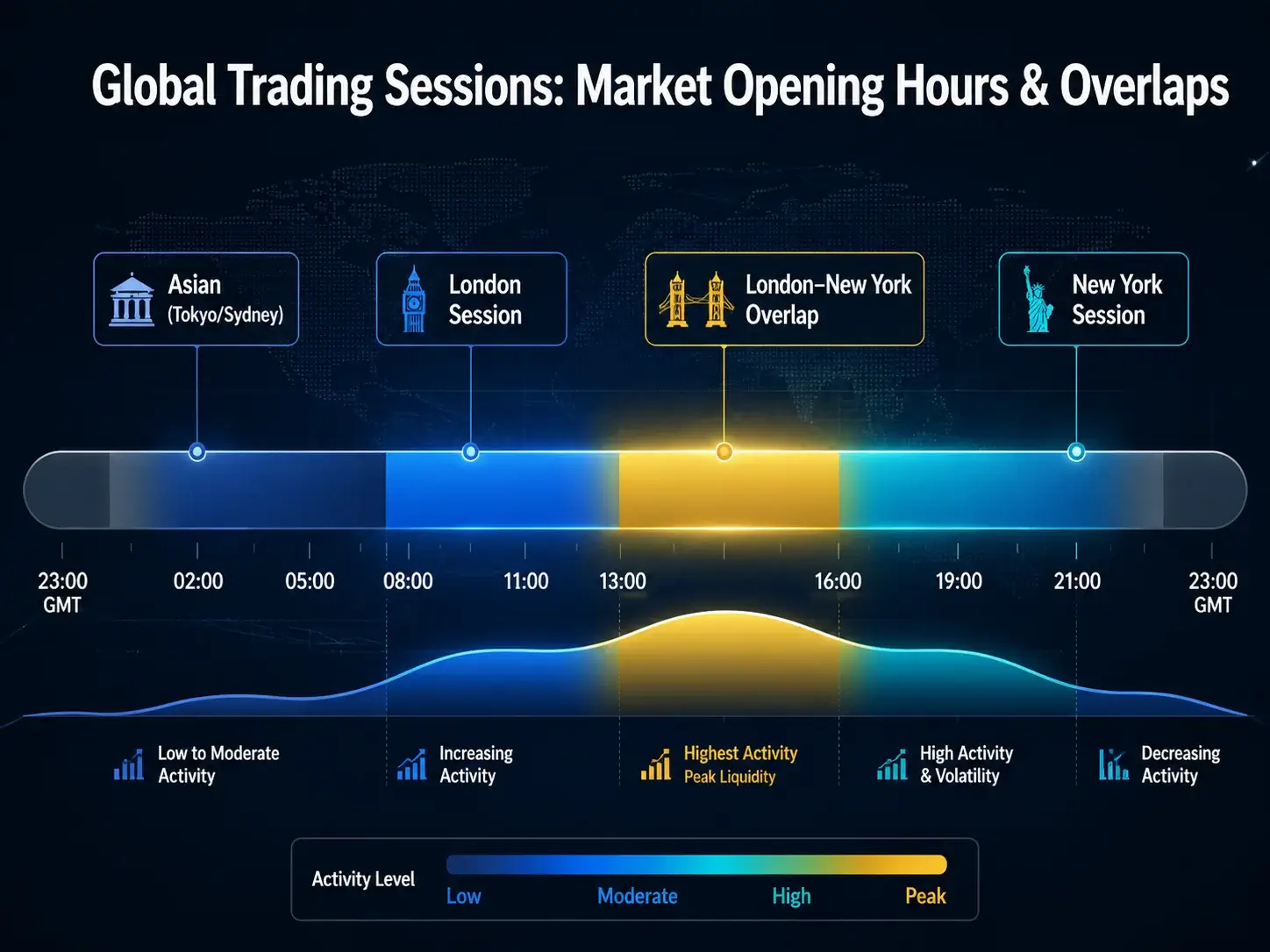
Gold trades almost around the clock during the trading week, but activity is not spread evenly. The most active window is usually the overlap between the London and New York sessions, when the two largest centres of trading are open at the same time.
During this overlap liquidity is deepest and spreads tend to be at their tightest, which is why many day traders concentrate on it. You can read more about when the gold market is most active for the full session breakdown.
| Session | Approx. GMT | Approx. IST | Typical gold activity |
| Asian (Tokyo/Sydney) | 23:00–08:00 | 04:30–13:30 | Lower volume; ranges are often narrower |
| London | 08:00–16:00 | 13:30–21:30 | Activity builds; European flows come in |
| London–New York overlap | 13:00–16:00 | 18:30–21:30 | Deepest liquidity, tightest spreads, strongest moves |
| New York | 13:00–21:00 | 18:30–02:30 | Driven by US data and dollar moves |
Timing also means being aware of scheduled events. Major US data releases — such as non-farm payrolls, the Consumer Price Index, and Federal Reserve rate decisions — can move gold sharply within seconds. Around these releases, spreads often widen and slippage becomes more likely, so many traders check an economic calendar before a session and treat the minutes around a release with extra caution.
What Moves Gold Prices Intraday
Understanding the main drivers helps explain why gold can be calm one hour and volatile the next. Several forces tend to shape its price during a session.
- The US dollar: Gold is priced in dollars and often moves inversely to it, so dollar strength can weigh on gold while dollar weakness can support it.
- Interest-rate expectations: Gold pays no yield, so shifting expectations for central-bank rates — particularly the Federal Reserve — can change its appeal relative to interest-bearing assets. A softer rate outlook often supports gold, while a firmer one can pressure it.
- Scheduled data and events: Employment, inflation, and central-bank announcements can trigger fast repricing, which is where much of the intraday range is created.
- Safe-haven demand: During geopolitical tension or market stress, gold often attracts defensive flows, though these moves can reverse quickly as sentiment shifts. You can follow how news events affect gold for more on this dynamic.
Longer-term forces set the backdrop against which intraday moves happen. Central banks have remained strong net buyers of gold — the World Gold Council reported robust official-sector purchases through the first quarter of 2026, reinforcing gold’s role as a reserve asset [1]. Demand in India is a significant part of the global picture: the country is gold’s second-largest market, with net demand of around 800 tonnes a year, and it imports effectively all of it [3].
India-specific factors can also feed through to local pricing. In Q1 2026, Indian gold demand rose 10% year-on-year to 151 tonnes, with value reaching a record of about US$25 billion as investment demand climbed [2]. And in early 2026 the government raised the gold import duty from 6% to 15% to ease pressure on the rupee and the current account [3] — a change that affects the cost of domestic gold and, in turn, local instruments such as MCX contracts.
The above figures are historical market data for context only and do not constitute a forecast or a recommendation to buy, sell, or hold any instrument.
Common Approaches Gold Day Traders Use
Day traders tend to rely on technical analysis — reading price and chart behaviour — because intraday moves are driven more by short-term flows than by long-term valuation. The approaches below are descriptive; they are not recommendations, and none removes the risk of loss.
Choosing a Timeframe
The chart timeframe sets how much detail a trader sees. Shorter timeframes show more potential entries but carry more “noise” — small, random moves that can be misleading — while longer intraday timeframes give a clearer sense of direction. Many traders combine them, using a higher timeframe to gauge the day’s trend and a lower one to time entries.
| Timeframe | Often used to | Trade-off |
| 1–5 minute | Time precise entries and exits | High noise; demands fast decisions |
| 15–30 minute | Balance detail with a clearer trend | Fewer signals than very short charts |
| 1 hour | Read the broader intraday direction | Slower to react to sudden moves |
Reading Trend, Support and Resistance
Identifying whether gold is trending up, down, or ranging helps frame decisions. Traders often map support and resistance levels — price zones where moves have paused or reversed before — and watch how price behaves around them. On volatile days, rounding these levels to nearby whole numbers can make them easier to track.
Using Technical Indicators
Indicators can help traders assess momentum and volatility, though they describe past and current behaviour rather than predict the future. Moving averages are commonly used to gauge trend direction; oscillators such as the Relative Strength Index (RSI) may help assess whether a move looks stretched; and the Moving Average Convergence Divergence (MACD) is sometimes used to read whether momentum is building or fading.
No indicator generates certainty, and many traders combine a small number rather than stacking many. A wider look at technical indicators covers how these tools are typically applied.
Managing Risk When Day Trading Gold
Risk management is the part of day trading gold that most affects whether a trader stays in the game, precisely because gold’s volatility works in both directions. A few practices are widely used.
- Use stop-loss orders: A stop-loss is commonly placed to cap the loss on a position, though it does not guarantee execution at the exact level in fast markets.
- Size positions to the account: As a general reference point, some traders risk only a small percentage of account equity per position, though the right amount varies by individual circumstances. Working through position and lot sizing helps set this consistently.
- Respect leverage: On margin products, leverage can magnify both gains and losses, and significant losses can occur over a short period. Understanding how leverage works before trading is important.
- Account for costs and slippage: The spread and any commissions affect results, and both spreads and slippage can worsen around major news.
As a simple illustration of the mechanics, consider a hypothetical margin position on a gold CFD at 20:1 leverage. A 1% move in gold against the position would erode roughly 20% of the margin committed to it; a 1% favourable move would do the reverse. This shows why leverage cuts both ways and why position sizing matters.
This example is hypothetical and for illustrative purposes only. It does not reflect actual trading results or client experiences.
Practising on a demo account is a common way to test an approach and get familiar with an instrument before committing real money, since it removes financial risk while the mechanics are learned. Risk management for gold specifically is covered in more depth in this guide to XAU/USD risk management.
How to Start Day Trading Gold

Getting started is less about a single first trade and more about setting up a compliant, considered process. The steps below outline how many traders approach it.
- Choose a regulated route for your jurisdiction: That generally means MCX gold futures and options or gold ETFs through a SEBI-registered broker; elsewhere, gold CFDs may be available where permitted.
- Open and verify an account: Brokers typically require identity and address verification before trading. For an offshore CFD account, confirm the product is available to residents of your country first.
- Build a plan before trading: Decide which sessions you will trade, your risk per position, and how you will use stops — a plan is what keeps decisions consistent under pressure.
- Practise first: A demo account lets you rehearse the process without financial risk.
Where permitted by applicable laws and regulations, gold CFDs trading may be available through authorised providers, subject to the laws and regulations applicable in the trader’s jurisdiction. Availability and trading conditions depend on the jurisdiction in which the trader resides. Whichever route applies, treating the first weeks as a learning period — small size, tight risk, and honest review — tends to matter more than any single setup.
The Bottom Line
Day trading gold offers the movement and liquidity that short-term traders look for, but the volatility that makes it attractive is the same feature that can produce rapid losses. Traders who last are usually those who focus on timing, apply clear risk controls, and choose instruments that align with their goals and the regulations in their jurisdiction. Understanding how gold moves, when it is most active, and what is permitted where you live is the groundwork that any single strategy is built on.
Frequently Asked Questions
Is Gold Good for Day Trading?
Gold is often chosen by day traders because it is highly liquid and tends to move enough to create intraday opportunities. However, that same volatility means reversals can be sudden, and no asset removes the risk of loss. Whether it suits a particular trader depends more on their preparation, timing, and risk control than on the metal itself.
Can You Day Trade Gold?
Yes, gold can be traded intraday through several instruments, including gold CFDs, exchange-traded gold futures and options, and gold ETFs. The instrument and platform that are appropriate depend on where you live and what your regulator permits. In India, MCX contracts and gold ETFs through a SEBI-registered broker are the recognised domestic routes.
What Is the Best Time to Day Trade Gold?
Gold is usually most active during the overlap between the London and New York sessions, roughly 13:00–16:00 GMT, or about 18:30–21:30 IST. Liquidity is deepest and spreads tend to be tightest during this window. Activity also spikes around major US data releases, which can bring both opportunity and elevated risk.
Is Day Trading Gold Legal?
References
- “Day Trader: Definition, Techniques, Strategies, and Risks – Investopedia” https://www.investopedia.com/terms/d/daytrader.asp Accessed 18 Jan 2024
- “Demo Trade Your Way to Success – Babypips” https://www.babypips.com/learn/forex/demo-your-way-to-success Accessed 18 Jan 2024
- “7 Common Factors That Influence Gold Prices – The Motley Fool” https://www.fool.com/investing/2016/10/13/7-common-factors-that-influence-gold-prices.aspx Accessed 18 Jan 2024