

Oil falls, stocks rally on Middle East optimism

Jamie Dutta >
Jamie Dutta >
Jamie Dutta is a Market Analyst for Vantage. He comes with extensive experience as a full-time trader and financial market commentator, having worked as a trader in top tier investment banks and trading houses.
 Updated Tue, 2026 August 4 05:00

* Trump cancels planned strike, says ‘last chance’ for Iran to sign deal
* More US-Japan FX intervention could occur, with other central bank joining
* Amazon tops $3 trillion market cap as stock continues post-earnings surge
* Astra Zeneca investors raise concerns over mega-merger talks
FX: USD steadied after early selling took the Dollar Index down to a near seven-week low at 99.41. That spike low had been due to the US and Japan announcing joint action in the yen, the US Treasury via EUR/JPY, and they were prepared to do more. But the dollar pared losses through the day with better than expected ISM Manufacturing data underpinning support. The Fed picture is also likely helping with a September rate hike given around a 65% chance. This week’s jobs data, including today’s JOLTs, ADP on Wednesday and Friday’s NFP are expected to cement a Warsh move.
EUR popped up to a fresh cycle high at 1.1558 buoyed by last week’s decent eurozone hard data, lower oil prices and lots of dollar selling from Japan. The 50-day SMA sits at 1.1478. The US used EUR/JPY to help Tokyo probably to avoid having to explain why it was selling the greenback and going against its official ‘strong ‘policy’. See below for a more in-depth look at the chart of the cross.
GBP was midpack among its peers as cable moved back lower towards the 100-day and 200-day SMA at 1.3398/4. Last week’s BoE meeting was marginally more dovish at the margin, even after the initial hawkish move on the 6-3 vote split. Governor Bailey said it would be wrong to conclude that the bank is edging towards a hike. Also, a previous hawk, Lombardelli, said her vote was not a tight call, denting those who thought she could be the next vote for a hike.
JPY strengthened for a fourth day as the major spiked to a low of 155.22 in the early hours of the Tokyo session, though it gave up a lot of its gains. Headlines around the US and Japan who will not hesitate to take further action spurred aggressive selling, with prices remaining below the 200-day SMA at 157.92. As much as $59 billion worth of yen was bought by the MoF on Thursday, likely a single-day record, while it was the US and Japan’s first intervention in 15 years. Joint cooperation typically means this move is longer lasting but there is some scepticism unless the policy mix and global growth outlook changes. Japan’s expansionary fiscal policy is chiefly the headwind for the yen.
US stocks: The S&P 500 added 1.48% to close at 7,601, the Nasdaq closed up 1.78% at 28,777 and the Dow Jones settled higher by 1.32% at 5`3,183. Gains were broad-based, evidenced by the Equal Weight S&P rising by 1%. Communication Services and Consumer Discretionary led the gainers, while three sectors were lower, with energy the clear laggard, tracking oil prices lower as President Trump refrained from a major attack against Iran over the weekend. AstraZeneca (-6.8%) and Bristol Myers Squibb (+0.24%) are in talks over a merger that would create a pharmaceutical group valued at nearly $400bn, according to the FT. Alibaba unveiled Qwen3.8-Max, its largest AI model and closed 4.1% higher. Amazon hit a record high and became part of the $3 trillion club, fuelled by strong earnings and huge demand for its cloud services.
Asian Stocks: Futures are green. APAC stocks were broadly down on mixed China PMI data and tech sector performance. The ASX 200 was flat on energy, real estate and financial weakness offset by defensive resilience. The Nikkei 225 retreated on increased BoJ rate hike bets and yen strength. The Hang Seng and Shanghai Comp were mixed as Alibaba outperformed after launching its Qwen 3.8 Max Ai model while chipmakers were sold.
Gold continued to trade in a range above $4,000. The longer prices track sideways, the bigger the range expansion and breakout typically will be.
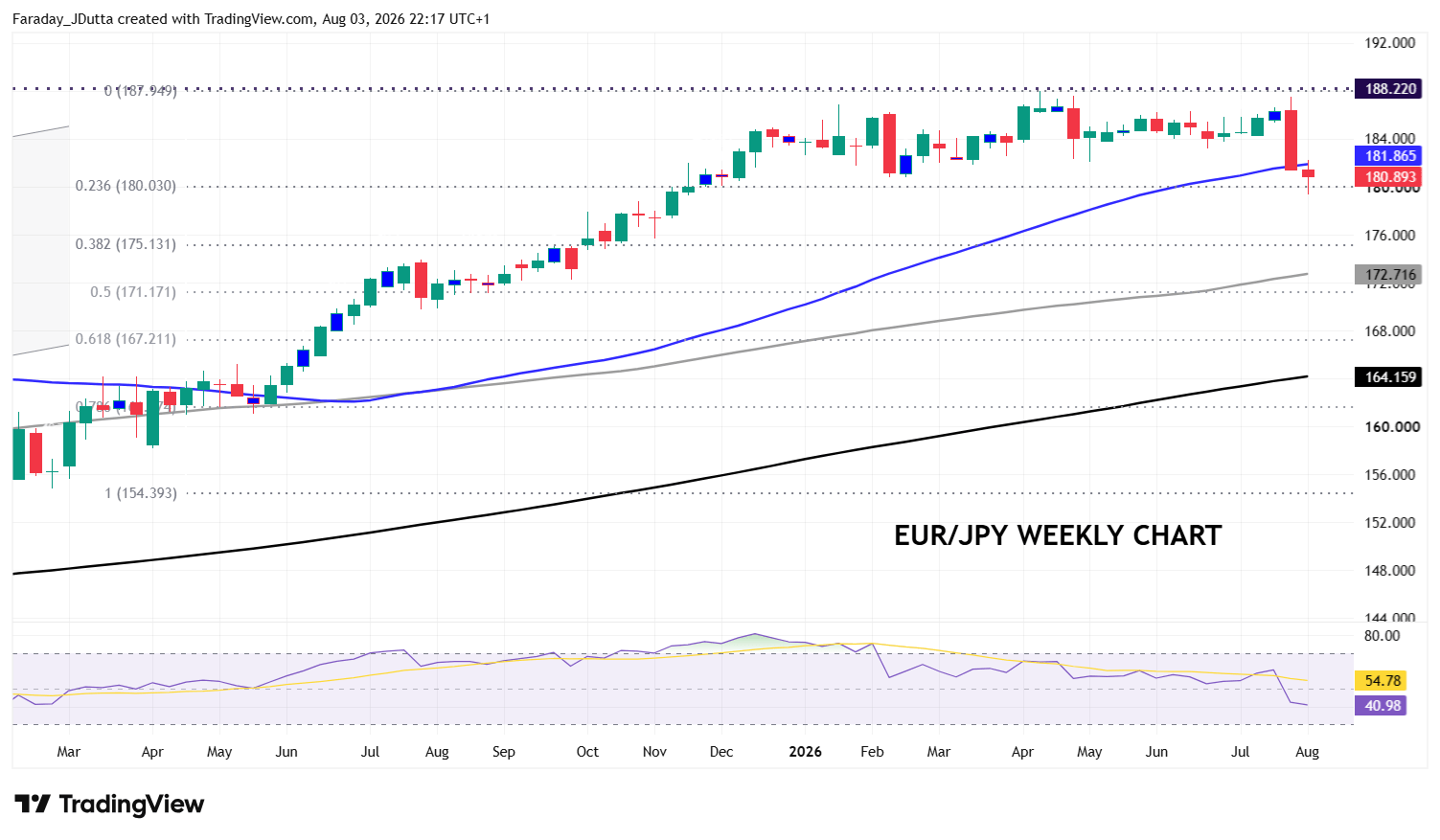
Chart of the Day – EUR/JPY plunges on intervention
Along with USD/JPY plunging, the popular cross, EUR/JPY has similarly fallen hard. The US authorities were checking rates and likely selling the pair to help the MoF as they bought a huge amount of yen to push the major lower. EUR/JPY had been tracking sideways between 180 and 188 for several months, with multiple attempts to break out above the long-term top from 1990 at 188.22. Last Thursday saw prices turn sharply lower through the 200-day SMA at 183.62. This hadn’t been crossed since April 2025. The 50-week SMA at 181.85 was also pierced and prices are sat just above the first minor long-term Fib retracement at 180.03. The next major Fib (38.2%) of this August 2024 low to April 2026 high sits at 175.13.