

Nasdaq in correction mode ahead of ‘live’ Fed and Tech results

Jamie Dutta >
Jamie Dutta >
Jamie Dutta is a Market Analyst for Vantage. He comes with extensive experience as a full-time trader and financial market commentator, having worked as a trader in top tier investment banks and trading houses.
 Updated Wed, 2026 July 29 04:44
* Iran proposes temporary Hormuz plan giving itself great control over transit lines
* Fed’ Warsh faces first major test as divisions emerge within FOMC
* Apple tops $5 trillion market cap for the first time on ‘capital-lite’ AI strategy
* SpaceX falls 20% below IPO price, erasing $1.2 trillion in market value
FX: USD was relatively quiet as it initially hit a one-month high before paring any gains. Speculation has increased about a surprise Fed quarter point hike. We wrote about this in the Week Ahead as an early Fed move would boost the Fed’s and new boss Warsh’s inflation-fighting credentials, having missed their 2% inflation target for more than five years. Ultimately, it also would lessen the need for subsequent tightening. Money markets see around a one in three chance of a move. Otherwise, a ‘hawkish hold’ is fully expected. See below for more. Middle East optimism saw tumbling crude oil prices and some greenback selling. Brent is back near its 200-day SMA at $80.12.
EUR threatened to break down as it hit 1-month lows before finding buyers. The cycle low sits at 1.1324. The market looks to be fading some of the hawkishness and tightening after the ECB teed up a September rate hike. The Fed theme is dominating at present.
GBP printed a doji after the Monday sell-off took cable below 1.33. Similar to the euro, sterling saw a loss of fundamental support as markets took back some of the BoE rate hikes priced in. The September meeting now sees around 14bps from 20bps last week and 36bps by year end from nigh on two quarter point moves. Central bank meetings over the next two days are front and centre.
JPY stayed near recent lows, with the major consolidating just below recent long-term highs just below 164. Near-term risk lies with Friday’s BoJ policy decision with markets reluctant to buy into policymakers’ recent shift in tone. Of course, we are also on alert for any signs of renewed interest in pursuing intervention, as government officials from the MoF have maintained their aggressive language in discussions of the monitoring of the currency.
AUD was a relative underperformer after RBA Governor Bullock noted some cooling in economic momentum but said it was unclear whether rates were high enough to return inflation to target. Australia releases June and Q2 CPI data today. June CPI is expected to hold at 4% in the year. Q2 underlying inflation – trimmed mean watched closely by the RBA – is forecast to rise 0.9% q/q and accelerate to 3.7% in the year.
US stocks: The S&P 500 added 0.2% to close at 7,429, the Nasdaq closed down 0.98% at 27,763 and the Dow Jones settled higher by 1.03% at 5`2,752. All but four sectors closed in positive territory, with Health Care, Consumer Staples and Materials outperforming, while Technology and Industrials, both heavily exposed to the AI theme, lagged alongside Energy, which was pressured by the sharp drop in crude prices. The equal-weight S&P 500 advanced, highlighting positive underlying market breadth. The Dow’s strength was driven by gains in UnitedHealth, Amgen and Sherwin-Williams. The tech-laden Nasdaq was weighed on by weakness in semiconductor names, with the SOXX index down another 4.5%. This followed a circuit-breaking 10% decline in South Korea’s KOSPI overnight as the global AI trade remained under heavy pressure. Seagate jumped after hours by 6.5% after blowout earnings fuelled by AI demand.
Asian Stocks: Futures are mixed. APAC stocks were mostly lower as tech selling ramped up after reports about China chip competition. The ASX 200 saw strength in telecoms offset soft mining and materials. The Nikkei 225 briefly dropped below 62,000 amid heavy tech losses. The record high from late June was 72,831. The Shanghai Comp and the Hang Seng were lower but there was limited downside in Hong Kong.
Gold dipped even as Treasury yields fell on lower energy prices. The Fed meeting is the key focus. The late June low is $3,942 which will likely get broken on a more hawkish than expected FOMC statement and guidance.
Day Ahead – FOMC Meeting
The bias is expected to be hawkish. Underlying inflation remains well above target, and policymakers are clearly uneasy about price pressures that stretch beyond energy. The AI-capex boom and rising chip costs seeping into goods prices, more supportive fiscal impulse and re-tightening labour market balance could justify hiking rates more than once in 2026. Uncertain and elevated energy prices could skew the balance of risks towards an early start. Markets price in 8-9bps (33% chance) of hikes for this meeting, 41bps by year-end and 54bps by April.
Do they go early? The Fed’s new modus operandi under new Chair Warsh and the lack of communication has certainly created fertile ground for mounting speculation about a surprise rate rise. Perhaps it would be too much of a shock, though new Chairs sometimes like to set out their stall. Warsh has already shortened the Fed’s policy statement considerably, so even minor wording changes will be closely scrutinised. At the press conference, he is likely to face questions about the inflationary effects of the Middle East conflict, the newly announced task forces and whether the latest oil surge could bring forward the timetable for action. Given Warsh’s dislike for forward guidance, he is unlikely to offer any clear signals. That means he will probably simply emphasise that all options remain open, and that future decisions will depend on the data.
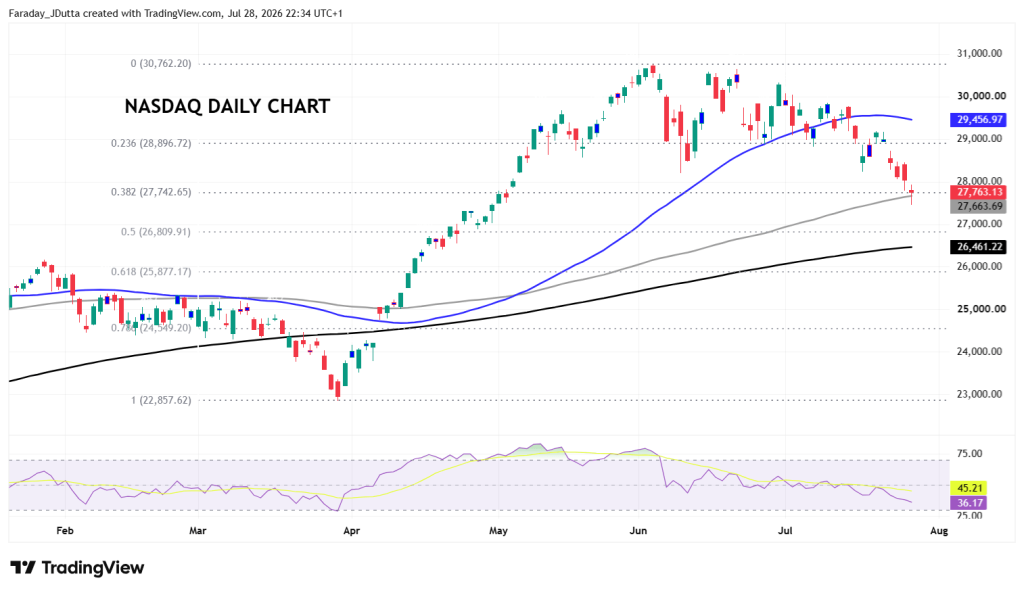
Chart of the Day – Nasdaq finds some support
We get two of the Mag 7, Meta and Microsoft, reporting after the US closing bell today. With Amazon and Apple releasing their results after hours on Thursday, that’s roughly 17% of the S&P 500 and 32% of the Nasdaq 100. Markets are intensely focused on whether massive AI capital expenditures are translating into tangible cloud and ad revenue growth for Meta, Microsoft and Amazon while assessing the profit resilience of Apple’s capital-lite AI strategy. Upward revisions to infrastructure spend without immediate bottom-line conversion could trigger an extended rotation out of Big Tech, whereas strong cloud guidance or accelerating device upgrade cycles could ignite a broader market rally.
Technically, the Nasdaq fell more than 10% from its record high in early June at 30,762, during yesterday’s trading session. But prices have found some support at the 100-day SMA at 27,663 and a major Fib level (38.2%) of the 2026 low to high move at 27,742. If we lose yesterday’s low, then bears will aim for the midpoint of that move at 26,809, with the 200-day SMA below at 26,461. Bulls probably need to get near to the 50-day SMA at 29,456 to reassert the bull trend.