


 Updated
Every time a traveller swaps rupees for dollars at an airport counter, they take part in the foreign exchange market—the same market where roughly $9.6 trillion changes hands every single day [1]. Forex trading refers to taking positions on movements in exchange rates between currency pairs. Depending on the jurisdiction, retail traders may access the market through products such as forex CFDs, spot forex, or exchange-traded derivatives. It sits at the centre of global finance, yet the mechanics behind it are often explained in jargon that leaves beginners more lost than when they started.
This guide breaks down what forex trading is, the different ways the market is structured, what actually moves currency prices, the core terms you will meet on any platform, and the risks that come with leverage and different trading styles.
Key Points
- Forex trading involves speculating on the changing exchange rate between two currencies, always quoted as a pair such as USD/INR or EUR/USD.
- The market is decentralised and trades roughly $9.6 trillion a day across spot, forward and futures channels, which is why prices move almost continuously from Monday morning in Asia to Friday evening in New York.
- Price moves are driven by central bank policy, economic data and shifting sentiment, and traders approach the market through different styles — from day trading to longer-term position trading — within the regulatory framework of their jurisdiction.
What Is Forex Trading?
Forex trading, short for foreign exchange trading, is the act of buying one currency while at the same time selling another, in the hope that the exchange rate between them moves in your favour. The word “forex” simply joins “foreign” and “exchange.”
Currencies are always traded in pairs because you are, in effect, taking a view on one currency relative to another. A trader buying EUR/USD is expressing the view that the euro may strengthen against the US dollar; if it does, the position can be closed at a better rate than it was opened.
The scale of this market is hard to overstate. Global foreign-exchange turnover averaged $9.6 trillion per day in April 2025—a 28% jump from $7.5 trillion three years earlier [1]. The US dollar sits on one side of 89.2% of all trades, followed by the euro at 28.9% and the Japanese yen at 16.8%. No stock market comes close to that daily volume.
Unlike shares, forex has no single central exchange. It runs as an over-the-counter (OTC) market—a global network of banks, institutions, and brokers linked electronically across the major hubs of London, New York, Sydney, and Tokyo.
A broad mix of participants keeps this market liquid: central banks manage reserves and shape policy, commercial banks and hedge funds provide liquidity and speculative flow, corporations hedge cross-border revenue, and retail traders speculate through CFDs and other leveraged products. That spread — from institutions moving billions to individual retail accounts — is part of why the market trades around the clock.
Because those hubs sit in different time zones, the market operates 24 hours a day, five days a week, opening in Asia on Monday morning and closing in New York on Friday evening. That continuous nature is why activity clusters around specific forex trading sessions when two hubs are open at once.
Types of Forex Markets: Spot, Forward and Futures
Forex trading happens through three distinct market structures. Spot is the most direct: two parties exchange currency at the current market rate, settling within two business days, and it’s what most retail CFD pricing references. Forwards lock in a rate today for a custom future settlement date, used mainly by corporations hedging currency exposure. Futures work similarly but trade on a regulated exchange with standardised sizes and centrally cleared counterparty risk.
| Market Type | What It Is | Who Typically Uses It |
| Spot | Currency exchanged at the current market rate, settled within two business days | Retail traders (via CFDs), banks, short-term institutional traders |
| Forward | A customised contract locking in an exchange rate for a future settlement date | Corporations and institutions hedging future currency exposure |
| Futures | A standardised, exchange-traded contract for future currency delivery | Institutional traders and funds seeking centrally cleared exposure |
Table 1: The Three Main Structures of the Forex Market
Retail traders typically access spot-market pricing indirectly, most often through forex CFDs rather than these markets directly — a distinction covered in How Retail Traders Access the Forex Market below.
How the Forex Market Works: Currency Pairs and Key Terms
Before placing a single trade, it helps to understand the vocabulary that appears on every forex platform. These terms describe how a pair is quoted, how price movements are measured, and how much a position actually costs to hold.
Base and Quote Currency
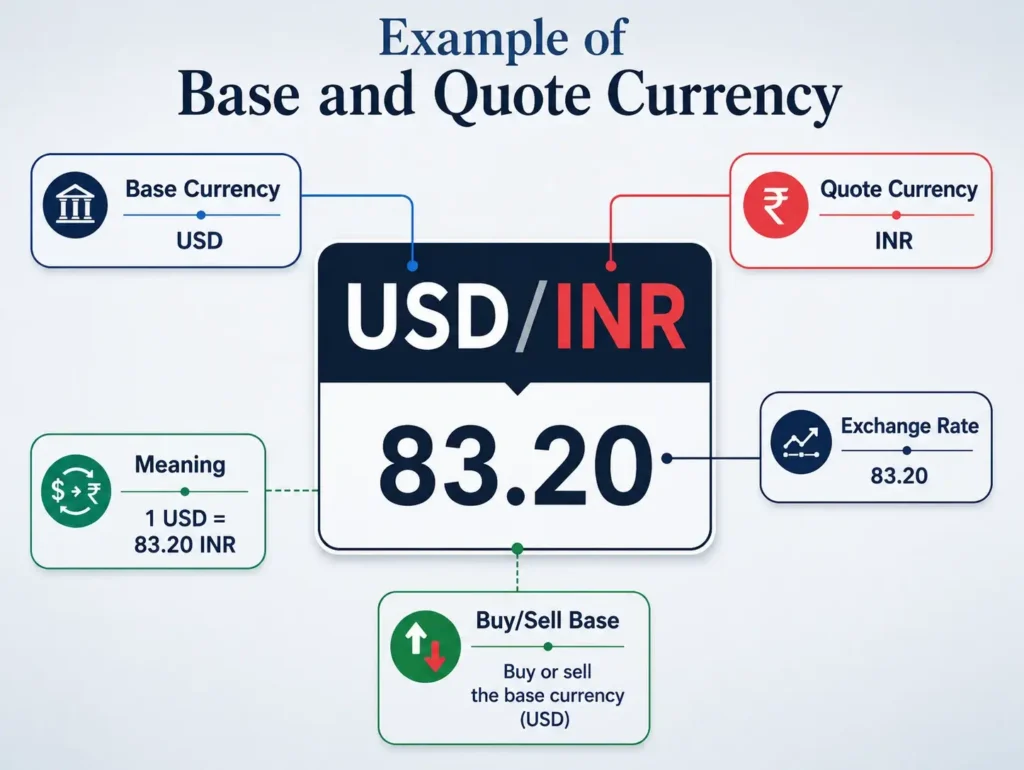
In any pair, the first currency is the base and the second is the quote. The base currency is the one being bought or sold, and the quote currency shows how much of it is needed to buy one unit of the base. For EUR/USD at 1.08, one Euro is worth 1.08 US dollars—the Euro is the base and the dollar is the quote.
Currency Pair Categories
Currency pairs fall into three broad groups by liquidity and popularity. Majors involve the US dollar against another leading currency and account for the bulk of daily volume; minors, or crosses, leave the dollar out; and exotics pair a major currency with one from a smaller or emerging economy.
| Category | Description | Examples |
| Majors | Most heavily traded; always include the US dollar | EUR/USD, USD/JPY, GBP/USD |
| Minors (crosses) | Actively traded pairs that exclude the US dollar | EUR/GBP, EUR/JPY, GBP/JPY |
| Exotics | A major currency paired with an emerging-market currency; usually wider spreads | USD/INR, USD/ZAR, USD/TRY |
Table 2: The Three Main Categories of Currency Pairs
Majors tend to carry the tightest spreads because they trade in such high volume, while exotic pairs move less predictably and usually cost more to trade. It is worth getting familiar with the most traded currency pairs before deciding what to follow.
Pips and Spreads
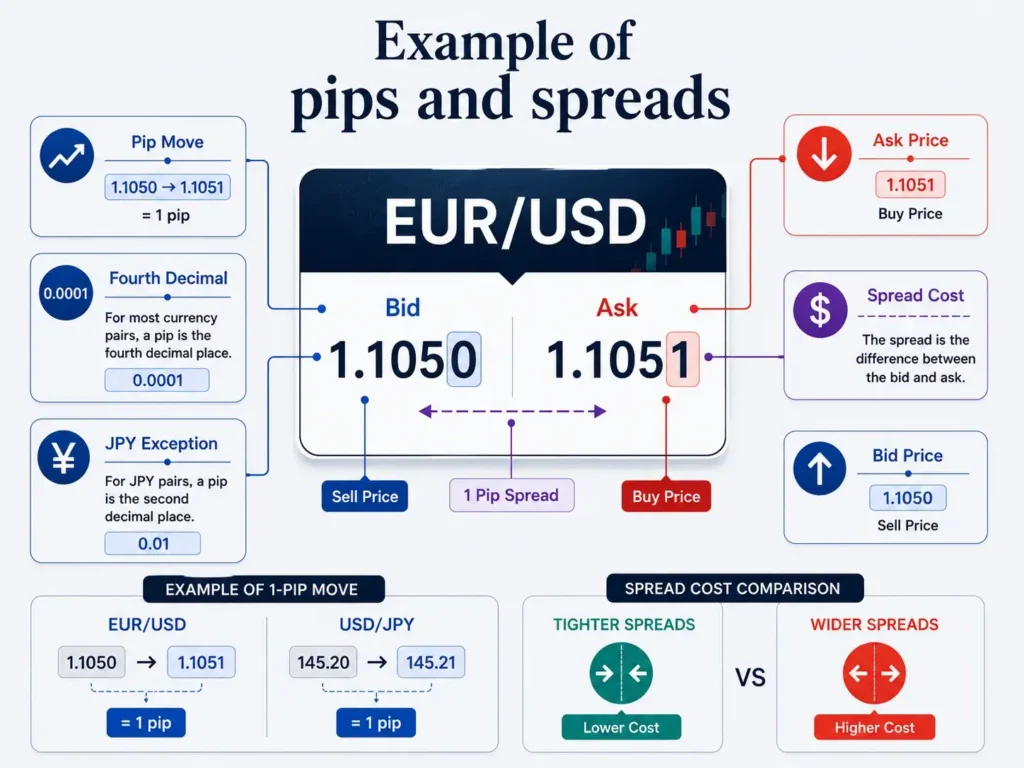
A pip is the smallest standard unit of price movement in a currency pair. For most pairs it is the fourth decimal place (0.0001), while for pairs quoted against the Japanese yen it is the second decimal place (0.01). If EUR/USD moves from 1.1050 to 1.1051, that is a one-pip move.
The spread is the difference between the bid (sell) price and the ask (buy) price of a pair—in effect, the cost of entering a trade. If EUR/USD shows a bid of 1.1050 and an ask of 1.1051, the spread is one pip. Tighter spreads generally mean lower trading costs, which is why heavily traded majors are usually cheaper to trade than exotics. A fuller explanation of how the spread works is available separately.
Lot Sizes and Pip Value
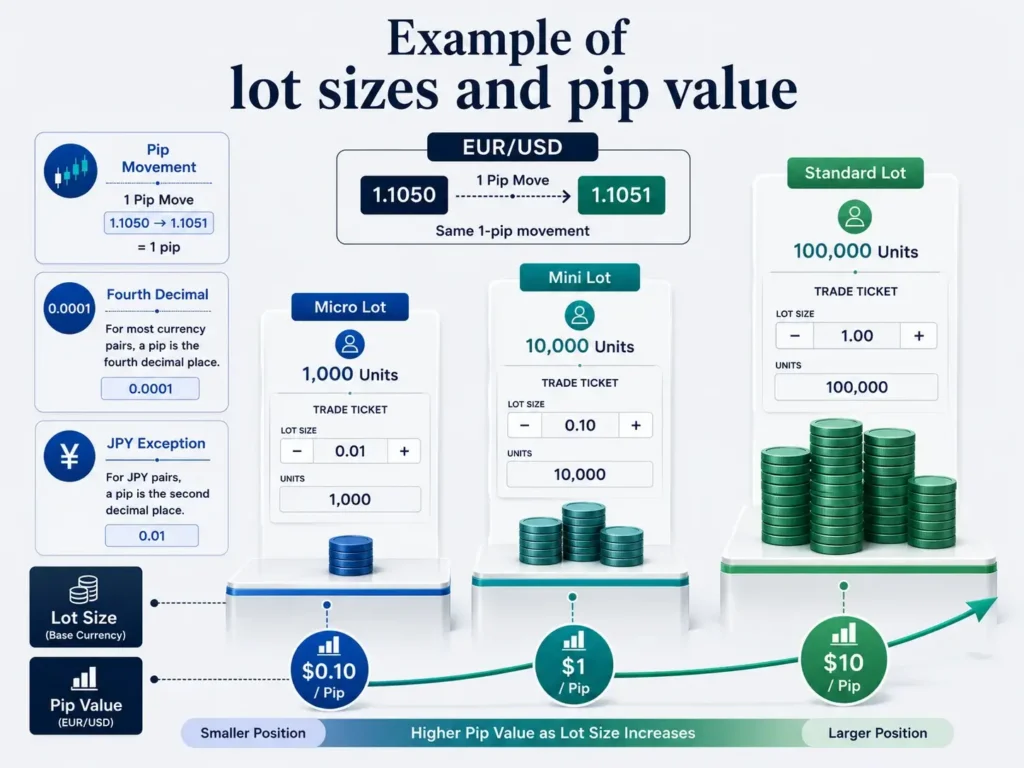
Forex is traded in standardised quantities called lots. A standard lot is 100,000 units of the base currency, a mini lot is 10,000 units, and a micro lot is 1,000 units.
Lot size sets how much each pip is worth: on a standard lot of EUR/USD one pip is worth about $10, on a mini lot about $1, and on a micro lot about $0.10. Getting comfortable with lot sizing and pip value is one of the first practical steps for a new trader, because it defines how much a single price move gains or costs.
Leverage and Margin
Leverage lets a trader control a large position with a relatively small deposit, called margin. At 30:1 leverage, for example, a trader can open a $30,000 position by putting up $1,000 of margin. This is what makes short-term currency trading accessible without large amounts of capital.
Leverage cuts both ways, though. It magnifies gains and losses in equal measure—the same 30:1 ratio that could multiply a profit will multiply a loss just as fast, and a position may be closed automatically if margin runs too low.
Our guide to the mechanics of leverage covers this in more depth. Leverage is the single concept a beginner most needs to respect, because misusing it is one of the most common ways new traders lose money quickly.
What Moves Currency Prices?
Currency prices are not driven by a single factor. Three broad forces sit behind most short- and medium-term exchange rate moves: central bank policy, economic data releases, and shifts in market sentiment.
Central Banks and Interest Rates
Central banks influence currency prices mainly through interest rate decisions: capital tends to flow toward currencies offering a higher yield, so a rate rise (or a signal that one is coming) often strengthens a currency, while a cut or a more cautious tone can weaken it.
On 31 July 2024, the Bank of Japan raised its short-term policy rate from around 0–0.1% to around 0.25% — a modest move that nonetheless ended years of near-zero yen borrowing costs and triggered rapid re-pricing across currency and equity markets in the days that followed [2]. Rate differentials between economies are watched closely for exactly this reason.
Economic Data and News Releases
Scheduled releases move currency prices by updating the market’s expectations for central bank policy. The US Non-Farm Payrolls (NFP) report — published on the first Friday of most months by the US Bureau of Labor Statistics — is among the most closely watched, since employment data feeds directly into Federal Reserve decisions.
The effect can be sharp: on 1 August 2025, data showing US employers added just 73,000 jobs in July, well below the 110,000 forecast, alongside a downgraded June figure, sent the US Dollar Index down 1.23% to 98.80, with EUR/USD gaining 1.37% to $1.1571 and USD/JPY falling 2.23% to 147.37 as traders raised bets on further Fed rate cuts [3]. Inflation prints, GDP figures, and central bank minutes can move prices just as sharply when they diverge meaningfully from consensus.
Market Sentiment and Risk Appetite
Currency prices also move on shifts in broader market sentiment — risk appetite. In risk-on conditions, capital flows toward higher-yielding currencies and growth assets; in risk-off conditions, it rotates toward safe havens such as the Japanese yen, Swiss franc, and gold.
The August 2024 episode shows how fast this can unwind. As the yen strengthened after the Bank of Japan’s rate rise, investors holding yen-funded carry trades — borrowed cheaply in yen to fund higher-yielding assets elsewhere — rushed to unwind them. The deleveraging sent Japan’s TOPIX index down 12% in a single session on 5 August 2024, with volatility spiking to levels unseen since the Covid-19 pandemic [2]. Sentiment-driven moves like this can be sudden and aren’t limited to one pair or region.
In short, currency prices commonly respond to:
- Central bank policy: interest rate decisions and forward guidance
- Economic data: releases such as Non-Farm Payrolls, CPI and GDP
- Market sentiment: shifts between risk-on and risk-off positioning
How Forex Trades Make or Lose Money
A forex trade can go in one of two directions. Going long means buying a pair because you expect the base currency to strengthen against the quote; going short means selling a pair because you expect the base to weaken.
Because currencies are always quoted in pairs, there is no structural barrier to selling first—you gain if the pair falls, and lose if it rises.
Consider a simple illustration. Suppose a trader goes long one mini lot of EUR/USD at 1.1000 and the pair rises 50 pips to 1.1050 — at roughly $1 per pip on a mini lot, that’s about a $50 gain before costs. Had the trader instead gone short at the same level and the pair risen the same 50 pips, the loss would be a mirrored $50.
This example is hypothetical and for illustrative purposes only. It does not reflect actual trading results or client experiences.
The risks are real and worth stating plainly. Exchange rates can move sharply on economic data, central-bank decisions, or geopolitical events, sometimes gapping straight through the level where a trader hoped to exit. Leverage amplifies those moves against an account as readily as it works in the account’s favour. No strategy removes this risk, and losses are always possible—which is why position sizing and risk management tend to matter far more to long-term outcomes than picking any single “right” trade.
Common Ways to Trade Forex
Beyond deciding what to trade, most forex traders eventually settle into a broader approach that matches how much time they can dedicate to watching the market. Four styles are common in retail forex trading.
| Style | Typical Timeframe | Holding Period | Who It Suits |
| Day Trading | Minutes to hours | Same day, no overnight positions | Traders who can monitor markets actively during the day |
| Swing Trading | Hours to days | A few days to several weeks | Traders with less time for constant monitoring |
| Range Trading | Minutes to days | Varies with the range | Traders in sideways, low-trend conditions |
| Position Trading | Weeks to months | Weeks to months | Traders focused on macro themes over short-term moves |
Table 3: Common Forex Trading Styles Compared
Each style carries its own risk profile, and no single approach suits every trader. A closer look at position trading versus swing trading, alongside a wider look at forex trading strategies, can help in weighing which fits a given trading plan.
How Retail Traders Access the Forex Market
The interbank market where trillions change hands each day is not directly open to individuals. Retail traders reach currency price movements through one of three main routes, and the distinction matters both for cost and for what is legally available in a given country.
- Spot forex: Buying or selling a currency pair for near-immediate settlement at the current market rate. This is the classic form of forex trading offered by many international brokers, though it is not the route available to retail traders in every jurisdiction.
- Exchange-traded currency derivatives: Futures and options on currency pairs that are traded on regulated exchanges rather than over the counter. Their availability and the requirements for retail participation vary by jurisdiction.
Contracts for Difference (CFDs): CFD is an agreement to exchange the difference in a currency pair’s price between opening and closing a position, without owning the underlying currency. Forex CFDs let traders speculate on price movements in either direction using leverage.
With forex CFDs, the broker’s main cost is usually built into the spread, sometimes alongside a small commission. Some CFD brokers, including Vantage, offer account types where trading costs may be reflected through raw spreads plus commission, while other account types incorporate costs primarily into the spread. Pricing varies by account type and market conditions.
Whichever the model, leverage on CFDs magnifies both gains and losses, and availability of CFD products varies by jurisdiction and may be subject to local regulation. A broader overview of how CFD trading works is available in a separate guide.
Forex Trading Rules and Regulatory Considerations
Forex trading is legal in many jurisdictions, but the rules and available products vary by country. The applicable framework may depend on where the trader resides, which broker or legal entity provides the service, the type of forex product being traded, and whether the platform is authorised to operate in that jurisdiction.
Financial authorities may regulate areas such as broker licensing, market conduct, client protection, leverage, risk disclosures, and permitted products. Depending on local rules, retail traders may be able to access spot forex, forex Contracts for Difference (CFDs), exchange-listed currency futures or options, or other approved instruments. Some jurisdictions may also restrict offshore platforms, certain currency pairs, leverage levels, or cross-border payment methods.
Before opening an account, traders should review the broker’s legal entity and regulatory status, confirm whether it is authorised to serve residents of their country, and check whether the relevant products and payment methods are permitted under local rules. The availability of a platform online does not necessarily mean that it is authorised in every jurisdiction.
Regulations and product availability can change over time. Traders should therefore consult the relevant financial regulator or seek independent professional advice for the latest requirements that apply to their circumstances.
In some jurisdictions, retail access is further restricted to specific exchange-traded channels — for example, retail traders in India can generally only access permitted currency pairs through SEBI-regulated exchanges under Reserve Bank of India rules [2], and offshore forex or CFD platforms that fall outside those rules are not authorised for India residents.
This information is provided for general educational purposes only and does not constitute financial or legal advice. Vantage’s products and services may not be available in every jurisdiction. For further information, read our dedicated guide on whether forex trading is legal.
Forex vs Stocks: What’s the Difference?
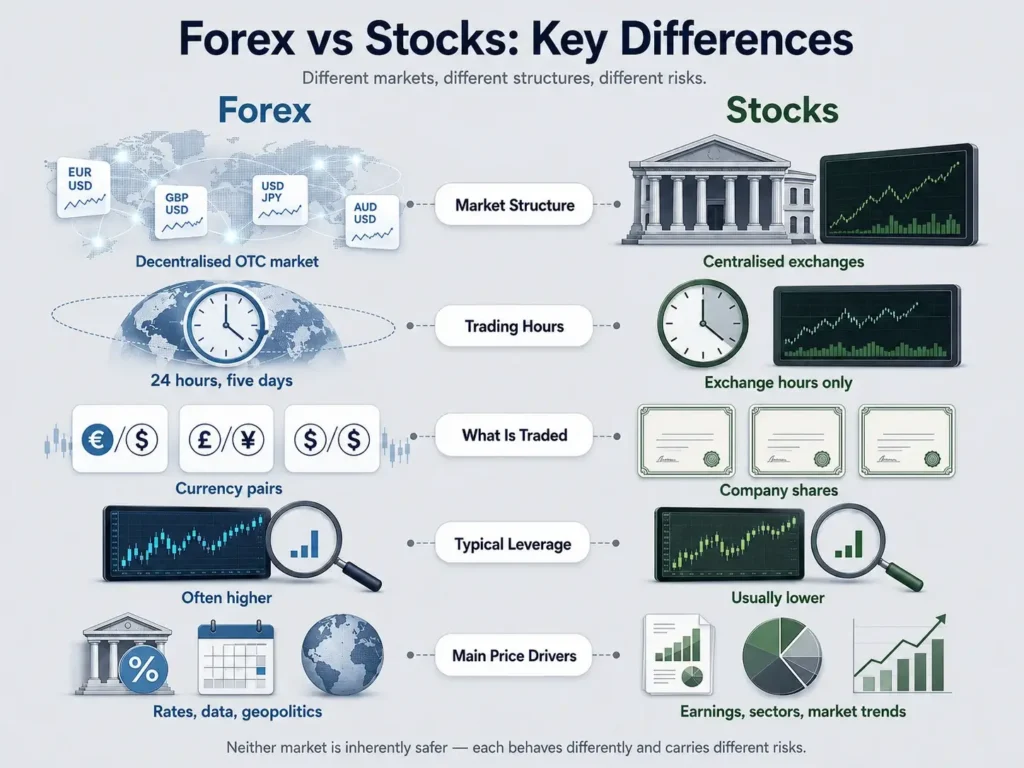
Many new traders come to forex after some exposure to shares, so it helps to see how the two differ. The table below summarises the main contrasts.
| Feature | Forex | Stocks |
| Market structure | Decentralised OTC market with no central exchange | Traded on centralised exchanges such as the NSE or NYSE |
| Trading hours | 24 hours a day, five days a week | Limited to exchange hours |
| What is traded | Currency pairs | Shares in individual companies |
| Typical leverage | Often higher, magnifying gains and losses | Usually lower for retail investors |
| Main price drivers | Interest rates, economic data, geopolitics | Company earnings, sector trends, broad market |
Table 4: Forex Trading Compared With Stock Trading
Neither market is inherently safer than the other; they simply behave differently and carry different risks.
Forex’s around-the-clock access and higher typical leverage can suit active short-term traders, though the same features demand tighter risk control. For anyone weighing the two, a closer look at how CFDs on shares differ from owning stock adds useful context.
Pros and Cons of Forex Trading
Every feature that makes forex trading accessible also carries a matching risk. Weighing both sides matters more than focusing on the advantages alone.
| Advantages | Considerations |
| High liquidity: roughly $9.6 trillion changes hands daily [1], so major pairs can typically be traded with minimal price impact. | Leverage risk: the same leverage that lowers the capital required also magnifies losses relative to the funds deposited. |
| Around-the-clock access: trading runs 24 hours a day, five days a week across overlapping global sessions. | High complexity for beginners: understanding pips, spreads, margin and macroeconomic drivers takes time before a beginner can trade with confidence. |
| Wide range of currency pairs: majors, minors and exotics offer exposure to a broad set of economies. | Most retail accounts lose money: regulatory disclosures show that a majority of retail CFD accounts lose money over a 12-month period [3], underlining that no strategy removes risk. |
| Lower capital requirements via CFDs: leverage lets a trader control a larger position with a smaller deposit than owning the underlying currency outright. | Counterparty and regulatory variation: protections, permitted products and leverage limits vary significantly between brokers and jurisdictions. |
| Two-way opportunity: because pairs are always quoted against each other, traders can seek gains whether a currency strengthens or weakens. | Volatility and gaps: prices can move sharply around news events or when markets reopen after a weekend, sometimes gapping past a level a trader intended to exit. |
Table 5: Advantages and Considerations of Trading Forex CFDs
Know the Mechanics, Respect the Risk
Forex trading involves taking a view on the relative value of two currencies. While the underlying concept is straightforward, the market can move quickly and is influenced by economic developments, market volatility, leverage, and regulatory requirements.
Understanding currency pairs, pips, spreads, and margin provides a foundation for learning how forex trading works. It is equally important to understand the risks involved and the rules that apply in the trader’s jurisdiction.
New traders should familiarise themselves with the market, the products available, and the potential for losses before placing a trade. Access to a trading platform does not remove the need to assess the risks or confirm whether the service is permitted in their location.
Traders who want to build on these fundamentals often start with a structured introduction to forex trading or a demo trading account, which lets them apply lot sizing, leverage and margin concepts in a live-priced environment without committing real funds.
Frequently Asked Questions
What is forex trading and how does it work?
Forex trading is the buying and selling of currency pairs to profit from changes in their exchange rate. A trader may buy a currency pair if they expect the base currency to strengthen against the quote currency, or sell the pair if they expect the opposite. Trades happen through a broker rather than a single central exchange, and prices move continuously throughout the global trading week.
What is a pip in forex trading?
A pip is the smallest standard unit of price movement in a currency pair. For most pairs it is the fourth decimal place (0.0001), while for pairs quoted against the Japanese yen it is the second decimal place (0.01). Pips are how traders measure gains, losses, and the spread on a position.
What is leverage in forex trading?
Leverage allows a trader to control a larger position with a smaller deposit, known as margin. For example, 30:1 leverage means $1,000 of margin can control a $30,000 position. It magnifies both profits and losses, so higher leverage increases risk as much as potential reward.
Is forex trading legal in India?
Forex trading is legal in India, but retail access is more restricted than in many other markets. Under Reserve Bank of India (RBI) rules, retail traders can generally only trade permitted currency derivatives — including USD/INR, EUR/INR, GBP/INR and JPY/INR — on exchanges regulated by the Securities and Exchange Board of India (SEBI), such as the National Stock Exchange [2]. Offshore forex or CFD platforms that fall outside these rules are not authorised for India residents. Traders can find a fuller breakdown of how these rules apply in our dedicated guide on whether forex trading is legal.
How much money do you need to start forex trading?
There is no fixed minimum — it varies by broker and account type. Because forex is traded in lots, brokers offering micro lots (1,000 units) allow small deposits: on a micro lot of EUR/USD, a pip is worth around $0.10. But leverage still magnifies losses relative to that deposit just as much as gains, so a low minimum isn’t the same as low risk — treat it as a technical floor, not a recommended starting amount.
Is forex trading risky?
Yes. All trading carries risk, and forex is no exception — exchange rates can move sharply and leverage magnifies losses as well as gains. Many retail traders lose money, particularly when they use high leverage without a risk-management plan. Understanding the market and using tools such as position sizing matters before trading with real funds.
What is the 90% rule in forex?
The “90% rule” is an informal trading maxim, not a codified regulation — it holds that roughly 90% of retail traders lose 90% of their capital within 90 days. The precise figures in that phrasing are not from an official study, but they are broadly consistent with regulatory disclosures: since 2018, brokers marketing CFDs to retail clients under European Securities and Markets Authority (ESMA) rules have been required to publish the percentage of their retail accounts that lose money, and these disclosures commonly fall in the 70–89% range [3]. The rule is best read as a reminder that most retail accounts lose money, particularly when high leverage is combined with limited risk management, rather than as a precise or official statistic.
RISK WARNING: CFDs are complex financial instruments and carry a high risk of losing money rapidly due to leverage. You should ensure you fully understand the risks involved and carefully consider whether you can afford to take the high risk of losing your money before trading.
Disclaimer: The information is provided for educational purposes only and doesn’t take into account your personal objectives, financial circumstances, or needs. It does not constitute investment advice. We encourage you to seek independent advice if necessary. The information has not been prepared in accordance with legal requirements designed to promote the independence of investment research. No representation or warranty is given as to the accuracy or completeness of any information contained within. This material may contain historical or past performance figures and should not be relied on. Furthermore estimates, forward-looking statements, and forecasts cannot be guaranteed. The information on this site and the products and services offered are not intended for distribution to any person in any country or jurisdiction where such distribution or use would be contrary to local law or regulation.
References
-
- “OTC foreign exchange turnover in April 2025 – Bank for International Settlements” https://www.bis.org/statistics/rpfx25_fx.htm Accessed 2 July 2026
-
- “Master Direction – Risk Management and Inter-Bank Dealings – Reserve Bank of India” https://www.rbi.org.in/Scripts/BS_ViewMasDirections.aspx?id=11200 Accessed 29 July 2026
-
- “ESMA Agrees to Prohibit Binary Options and Restrict CFDs to Protect Retail Investors – European Securities and Markets Authority” https://www.esma.europa.eu/press-news/esma-news/esma-agrees-prohibit-binary-options-and-restrict-cfds-protect-retail-investors Accessed 29 July 2026