


 Updated
Silver is traded across futures exchanges, over-the-counter markets, and broker platforms, so there is no single opening bell for every silver product.
If you’re asking when the silver market opens, the practical answer for COMEX Silver futures is Sunday at 6:00pm Eastern Time (ET). Trading then continues almost around the clock until Friday at 5:00 pm (ET), with a daily maintenance break from 5:00 pm to 6:00 pm (ET).1
Spot silver and silver Contracts for Difference (CFDs), commonly shown as XAG/USD, often follow a similar weekday cycle. However, their exact opening times are set by the broker and product specification. Shanghai silver futures follow a separate schedule in China Standard Time (CST). This guide explains the differences so you can check the clock that applies to the instrument you trade.
Key Points
- COMEX Silver futures commonly open on Sunday at 6:00 pm (ET) and close for the week on Friday at 5:00 pm (ET), with a one-hour maintenance break each trading day.
- Spot silver and XAG/USD CFDs may be available for nearly 23 hours a day during the trading week, but the broker’s product schedule typically determines exact access.
- Silver is usually not traded 24/7 because standard products pause for daily maintenance, weekends, and some public holidays.
- SHFE silver futures use separate daytime and night sessions in China Standard Time, so their opening hours should not be confused with COMEX hours.3
- Liquidity and spreads can change between Asian, London, and New York sessions, which means an open market is not always an equally active market.
When Does the Silver Market Open?
If you’re looking for a quick answer to the question “When does the silver market open?”, COMEX Silver futures on CME Globex generally open for the trading week at 6:00 pm (ET) on Sunday. From Monday to Thursday, the next session also begins at 6:00 pm (ET) after the daily break. The market then closes for the week at 5:00 pm (ET) on Friday.
When converted to Coordinated Universal Time (UTC), the Sunday session opens at approximately 22:00 during US daylight saving time (DST) and 23:00 during US standard time.
XAG/USD CFDs may follow a schedule similar to COMEX Silver futures, although the exact trading hours depend on the broker, product specification, and applicable trading conditions. Platform maintenance, liquidity-provider access, public holidays, and the specific silver product can all affect when orders are accepted. Check the symbol specification in your trading platform before relying on a general market-hours table.
What Are the Main Silver Trading Hours?
Did you know that the term ‘silver market’ can refer to several instruments? The following comparison table shows why the relevant market should be identified before converting the time to your location.
| Silver Market | Regular Schedule | Notes for Silver Traders & Investors |
| COMEX Silver futures | Sunday-Friday, 6:00 pm-5:00 pm (ET) | Daily break from 5:00 pm to 6:00 pm (ET); holiday schedules can differ.12 |
| Spot silver / XAG/USD CFDs | Often near-continuous on weekdays | Exact access is usually broker- and product-specific; check the platform specification. |
| SHFE Silver futures | Day: 09:00-10:15, 10:30-11:30 and 13:30-15:00 (CST) Night: 21:00-02:30 (CST) | The night session belongs to the next trading day, and national-holiday arrangements can change normal access.34 |
| Physical bullion market | Dealer or venue opening hours | Retail shops and online dealers do not share one global exchange schedule. |
COMEX Silver Futures Trading Hours
COMEX Silver futures are among the most widely followed exchange-traded silver contracts. CME Globex provides an electronic session that spans most of the day, making COMEX a common timing reference for global silver price discovery.
The one-hour break matters. Orders may not execute during the maintenance window, and conditions immediately before or after the pause can differ from more active periods. Exchange holidays can also bring early closes or altered sessions, so CME Group’s current holiday calendar should be checked around US public holidays.
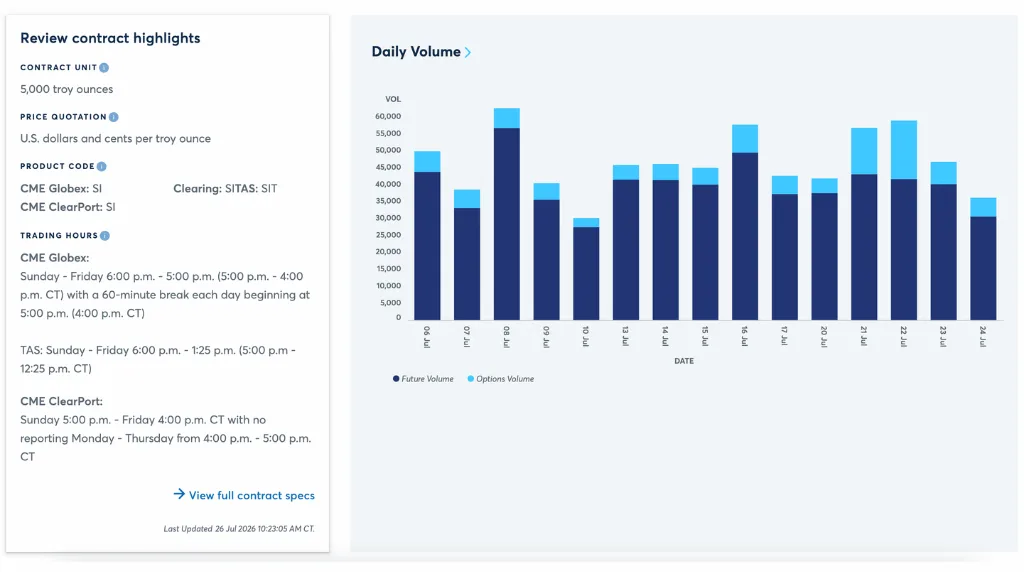
Image credit: CME Group
XAG/USD and Silver CFD Trading Hours
XAG/USD represents silver priced in US dollars. Brokers may offer this exposure through a contract for difference (CFD) rather than an exchange-traded futures contract. Silver CFDs can provide extended weekday access, but the broker controls the exact platform hours, including any rollover or maintenance break.
A price chart that remains visible does not necessarily mean that new orders can be opened at that moment. The product’s symbol details should still be used as the final source of truth for its trading session, spread conditions, and holiday treatment. Take note that silver CFD product availability can also vary by region.
SHFE Silver Futures Trading Hours
Shanghai Futures Exchange Silver futures (identified by the symbol AG) follow China-based sessions. SHFE lists daytime auction trading from 09:00 to 10:15, 10:30 to 11:30 and 13:30 to 15:00 (CST). Its continuous night session runs from 21:00 to 02:30 (CST) for silver.
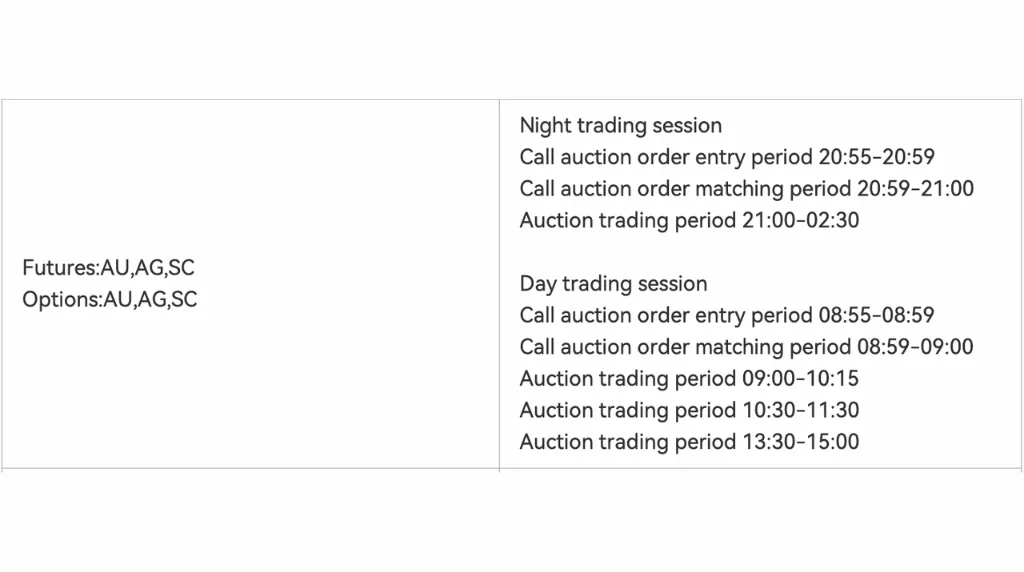
Image credit: Shanghai Futures Exchange (SHFE)
Silver traders and investors should note that these sessions are distinct from COMEX. The SHFE night session is treated as part of the following trading day, and night trading is generally not held on the business day before a Chinese national holiday.
Note: Check the latest SHFE trading calendar before public holidays, as trading sessions may differ from the regular schedule.
What Are Popular Silver Trading Sessions by Time Zone?
Silver trading activity moves across the Asian, European, and US sessions throughout the day. The times below indicate when each regional session is generally active; they do not represent guaranteed XAG/USD trading hours on any particular platform.
| Session | Approximate (UTC) window | What traders commonly monitor |
| Sydney / early Asia | 22:00-07:00 (UTC) | The weekday cycle reopens, but liquidity may be thinner and weekend news can create gaps. |
| Tokyo / Shanghai | 00:00-09:00 (UTC) | Asian futures activity, physical demand, and China-related industrial data can influence silver’s movements. |
| London | 08:00-16:00 (UTC) | European liquidity increases, and London precious-metals activity can support price discovery. |
| New York / COMEX | 12:00-21:00 (UTC) | COMEX activity and US data may produce faster moves in USD-denominated silver (XAG/USD). |
| London-New York overlap | 12:00-16:00 (UTC) | Participation from both regions can increase liquidity as well as the speed of price changes. |
These (UTC) ranges can shift relative to local clocks when DST changes in the United States, United Kingdom or Australia. They describe broad sessions and should not replace the hours shown for a particular product.
When Does the Silver Market Close?
COMEX Silver futures generally close for the week at 5:00 pm (ET) on Friday and reopen at 6:00 pm (ET) on Sunday. They also pause from 5:00 pm to 6:00 pm (ET) from Sunday through Thursday.
Other silver products may close at different times. For example, SHFE has breaks between its daytime sessions and between the day and night markets. Meanwhile, silver CFDs may pause for rollover or brokerage platform maintenance. Physical bullion dealers typically set their own business hours.
| Closure | When it occurs | Why it matters |
| Daily break | Exchange- or platform-specific | Orders may pause, and liquidity or spreads can change around reopening. |
| Weekend close | Usually Friday to Sunday for standard global products | Weekend news may be reflected in a gap when trading resumes. |
| Holiday schedule | Exchange and jurisdiction-specific | Early closes, delayed opens, or full closures can replace normal hours. |
| Platform maintenance | Broker-specific | A broker may temporarily restrict orders even while another competitor platform is open. |
Is Silver Traded 24 Hours a Day?
Silver is commonly described as trading 24 hours a day, but “nearly 24 hours on weekdays” is more accurate for standard futures and CFD access. That’s because COMEX has a scheduled daily break and a weekend closure, while SHFE operates defined day and night sessions rather than continuously.
Silver is also not a single centralised spot market. Prices can be quoted by dealers outside the main sessions, but a visible quote does not guarantee normal liquidity, spreads, or order execution. For that reason, 24/5 should be treated as shorthand rather than a promise that every silver product is continuously tradable.
Related Article: Trading Silver: Understanding XAG/USD and XAG/AUD
When Is the Silver Market Typically Most Active?
Silver activity often increases when London and New York are both open, particularly during the early COMEX session. This overlap brings together European precious-metals trading and US futures activity. US economic releases during this period can also influence the US dollar and interest-rate expectations, both of which may affect silver prices.
Higher activity may support deeper liquidity, but it can also lead to faster price movements. Higher liquidity or market activity does not necessarily result in more favourable trading opportunities and may also be accompanied by increased volatility and risk. US Consumer Price Index (CPI) releases, Non-Farm Payrolls reports, and Federal Reserve decisions can cause volatility to change quickly. Manufacturing data from China and other major economies may also influence silver because industrial uses account for a meaningful share of demand.
In summary, there is no universally best time to trade silver, and periods of higher market activity or liquidity do not necessarily improve trading outcomes. A suitable trading window usually depends on the instrument, strategy, execution conditions, and individual risk tolerance. Greater liquidity does not ensure a favourable outcome, while quieter sessions can still experience sudden price movements.
Eligible clients may open a Vantage Live Account to trade XAG/USD CFDs, subject to product availability in their jurisdiction. Before placing a trade, check the instrument’s current trading hours, spreads, and contract specifications, and applicable risk disclosures on the platform.
Read Next: When Does the Gold Market Open?
FAQs
What time does the silver market open?
COMEX Silver futures generally open for the week at 6:00 pm (ET) on Sunday. During the week, trading resumes at 6:00 pm (ET) after a daily one-hour break. XAG/USD CFD hours can differ, so always check the broker’s symbol specifications.
When does the silver market close?
COMEX Silver futures generally close for the week at 5:00 pm (ET) on Friday. They also pause daily from 5:00 pm to 6:00 pm (ET) from Sunday through Thursday. Other exchanges and CFD platforms may use different closing times.
When does the silver market open on Sunday?
The commonly followed COMEX Silver futures market opens at 18:00 (ET) on Sunday. That is approximately 22:00 (UTC) during US daylight saving time or 23:00 (UTC) during US standard time.
Is silver trading open 24/7?
No, standard silver futures and most XAG/USD products are usually not open 24/7. COMEX trades for nearly 23 hours a day during the trading week but closes for a daily maintenance break and for the weekend.
What are COMEX Silver futures trading hours?
The regular CME Globex schedule is generally Sunday to Friday from 6:00 pm to 5:00 pm (ET), with a daily break from 5:00 pm to 6:00 pm (ET). Holiday schedules can alter these hours.
What are SHFE silver futures trading hours?
SHFE Silver futures have daytime sessions from 09:00 to 10:15, 10:30 to 11:30 and 13:30 to 15:00 (CST), plus a night session from 21:00 to 02:30 (CST). Holiday arrangements may change the schedule.
Is the silver market open right now?
That depends on the instrument, platform, day, time zone, and holiday calendar. Check the market-status indicator and symbol details on the platform you use rather than relying only on a general schedule.
What is the best time to trade silver?
There is no universal best time. The London-New York overlap and early COMEX session often attract more activity, but faster markets can also bring greater volatility and risk.
RISK WARNING: CFDs are complex financial instruments and carry a high risk of losing money rapidly due to leverage. You should ensure you fully understand the risks involved and carefully consider whether you can afford to take the high risk of losing your money before trading.
Disclaimer: The information is provided for educational purposes only and doesn’t take into account your personal objectives, financial circumstances, or needs. It does not constitute investment advice. We encourage you to seek independent advice if necessary. The information has not been prepared in accordance with legal requirements designed to promote the independence of investment research. No representation or warranty is given as to the accuracy or completeness of any information contained within. This material may contain historical or past performance figures and should not be relied on. Furthermore estimates, forward-looking statements, and forecasts cannot be guaranteed. The information on this site and the products and services offered are not intended for distribution to any person in any country or jurisdiction where such distribution or use would be contrary to local law or regulation.
References
- “Silver Futures Contract Specs – CME Group” https://www.cmegroup.com/markets/metals/precious/silver.contractSpecs.html. Accessed on 22 July 2026.
- “Trading – Shanghai Futures Exchange” https://www.shfe.com.cn/eng/services/investor/Investor_trade/. Accessed on 22 July 2026.
- “Silver Futures Rules – Shanghai Futures Exchange” https://www.shfe.com.cn/eng/services/rules/shfe/911404889.html. Accessed on 22 July 2026.
- “Holiday and Trading Hours – CME Group” https://www.cmegroup.com/trading-hours.html. Accessed on 22 July 2026.