


 Updated
Safe haven assets are investments that tend to hold or increase in value when markets fall. When confidence drains out of equities and other risk assets, capital often rotates toward a handful of holdings seen as more stable — a shift widely known as a flight to safety. That rotation is what drives safe haven demand.
Gold, high-quality government bonds, a few resilient currencies, and defensive shares are the assets most often placed in this category. None of them is risk-free, and none behaves the same way in every crisis.
What makes an asset a safe haven, which assets qualify, and where they fall short are worth understanding together — the last part is what most explainers skip. A safe haven only helps if you know what it can and cannot do.
Key Points
- Safe haven assets share four traits that matter more than the label: low or negative correlation to equities, deep liquidity, limited supply, and broad market trust. An asset missing these can carry the name without the behaviour.
- Gold, government bonds, defensive currencies such as the Swiss franc and Japanese yen, and defensive shares are the assets most often used — but each tends to protect against a different type of shock rather than all of them.
- Safe havens can still fall. Gold dropped sharply in the first half of 2026 after a run of record highs, and government bonds lost value when interest rates rose. Capital preservation is a tendency, not a guarantee.
What Are Safe Haven Assets?
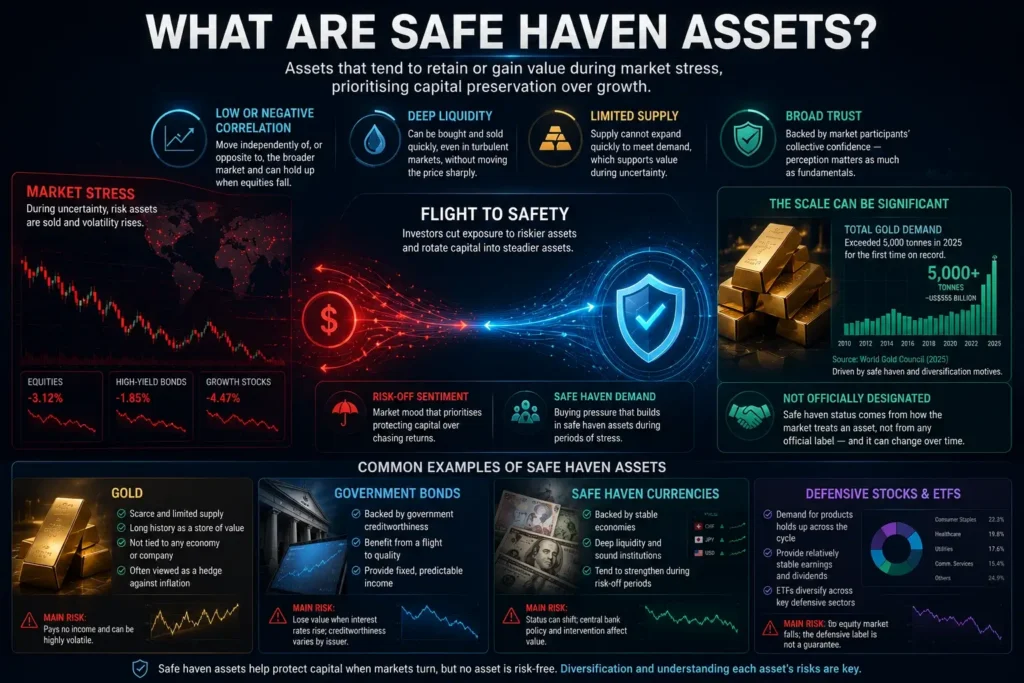
A safe haven asset is a financial asset expected to retain or gain value during periods of market stress, when riskier investments are falling. Its main job is capital preservation rather than growth, which is why it can lag in a strong market yet earn its place when conditions turn.
Safe haven assets span several asset classes, from precious metals to bonds and currencies. Despite those differences, they tend to share a few common characteristics:
- Low or negative correlation: their value tends to move independently of, or opposite to, the broader market, so they can hold up while equities fall.
- Deep liquidity: they can be bought and sold quickly, even in turbulent markets, without moving the price sharply.
- Limited supply: supply cannot expand quickly to meet demand, which supports value during periods of uncertainty.
- Broad trust: an asset becomes a safe haven partly because market participants collectively treat it as one — perception matters as much as fundamentals.
When markets turn, investors often cut exposure to riskier holdings such as growth stocks and high-yield bonds and move into steadier assets. This behaviour is called a flight to safety, and the buying pressure it creates is what analysts mean by safe haven demand. The same idea appears under the label risk-off sentiment — a market mood that prioritises protecting capital over chasing returns.
The scale can be significant. The World Gold Council reported that safe haven and diversification motives helped push total gold demand above 5,000 tonnes in 2025 for the first time on record, worth about US$555 billion [1].
An asset earns safe haven status from how the market treats it, not from any official designation — which is also why that status can shift over time.
Why Investors Turn to Safe Haven Assets
The core reason investors hold safe haven assets is capital preservation — protecting a portfolio’s value when broader markets decline. Because many safe havens show low or negative correlation to equities, they can also play a portfolio diversification role, potentially smoothing overall swings across a cycle. This is general information only and does not constitute financial advice; individual circumstances vary.
Demand tends to build around recognisable triggers: equity market corrections, recessions, geopolitical conflict, and sharp rises in inflation. During these periods, headlines about crashes and plunges can amplify the move, as fear pushes more investors to rotate out of falling markets faster. The way inflation and recession affect different asset classes varies widely, which is part of why a mix of holdings behaves differently from any single one.
It helps to be clear about what safe havens are not. They are not growth engines. Over a long expansion, a portfolio weighted heavily toward defensive assets may lag one exposed to rising markets — the trade-off for lower drawdowns is usually lower upside.
Common Examples of Safe Haven Assets
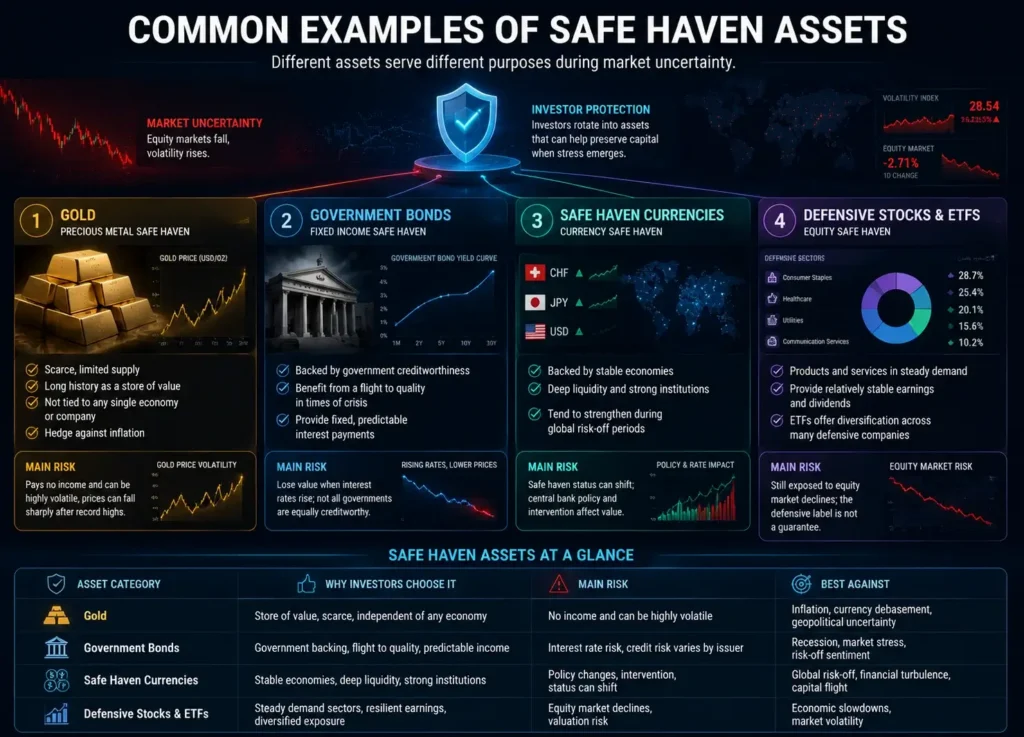
No single asset is the definitive safe haven. The list below covers the categories investors turn to most often, along with the main risk attached to each — because every one of them can behave differently depending on the type of shock.
| Asset type | Why it is seen as a safe haven | Main risk to be aware of |
| Gold | Scarce, not tied to any single economy or company, with a long history as a store of value. | Pays no income and can be highly volatile; it fell sharply in early 2026 after record highs. |
| Government bonds | Backed by the issuing government’s creditworthiness; benefit from a flight to quality in a crisis. | Lose value when interest rates rise, and not all governments are equally creditworthy. |
| Safe haven currencies | Backed by stable economies, deep liquidity, and sound institutions. | Safe haven status can shift; central bank policy and intervention affect value. |
| Defensive stocks and ETFs | Demand for their products holds up across the economic cycle. | Still exposed to equity market falls; the defensive label is not a guarantee. |
Gold
Gold is a precious metal with a long history as a store of value, and it remains the most widely held safe haven asset. Its appeal rests on scarcity, limited supply, and the fact that its value is not tied to the performance of any single economy or company.
Institutional demand reinforces that role. According to the World Gold Council, central banks bought 863.3 tonnes of gold in 2025 — below the 1,000-tonne-plus levels of 2022, 2023, and 2024, but still well above the 2010–2021 annual average of 473 tonnes, extending a run of net buying that has lasted 15 straight years [2]. Gold is also frequently discussed as a hedge against inflation, as it has often held real value when the purchasing power of cash erodes, though this does not hold in every period.
Consumer demand matters too, and it is especially relevant across Asia. India is the world’s second-largest gold consumer after China, and the World Gold Council estimates that roughly 24,000 to 25,000 tonnes of gold sit in Indian households — more than the reserves of any single central bank [3]. That deep, culturally rooted demand is one reason gold’s safe haven reputation is so durable.
Silver is sometimes grouped with gold as a precious-metal safe haven, but silver tends to be more volatile and more tied to industrial demand, which can weaken its defensive behaviour in a downturn. Past performance is not a reliable indicator of future results.
Key features:
- Widely recognised store of value with scarcity and limited supply
- Not linked to the earnings of any single company or economy
- Supported by sustained central bank and consumer demand
- Pays no income and can experience sharp price swings
Government Bonds
Government bonds are loans to a government that pay a fixed rate of interest over a set term, and those issued by financially strong governments are among the most established safe haven assets. In a crisis, investors often move into them in a pattern known as a flight to quality, because the perceived risk of a stable government defaulting is low. You can read more about the different types of bonds and how they are structured.
Their safe haven status is not universal, though. Bond prices move inversely to interest rates, so when central banks raise rates aggressively, the value of existing bonds can fall — even during uncertain times. Creditworthiness also varies considerably from one issuer to another, which is why the market treats bonds from different governments very differently.
Key features:
- Fixed, predictable interest payments over a defined term
- Benefit from a flight to quality when risk appetite falls
- Value is sensitive to changes in interest rates
- Safety depends heavily on the issuing government’s creditworthiness
Safe Haven Currencies
Safe haven currencies are currencies backed by stable economies, deep liquidity, and sound institutions, which tend to attract demand when global risk appetite falls. Three are cited most often, each for different reasons.
The Swiss franc benefits from Switzerland’s long-standing political neutrality and fiscal prudence, supported by the Swiss National Bank’s focus on currency stability. The Japanese yen draws on Japan’s large economy, deep financial markets, and current account surplus, although its behaviour is closely linked to the Bank of Japan’s policy on interest rates. The US dollar has traditionally been a haven thanks to its status as the world’s reserve currency, though that role can weaken when the stress originates in the United States itself.
Key features:
- Backed by stable economies and deep, liquid markets
- Tend to strengthen during global risk-off periods
- Influenced heavily by central bank policy and intervention
- A currency’s haven status can change with the source of the shock
Defensive Stocks and ETFs
Defensive stocks are shares in companies whose products stay in demand regardless of the economic cycle, and defensive ETFs bundle baskets of them into a single instrument. Their prices tend to be steadier than the broader market because demand for what they sell is relatively inelastic — people keep buying groceries, medicine, and electricity even when budgets tighten.
Common defensive sectors include consumer staples, healthcare, utilities, and communication services. Defensive ETFs give exposure to a spread of these companies at once; examples commonly cited in the market include low-volatility, utilities, and consumer-staples funds. These are illustrations, not recommendations. It is worth remembering that a defensive label does not remove equity risk — a richly valued defensive stock can still fall in a broad sell-off.
Key features:
- Backed by companies with steady, inelastic demand
- Can provide relatively stable earnings and dividends
- ETFs spread exposure across many defensive names at once
- Still carry equity market risk in a broad downturn
Do Safe Haven Assets Always Work? The Limits
Safe haven status is a tendency, not a guarantee — and this is the part a simple list of assets tends to miss. Even the most trusted havens can fall, and sometimes they fall at the same moment investors most need protection.
Gold is the clearest recent example. It set repeated record highs through 2025 and into January 2026, then corrected sharply through the first half of the year, sliding from a record of around US$5,600 an ounce in January to roughly US$3,960 by the end of June 2026 [4]. Anyone who bought near the peak expecting steady protection experienced the opposite over that stretch.
The type of shock matters as much as its severity. In a severe liquidity crisis, investors may sell everything they can to raise cash, and even gold can drop in the initial panic before recovering — a pattern seen in the early stages of the March 2020 market sell-off.
An inflationary shock is harder still: rising real yields can weigh on gold at the same time that higher inflation pushes bond prices down, so two classic havens can weaken together. That dynamic is often behind a common frustration — a portfolio holding safe haven assets still losing value during a global conflict, because the specific shock worked against those particular havens.
Correlations that normally sit low or negative can also converge toward one in a crisis, temporarily eroding the diversification benefit. A safe haven is only “safe” relative to a particular kind of stress. Matching the asset to the shock — and accepting that no asset covers every scenario — is closer to how safe havens actually work.
How Traders Approach Safe Haven Assets
Retail traders typically access safe haven markets through Contracts for Difference (CFDs) rather than by owning the underlying asset. A CFD is an agreement to exchange the difference in an asset’s price between opening and closing a position, which lets a trader speculate on price movements in either direction without holding physical gold, a bond, or foreign currency. You can find a fuller explanation in this guide to CFD trading.
Vantage offers CFDs across several markets often linked to safe haven demand, including gold (XAUUSD), major and defensive currency pairs, government bond instruments, and index and ETF CFDs. CFDs are leveraged products: leverage can magnify both gains and losses, and losses can exceed the initial margin. That makes position sizing and risk controls as important as the choice of asset.
A few practical points are worth keeping in mind:
- Understand the market first: even a recognised safe haven can move unexpectedly, so studying how a specific asset behaves matters before taking a position.
- Watch the entry point: safe haven prices are often already elevated by the time a crisis dominates the headlines, so buying late can mean buying near a top.
- Manage the risk deliberately: stop-loss orders are commonly used to limit downside, though they do not guarantee execution at the set level in fast-moving markets.
- Keep a longer-term view: corrections are a normal feature of markets, and reacting to every swing can add cost and stress rather than protection.
Where Safe Haven Assets Fit
Safe haven assets are best understood as a tool for managing uncertainty, not a promise of protection. Each one — gold, government bonds, defensive currencies, defensive shares — guards against a particular kind of stress, and each carries its own risk when the shock does not fit. The value comes from knowing which is which, and from accepting that lower drawdowns usually mean giving up some upside.
The steadier way to use them is to treat capital preservation as a tendency to plan around, not a guarantee to rely on. What suits any individual depends on personal circumstances, and this article is general information rather than a personal recommendation; independent advice should be sought where needed.
Frequently Asked Questions
What are safe haven assets?
Safe haven assets are investments that tend to hold or increase in value when broader markets fall, with the primary aim of preserving capital rather than generating growth. They usually share low or negative correlation to equities, deep liquidity, limited supply, and broad market trust. Common examples include gold, high-quality government bonds, certain currencies, and defensive shares. None is completely risk-free.
Is gold a safe haven asset?
Gold is widely regarded as the classic safe haven asset because of its scarcity, its long history as a store of value, and the fact that it is not tied to any single economy or company. Central banks and consumers continue to buy it in large volumes, which supports that reputation. However, gold is not immune to volatility — it can fall sharply, as it did in the first half of 2026, and it may even drop during the initial panic of a severe crisis before recovering.
Is silver a safe haven asset?
Silver is sometimes treated as a safe haven alongside gold, as both are precious metals with a store-of-value history. In practice, silver tends to be more volatile than gold and is more closely tied to industrial demand, so its price can weaken when economic activity slows. That mix of drivers makes it a less consistent haven than gold, though it may still play a diversification role for some investors.
Why is the Japanese yen considered a safe haven currency?
The Japanese yen is viewed as a safe haven currency because Japan has a large economy, deep and liquid financial markets, and a current account surplus that provides support during downturns. In risk-off periods, capital has historically tended to flow toward the yen. Its behaviour is closely tied to Bank of Japan policy, however, so its haven status is not fixed and can vary with interest rate and monetary decisions.
What is safe haven demand?
Safe haven demand is the buying pressure that builds when investors move money out of riskier assets and into more stable ones during periods of market stress. It is closely linked to the ideas of a flight to safety and risk-off sentiment, where preserving capital takes priority over chasing returns. This demand often rises around market corrections, recessions, geopolitical conflict, and inflation spikes, and it can push the prices of popular havens higher.
Can safe haven assets lose value?
Yes. Safe haven assets can and do lose value, because their protective behaviour is a tendency rather than a guarantee. Gold has fallen sharply at times, government bonds decline when interest rates rise, and in a severe liquidity crisis investors may sell almost everything to raise cash. The effectiveness of a safe haven depends heavily on the type of shock, which is why no single asset protects against every scenario.
RISK WARNING: CFDs are complex financial instruments and carry a high risk of losing money rapidly due to leverage. You should ensure you fully understand the risks involved and carefully consider whether you can afford to take the high risk of losing your money before trading.
Disclaimer: The information is provided for educational purposes only and doesn’t take into account your personal objectives, financial circumstances, or needs. It does not constitute investment advice. We encourage you to seek independent advice if necessary. The information has not been prepared in accordance with legal requirements designed to promote the independence of investment research. No representation or warranty is given as to the accuracy or completeness of any information contained within. This material may contain historical or past performance figures and should not be relied on. Furthermore estimates, forward-looking statements, and forecasts cannot be guaranteed. The information on this site and the products and services offered are not intended for distribution to any person in any country or jurisdiction where such distribution or use would be contrary to local law or regulation.
References
- “Gold Demand Trends: Q4 and Full Year 2025 – World Gold Council” https://www.gold.org/goldhub/research/gold-demand-trends/gold-demand-trends-full-year-2025 Accessed 3 July 2026
- “Gold Demand Trends: Full Year 2025 – Central Banks – World Gold Council” https://www.gold.org/goldhub/research/gold-demand-trends/gold-demand-trends-full-year-2025/central-banks Accessed 3 July 2026
- “India’s Gold Market and Demand – World Gold Council” https://www.gold.org/about-gold/gold-demand/geographical-diversity/india Accessed 3 July 2026
- “India’s higher gold import duty could cut demand by up to 60 tonnes in 2026: WGC – Business Today” https://www.businesstoday.in/latest/economy/story/indias-higher-gold-import-duty-could-cut-demand-by-up-to-60-tonnes-in-2026-wgc-540366-2026-07-01 Accessed 3 July 2026