


 Updated
A micro lot is the smallest position size most forex brokers offer as standard, equal to 1,000 units of the base currency – or 0.01 lots on a trading platform. It sits at the lower end of a fixed scale that runs from standard lots down through mini, micro and nano, and it is the size many newer traders reach for first, because each price move is worth far less in cash terms than it would be on a larger position.
Getting these sizes right matters, because lot size decides how much money is at stake every time the market moves a single pip. This guide covers what each forex lot size is worth, how much a micro lot represents in dollars, how the numbers change on gold CFDs, and how position size ties into the risk on a trade.
Key Points
- A micro lot equals 1,000 units of the base currency, or 0.01 lots – one-tenth of a mini lot and one-hundredth of a standard lot.
- On a USD-quoted forex pair, one pip is worth roughly $0.10 on a micro lot, against about $1 on a mini lot and $10 on a standard lot, so the lot size chosen sets the cash value of every pip.
- A smaller lot lowers the cash value of each pip, but it does not remove risk: leverage still applies, and an undersized account can still be depleted in fast-moving markets.
What Is a Lot in Forex?
A lot is a standardised unit of trade size in forex, representing a fixed number of units of the base currency in a currency pair. Prices in the foreign exchange market move in tiny increments, so trades are grouped into set sizes to keep position sizing consistent across brokers and platforms. The base currency is the first currency listed in a pair – in EUR/USD, that is the euro.
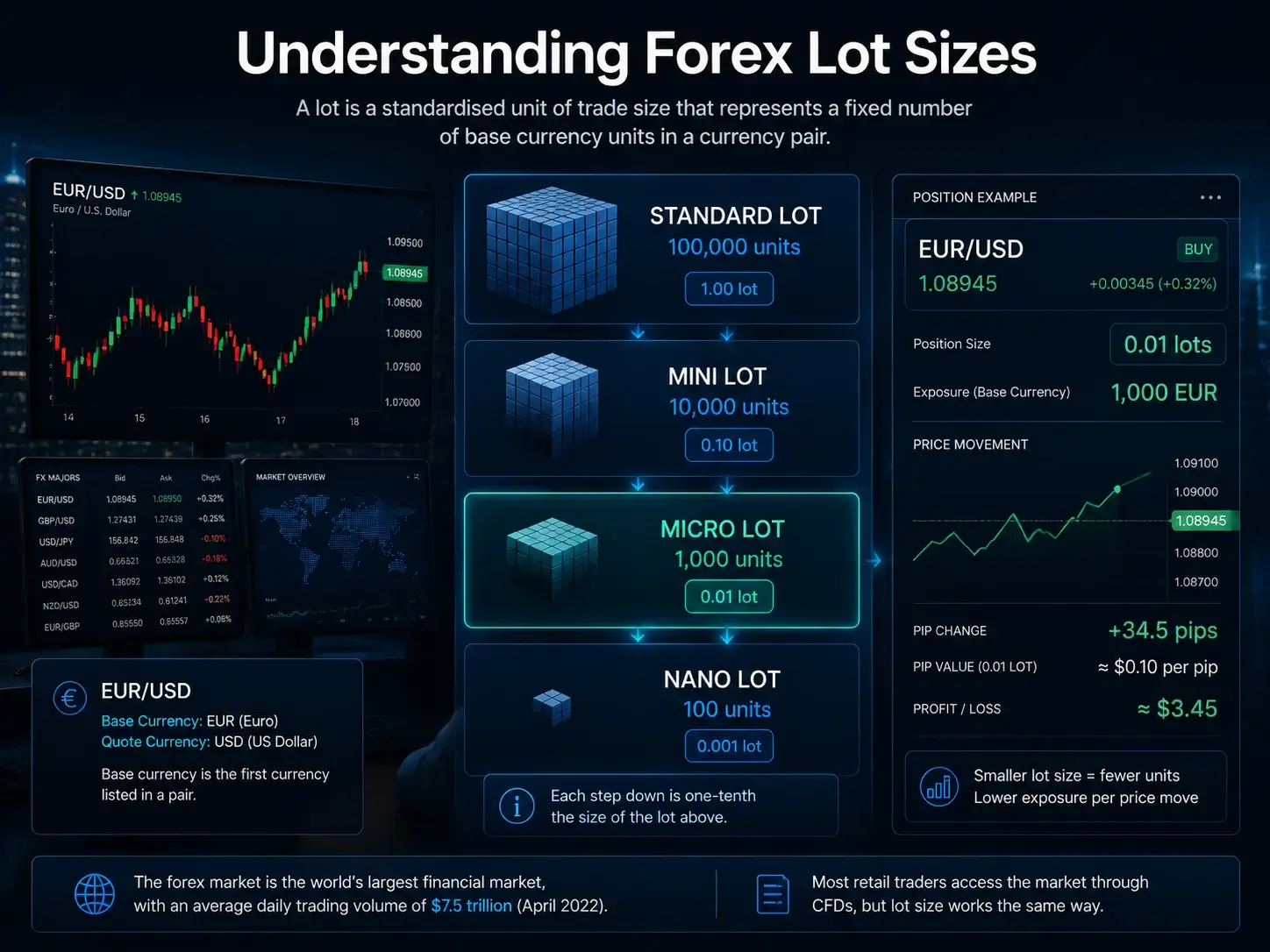
The scale is fixed and universal. One standard lot is 100,000 units of the base currency, and the mini, micro and nano lots below it are simply smaller fractions of that. Because a lot measures units rather than a fixed cash amount, its value in your account currency depends on the pair and the current exchange rate.
The underlying market is large – trading in global foreign exchange averaged $7.5 trillion per day in April 2022, according to the Bank for International Settlements [1]. Most retail traders access this market through forex CFDs – Contracts for Difference (CFD) – which allow speculation on the price movement of a currency pair without owning the underlying currency. When you open a CFD position, the lot size you select still sets your exposure in exactly the same way.
Whether you trade one nano lot or ten standard lots, the number of units – and therefore the money exposed to each price move – comes straight from the lot size.
The Four Forex Lot Sizes: Standard, Mini, Micro and Nano
Forex lots come in four standardised sizes. Each step down is one-tenth of the size above it, which is what lets traders scale exposure up or down in fixed, predictable amounts.
| Lot Size | Units of Base Currency | Size on Platform | Fraction of a Standard Lot |
|---|---|---|---|
| Standard | 100,000 | 1.00 | 1 |
| Mini | 10,000 | 0.10 | 1/10 |
| Micro | 1,000 | 0.01 | 1/100 |
| Nano | 100 | 0.001 | 1/1,000 |
Standard lot: 100,000 units of the base currency. The largest of the four, it is generally used with larger account balances, as even a small price move carries a sizeable cash value.
Mini lot: 10,000 units, one-tenth of a standard lot. It offers a middle ground for traders who want smaller exposure than a full lot while still seeing a meaningful cash move per pip.
Micro lot: 1,000 units, one-tenth of a mini lot and one-hundredth of a standard lot. It is often used by newer traders and by those testing a strategy on live markets, because the cash value of each pip stays small.
Nano lot: 100 units, one-tenth of a micro lot. It is the smallest size, though not every broker offers it, and its pip value is small enough that it is mainly used for testing rather than for meaningful returns.
The pattern is consistent all the way down: each smaller lot cuts both the units held and the cash value of every pip by a factor of ten.
How Much Is Each Lot Size Worth Per Pip?
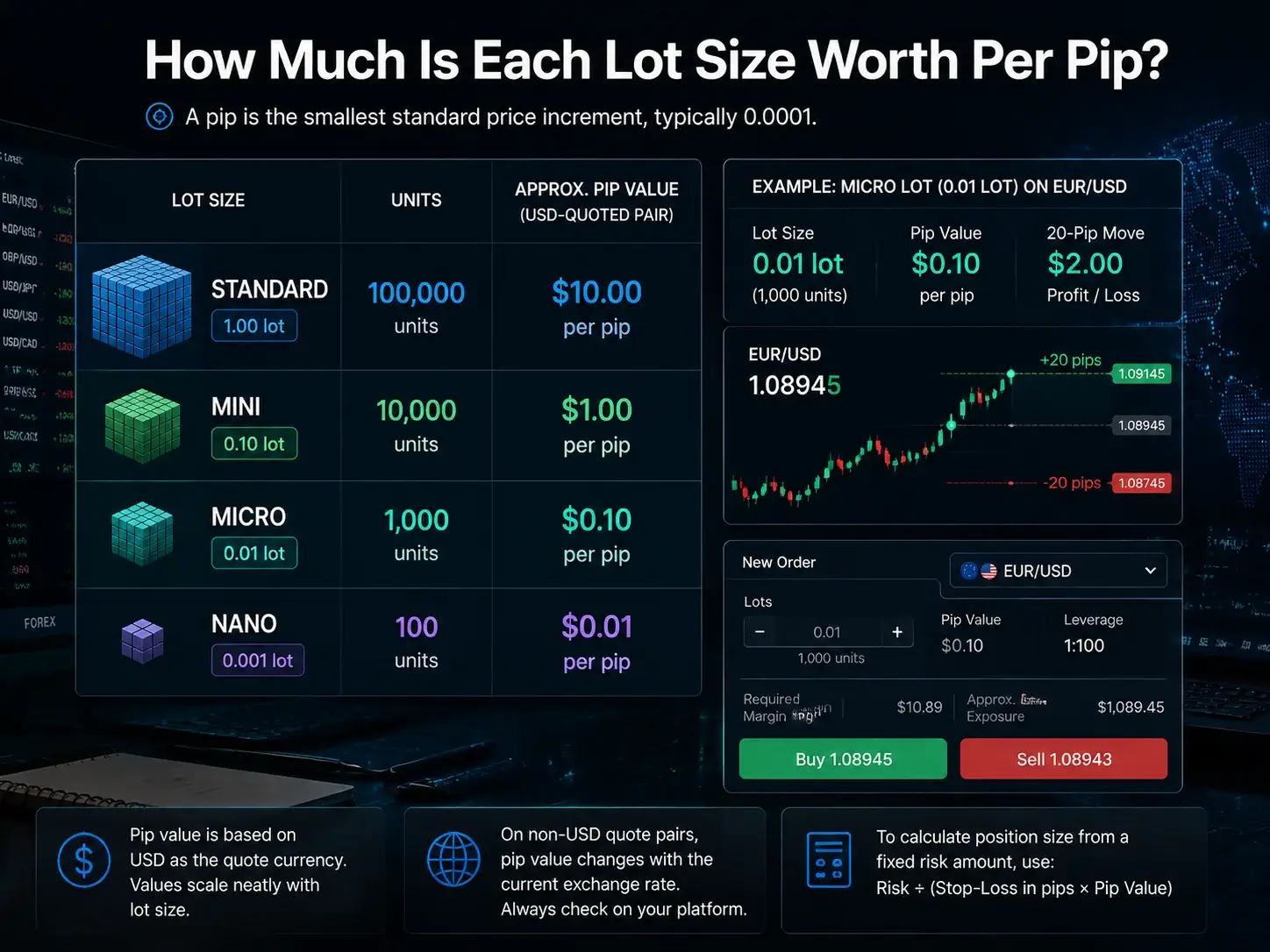
A pip is the smallest standard price increment a currency pair usually moves, most often the fourth decimal place – a change of 0.0001. What a pip is worth in cash depends on the lot size, and on a pair where the US dollar is the quote currency the figures scale neatly with the lot.
| Lot Size | Units | Approx. Pip Value (USD-Quoted Pair) |
|---|---|---|
| Standard | 100,000 | $10.00 |
| Mini | 10,000 | $1.00 |
| Micro | 1,000 | $0.10 |
| Nano | 100 | $0.01 |
So a 0.01 lot is one micro lot – 1,000 units – and on a USD-quoted pair each pip is worth about $0.10, which means a 20-pip move represents roughly $2 in profit or loss. This example is for illustrative purposes only and does not reflect actual trading results or client experiences.
These figures hold where the US dollar is the quote currency, as in EUR/USD or GBP/USD. Where it is not, the pip value shifts with the live exchange rate, so many traders confirm the exact figure on their platform before sizing a position. To work backwards from a fixed risk amount to a lot size, some traders calculate a position size around a fixed risk amount, using their stop-loss distance together with the pip value.
Micro Lots on Gold and Other CFDs
Lot sizes are not only a forex idea. Gold, indices and other markets are traded as CFDs too, but each instrument has its own contract size, so the same lot label can represent a different number of units from one market to the next.
Gold (XAUUSD) is a common example. One standard lot of gold is typically 100 troy ounces rather than 100,000 units, and gold is quoted to two decimal places instead of four. One pip on gold is a $0.01 price move, which works out to about $1 per pip on a standard lot, $0.10 on a mini lot and $0.01 on a micro lot of one ounce. The mechanics of counting gold pips differ enough from currency pairs that applying the standard forex pip formula to gold gives the wrong answer.
Whether a broker offers micro or fractional sizes on gold CFDs – and what the minimum trade size is – varies between providers. The reliable way to confirm it is to check the instrument’s contract specifications before sizing a position, rather than assuming the forex micro-lot figures carry over.
Choosing a Lot Size to Manage Risk
Because lot size fixes the cash value of each pip, it is the main lever a trader has over how much a single trade can gain or lose. A larger lot magnifies both, a smaller lot shrinks both. As a general reference point, some traders risk only a small percentage of account equity per trade, though the right amount varies by individual circumstances.
Lot size and leverage are separate settings that are easy to confuse. How leverage works determines the margin needed to open a position, while lot size sets the pip value. Leverage can magnify both gains and losses, so a small lot on a heavily leveraged account is not automatically low risk.
On Vantage, the Standard STP and Raw ECN accounts default to standard lots, but the MetaTrader 4 and MetaTrader 5 platforms allow trading down to 0.01 lots – one micro lot – so smaller position sizes are available without a separate account. For balances that are smaller still, a Cent account displays funds in cents rather than dollars, which makes very small trades easier to read. Availability of CFD products varies by jurisdiction.
None of this removes risk. A micro or nano lot lowers the cash value of each pip, but leverage still applies, and a small account can be depleted during sharp moves, widened spreads, or price gaps around news.
Smaller Lots Shrink the Pip, Not the Risk
The four lot sizes give traders a fixed scale for matching position size to account size and risk tolerance. A micro lot’s appeal is straightforward: at roughly $0.10 per pip on a USD-quoted pair, it keeps the cash impact of each move small while a trader builds experience on live markets. What it does not do is remove risk – pip value falls with lot size, but leverage, spreads and market gaps do not. Knowing what each lot is worth, in forex and on gold CFDs, is the starting point for sizing a trade around the risk a trader is prepared to take, not the profit they hope to make.
Frequently Asked Questions
What Is a Micro Lot in Forex?
A micro lot is a position size of 1,000 units of the base currency, shown as 0.01 lots on most trading platforms. It is one-tenth of a mini lot and one-hundredth of a standard lot. Because it is small, each pip is worth about $0.10 on a USD-quoted pair, which is why micro lots are often used by traders who want limited exposure per trade.
How Much Is 0.01 Lots Worth in Dollars?
A 0.01 lot is one micro lot, or 1,000 units of the base currency. On a pair where the US dollar is the quote currency, such as EUR/USD, each pip is worth roughly $0.10, so a 20-pip move is about $2 in profit or loss. On pairs where the US dollar is not the quote currency, the figure shifts with the current exchange rate, and most platforms display the exact pip value when you select the pair.
What Is the Smallest Lot Size in Forex?
The smallest widely available size is the micro lot at 1,000 units, or 0.01 lots. Some brokers also offer nano lots of 100 units (0.001 lots), which are smaller again but are not offered everywhere. Below the micro lot, availability depends entirely on the broker and platform.
What Is the Difference Between a Micro Lot and a Standard Lot?
A standard lot is 100,000 units of the base currency, while a micro lot is 1,000 units – one-hundredth of that size. The practical difference is pip value: on a USD-quoted pair, a standard lot is worth about $10 per pip against roughly $0.10 for a micro lot. A standard lot therefore exposes an account to around 100 times the cash movement per pip, which is why larger sizes are generally used with larger balances and stricter risk controls.
Do Brokers Offer Micro Lots on Gold?
Many brokers allow micro or fractional sizes on gold CFDs, but gold uses a different contract size from currency pairs – one standard lot is typically 100 troy ounces – so the units behind each lot are not the same. Whether a specific broker offers micro sizes on gold, and what the minimum trade size is, varies between providers. The reliable way to confirm it is to check the instrument’s contract specifications before opening a position.
What Does 300 Micro Lots Mean?
300 micro lots is 300 × 1,000 units, or 300,000 units of the base currency – the equivalent of 3 standard lots. A platform would usually show this as 3.00 lots. On a USD-quoted pair, that position would be worth around $30 per pip, so the same price move carries far more cash impact than a single micro lot.
RISK WARNING: CFDs are complex financial instruments and carry a high risk of losing money rapidly due to leverage. You should ensure you fully understand the risks involved and carefully consider whether you can afford to take the high risk of losing your money before trading.
Disclaimer: The information is provided for educational purposes only and doesn’t take into account your personal objectives, financial circumstances, or needs. It does not constitute investment advice. We encourage you to seek independent advice if necessary. The information has not been prepared in accordance with legal requirements designed to promote the independence of investment research. No representation or warranty is given as to the accuracy or completeness of any information contained within. This material may contain historical or past performance figures and should not be relied on. Furthermore estimates, forward-looking statements, and forecasts cannot be guaranteed. The information on this site and the products and services offered are not intended for distribution to any person in any country or jurisdiction where such distribution or use would be contrary to local law or regulation.
References
1. Bank for International Settlements – OTC foreign exchange turnover in April 2022. https://www.bis.org/statistics/rpfx22_fx.htm