


 Updated
Meta Platforms entered the second half of 2026 with two very different stories unfolding at once.
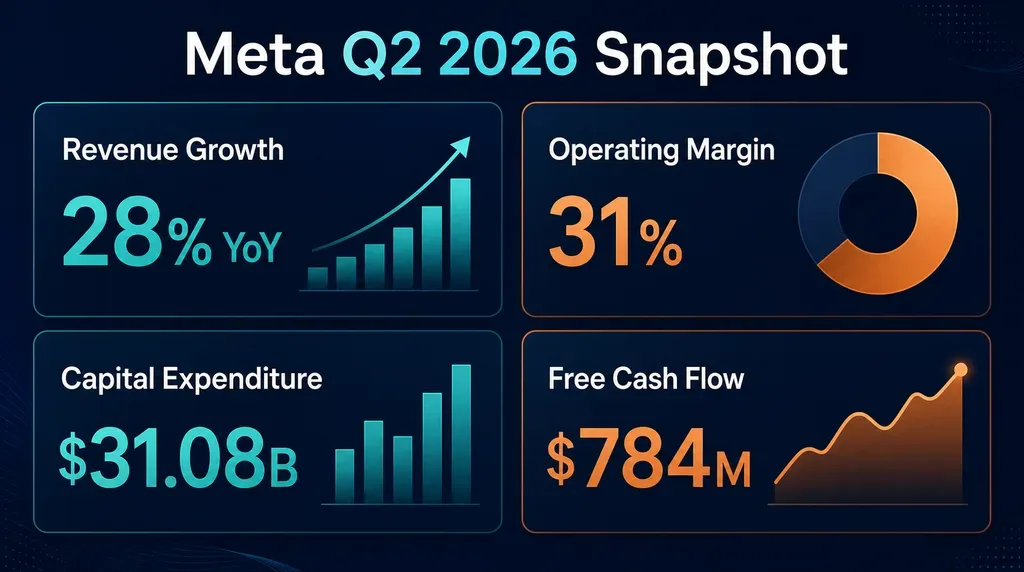
Its advertising engine remained strong, with second-quarter revenue growing 28% year over year (YoY). At the same time, higher research, infrastructure, legal, and restructuring costs reduced profit and free cash flow, prompting a sharp fall in the Meta stock price after earnings.
This Meta stock outlook examines its latest Q2 2026 results, the company’s AI investment cycle, analyst targets, dividend as well as the key drivers that may shape the shares. Forecasts and analyst targets are estimates rather than guarantees, and this article does not constitute investment advice.
Key Points
- Meta’s Q2 revenue rose 28% as ad impressions increased 14% and the average price per ad increased 12% YoY.
- Profitability moved in the opposite direction: Total costs increased 55%, operating margin fell from 43% to 31%, and quarterly free cash flow declined to $784 million.
- The central question for the Meta stock forecast in 2026 is whether the company can turn its large AI and infrastructure commitments into durable advertising, enterprise, and platform revenue.
Meta Stock at a Glance
| Metric | Latest available figure |
| Closing price | $539.03 on 30 July 2026 |
| Latest one-day move | -7.95% on 30 July 2026 |
| 52-week range | $520.26-$796.25 |
| Market capitalisation | Approximately $1.37 trillion |
| Latest reported quarter | Q2 2026, released 29 July 2026 |
| Q2 revenue | $60.80 billion, up 28% year over year |
| Q2 diluted EPS | $6.18, down 13% year over year |
| Quarterly dividend | $0.525 per Class A and Class B share at the latest declaration |
| Analyst consensus | 36 Buy, 5 Hold and 0 Sell ratings from 41 analysts |
| Average 12-month analyst target | $763.97, with a $580-$1,000 range |
| Next earnings date | Not officially announced as of 31 July 2026; expected in late October based on the normal reporting cycle |
Price, range, market-capitalisation and analyst-consensus data are timestamped to 30 July and can change quickly.123
What Is Meta Platforms, and Where Is META Stock Listed?
As many traders and investors would know, Meta Platforms is the technology company behind Facebook, Instagram, WhatsApp, Messenger, and Threads. These services sit within its Family of Apps segment. Meanwhile, the company’s Reality Labs segment contains its virtual- and augmented-reality hardware, software, and content businesses.
The business remains heavily dependent on advertising. In Q2 2026, advertising generated $59.36 billion of Meta’s $60.80 billion in total revenue. Family of Apps produced $60.37 billion in revenue, while Reality Labs generated $431 million and recorded a $4.62 billion operating loss. This concentration makes the strength of Meta’s advertising tools and user engagement particularly important to the outlook for Meta Platforms stock.
Other notable information:
- Meta’s Class A shares trade on the Nasdaq Global Select Market under the ticker META.
- Facebook priced its initial public offering at $38 per share and began trading under the symbol FB on 18 May 2012.
- The company later changed its corporate name to Meta Platforms, and the ticker changed from FB to META on 9 June 2022.45
Did you know that Meta uses a dual-class structure?
Publicly traded Class A shares carry one vote per share, while Class B shares carry greater voting power and are principally held by insiders. This structure is designed to give its founder and chief executive, Mark Zuckerberg, significant influence over the company’s strategic direction.
Meta Stock Price Chart and Price History
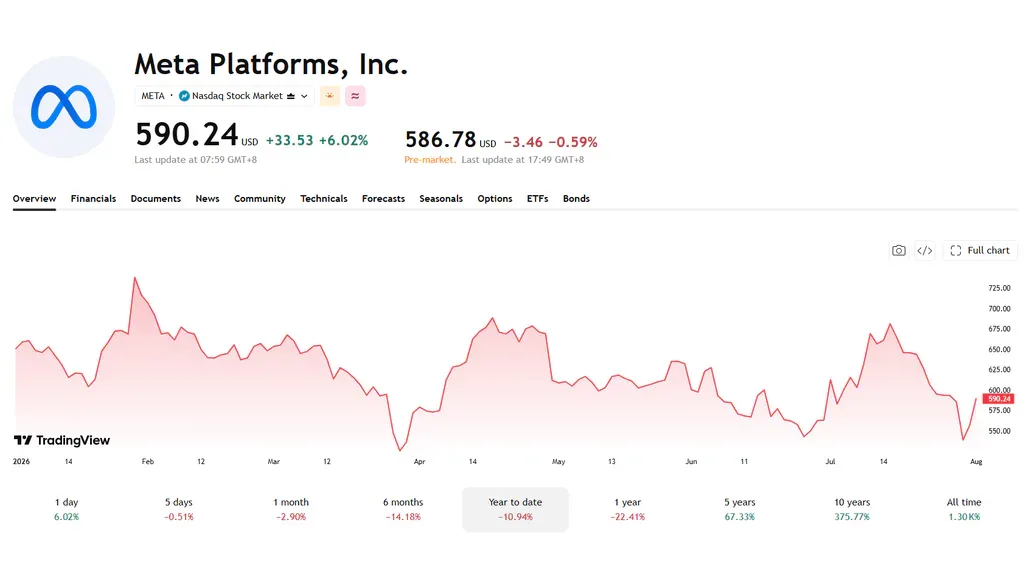
In 2026, recent Meta stock price history has shown substantial volatility.
META traded within a 52-week range of $520.26 to $796.25 and closed at $539.03 on 30 July 2026. That left the shares about 32% below the top of the range and only around 4% above the 52-week low.
The latest move seemed to be predominantly earnings-driven. The stock fell 7.95% in the first regular session after Meta released Q2 results, even as the Nasdaq Composite gained 2.8% that day. This divergence indicates that investors were responding to company-specific profitability and spending concerns rather than simply following the wider technology sector.16
Bear in mind that historical performance does not determine future returns. A chart can show how the market reacted to previous information, but it cannot by itself establish whether the next move will be higher or lower.
For a dated technical view rather than this evergreen overview, see Vantage’s 27 July 2026 Meta market analysis.
What Did Meta’s Q2 2026 Earnings Show?
The latest Meta stock earnings report showed robust top-line growth, but much weaker cash conversion and profitability.2
| Q2 Metric | 2026 | 2025 | YoY Change |
| Revenue | $60.80bn | $47.52bn | +28% |
| Advertising revenue | $59.36bn | $46.56bn | +27% |
| Costs and expenses | $42.03bn | $27.08bn | +55% |
| Operating income | $18.78bn | $20.44bn | -8% |
| Operating margin | 31% | 43% | -12 percentage points |
| Net income | $15.85bn | $18.34bn | -14% |
| Diluted EPS | $6.18 | $7.14 | -13% |
| Capital expenditure, including finance-lease principal | $31.08bn | $17.01bn | Approximately +83% |
| Free cash flow | $0.78bn | $8.55bn | -91% |
Advertising and Engagement Remained Strong
Meta reported 3.60 billion family daily active people for June 2026, up 3% from the prior year. Ad impressions across its Family of Apps grew 14%, while the average price per ad rose 12%. Together, those figures help explain why advertising revenue increased 27%.
This combination is important. More impressions can expand advertising inventory, while a higher average price per ad can indicate stronger demand, improved targeting or better monetisation. Both contributed to Meta’s revenue growth in the quarter.
Costs Grew Much Faster Than Revenue
In terms of Meta’s cost base, research and development expenses increased to $21.66 billion from $12.94 billion. General and administrative costs included $2.40 billion of charges related to legal proceedings, while Meta also recorded $1.18 billion in severance expenses that were connected with its May 2026 workforce reduction.
Some of those charges were unusual, but infrastructure expenditure was also substantial. Capital expenditure (aka capex), including principal payments on finance leases, reached $31.08 billion. That absorbed most of the $31.86 billion in cash generated from operations and reduced free cash flow to $784 million.
Guidance Kept the AI-Spending Debate Alive
Meta forecasted its Q3 2026 revenue of $61 billion to $64 billion. It also raised the lower end of its full-year expense outlook to $165–$169 billion and narrowed expected 2026 capex to $130–$145 billion, from $125–$145 billion previously.
Management still expects 2026 operating income to exceed the 2025 level. Therefore, the question is not simply whether Meta can grow; it’s whether its revenue and operating income can grow fast enough to justify the scale and timing of the investment programme.
Why Is Meta Stock Down After Earnings?
The answer to why Meta stock is down is because investors looked beyond the revenue beat and focused on four pressure points.
1. Meta’s EPS Did Not Meet Expectations
Firstly, Meta’s earnings per share (EPS) fell short of market expectations. In Q2 2026, Meta earned $6.18 per diluted share, compared with the roughly $7.19 consensus cited by FactSet. Revenue of $60.80 billion exceeded the corresponding $60.22 billion expectation, but the profit miss was more consequential for the immediate reaction.7
2. Operating Margin Shrunk Amidst Increased Costs
Secondly, Meta’s operating margin contracted sharply as its costs increased by 55%. Even allowing for legal and severance charges, the figures showed how quickly AI research and infrastructure spending is entering the income statement and cash-flow statement.
3. Free Cash Flow Has Declined YoY
Thirdly, Meta’s free cash flow fell 91% year over year. This does not mean the core advertising business stopped generating cash. Rather, much of the operating cash was reinvested in property, equipment, and finance leases. The market must decide whether those investments will generate adequate future returns.
4. Q3 Guidance Didn’t Smooth Out Spending Concerns
Last but not least, Meta’s Q3 revenue guidance did not fully offset spending concerns. Investors had already been debating whether Meta’s AI ambitions would translate into new revenue quickly enough. The Q2 report strengthened both sides of that debate: Advertising growth remained healthy, but the cost of building the next stage of the business was unusually high.
What Could Drive Meta Stock Next?
Five areas are likely to shape the next phase of the Meta stock outlook, although each would depend on execution and market conditions.
1. AI Improvements to Advertising
Meta already uses artificial intelligence (AI) to rank content, recommend Reels, improve ad targeting, and automate campaign creation. If these tools increase conversions for advertisers or improve engagement without proportionate cost growth, they may support both ad pricing and impression volume.
The Q2 figures offer evidence that the current advertising engine is working: Impressions rose 14% and price per ad rose 12%. The next question is whether that performance can sustain as comparisons become harder.
2. New Ways to Monetise WhatsApp, Threads & Business Messaging
Facebook and Instagram already operate at enormous scale, but WhatsApp and Threads may provide additional routes to revenue. Business messaging, click-to-message advertising, and paid commercial tools could diversify growth within the Family of Apps ecosystem.
Execution matters, however. New advertising or paid features must be introduced without weakening the user experience that makes the platforms valuable to advertisers in the first place.
3. Returns From AI Infrastructure
Meta’s infrastructure could support internal products and, potentially, enterprise-facing AI services. The opportunity is significant if the company can convert computing capacity, models, and business agents into external revenue. The risk is that large fixed investments arrive well before commercial demand.
Evidence of higher utilisation, incremental enterprise sales, or measurable improvements in ad monetisation would make the investment case easier to evaluate.
4. Greater Cost Discipline
Investors will watch whether legal and severance charges diminish and whether the growth rate of recurring expenses begins to moderate. Margin stabilisation could become a catalyst even if capex remains high, particularly if revenue continues to grow at a double-digit rate.
5. Q3 2026 Earnings Update
The next Meta stock Q3 earnings report should show whether revenue is tracking within the $61–$64 billion guidance range. It may also provide new information on capital expenditure, operating margin, legal exposure, and the commercial progress of Meta’s AI initiatives.
As of 31 July 2026, Meta has not officially announced its Q3 reporting date. Based on its usual reporting cycle, the release is likely to fall in late October, but investors should verify the date on Meta’s investor-events page before relying on it.8

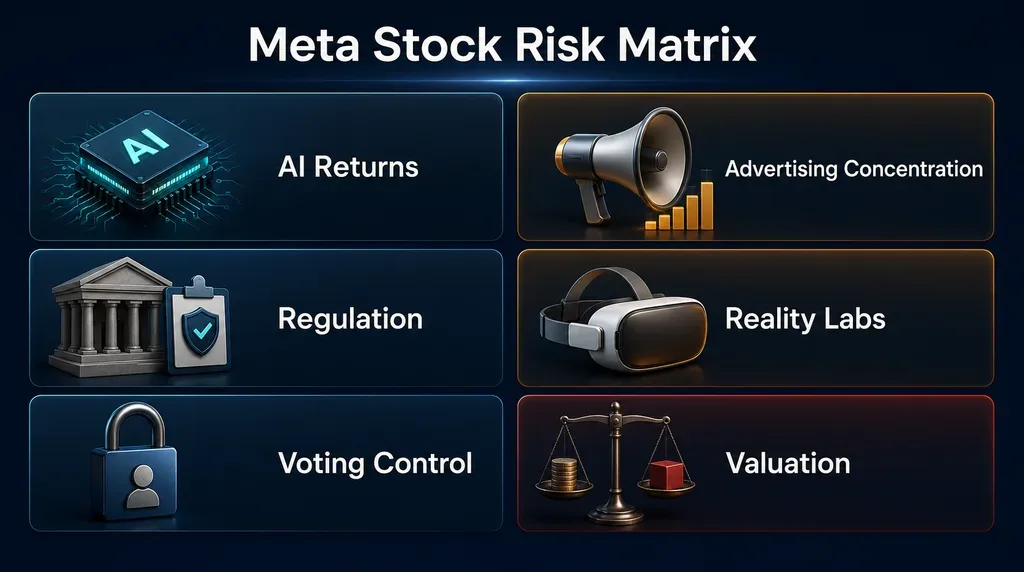
What Are the Biggest Risks to Meta Stock?
The same factors that could support growth can also create material uncertainty, so the following risks should be assessed alongside the potential catalysts.
1. AI Investment May Not Generate Sufficient Returns
Meta is committing substantial capital before the full revenue model for some AI investments is proven. If utilisation, advertising benefits, or enterprise demand disappoint, depreciation and operating expenses may continue to weigh on margins and free cash flow.
2. Advertising Remains Highly Concentrated
Per its latest earnings report, Meta’s advertising pillar represented approximately 98% of Q2 revenue. This creates sensitivity to economic cycles, advertiser demand, platform-policy changes, and competition for consumer attention.
3. Regulation and Litigation Can Create Material Costs
Meta said it continues to face scrutiny involving privacy, competition, content, youth safety, and advertising practices. The $2.40 billion Q2 legal charge and $1.18 billion of severance expenses demonstrated that such costs can move beyond headlines and affect reported earnings.
4. Reality Labs Continues to Lose Money
Reality Labs produced $431 million of quarterly revenue and a $4.62 billion operating loss. Its products may support a longer-term computing platform, but ongoing losses raise the hurdle for the Family of Apps business and Meta’s newer AI projects.
5. Dual-Class Control Limits Outside Shareholder Influence
Meta’s voting structure gives its founder substantial control. This can support long-term decision-making, but it also means public Class A shareholders have limited ability to redirect strategy if they disagree with the pace or scale of investment.
6. Valuation and Market Expectations Can Change Quickly
The stock’s 52-week range and post-earnings move show that expectations can reset quickly. A strong business result does not necessarily lead to a higher share price if the result falls short of what the market had already priced in.
What Is the Meta Stock Forecast and 12-Month Price Target?
As of 30 July 2026, 41 analysts had issued 36 Buy ratings and five Hold ratings for the Meta stock forecast, with no Sell ratings shown.
Their average 12-month target was $763.97, while individual targets ranged from $580 to $1,000. Compared with the $539.03 closing price, the average target represented approximately 42% potential upside, the low target about 8%, and the high target about 86%.1
Take note that these figures should not be treated as a promise of future performance. Analyst targets rely on assumptions about revenue, margins, capital spending, valuation multiples, and market conditions. They can be revised immediately after new information emerges, and the broad $580-$1,000 range continues to illustrate the uncertainty surrounding Meta’s investment cycle.
Hypothetical Bull Case
- Advertising growth remains strong as AI improves recommendation and conversion tools.
- WhatsApp, Threads, and business messaging generate new revenue streams.
- Infrastructure investment supports enterprise AI revenue or measurable improvements in Meta’s core products.
- Legal and severance costs normalise, allowing margins and free cash flow to recover.
Hypothetical Base Case
- Revenue continues to grow, but high capex and depreciation limit near-term margin expansion.
- The stock remains sensitive to quarterly guidance while investors wait for clearer evidence of returns on AI investment.
- Family of Apps finances the investment programme, while Reality Labs remains loss-making.
Hypothetical Bear Case
- AI and infrastructure costs rise faster than revenue for longer than expected.
- Advertising demand slows, user engagement weakens, or competitors like Bing and Google capture more consumer attention.
- Regulatory and legal costs remain elevated.
- The market assigns a lower valuation multiple because of weaker free-cash-flow conversion and execution uncertainty.
Can Meta Stock Reach $1,000?
Many people have wondered if Meta stock has the potential to reach $1,000.
Realistically speaking, a move from $539.03 to $1,000 would require an increase of approximately 86%. Such an outcome would likely require a combination of sustained revenue growth, visible returns from AI infrastructure, renewed margin expansion, and a supportive market valuation.
Bear in mind that a price target at the top of an analyst range is a scenario, not a guaranteed destination.
Is Meta a Good Stock to Buy in 2026?
Whether someone should buy Meta stock depends on their objectives, investment horizon, and tolerance for volatility. The Q2 report provides credible evidence for both an optimistic and a cautious view.
| Factors That May Support a Buy Rating | Factors That May Support a Sell Rating |
| 28% revenue growth | 55% increase in costs and expenses |
| Rising ad impressions and price per ad | Operating margin down from 43% to 31% |
| 3.60 billion family daily active people | Free cash flow down to $784 million |
| Large and profitable Family of Apps ecosystem | $130bn-$145bn full-year capex outlook |
| Potential for new AI, messaging, and enterprise revenue | Legal, regulatory, and execution risks |
| Dividend provides a modest cash return | Reality Labs continues to record large losses |
For readers asking “Is Meta a good stock to buy?”, the key issue is not simply whether Meta owns strong platforms—it does. The harder question is whether the future cash flows created by its investment programme will compensate for the cost and uncertainty involved.
Vantage Tip: A Meta stock buy or sell decision should be based on a process rather than a single earnings move or analyst rating.
Meta Stock: Buy or Sell Considerations
Potential buy and sell considerations for Meta stock include:
- Time horizon: A long-term view may be more tolerant of near-term capital spending, while a short-term position may be dominated by earnings volatility.
- Evidence threshold: Investors can monitor advertising growth, operating margin, capital expenditure, free cash flow, and new AI-related revenue.
- Valuation: A lower share price does not automatically mean a stock is inexpensive; expected earnings and cash flow matter as well.
- Concentration: Exposure to one company, sector, or earnings event can increase portfolio risk.
- Scenario risk: Bull, base, and bear cases should all be considered before a position is opened.
This framework is educational and does not provide a personal recommendation. Check out Vantage Markets’ guide to risk management techniques for assessing exposure and loss capacity.
Does Meta Stock Pay a Dividend?
Yes, Meta stock does pay dividends. In fact, the latest Meta stock dividend declared before this update was $0.525 per share of outstanding Class A and Class B common stock. It was payable on 25 June 2026 to shareholders of record at the close of business on 15 June.3
At the $539.03 closing price on 30 July, four quarterly payments at that rate would equal $2.10 per year and an indicative yield of about 0.39%. This is a backward-looking illustration, not a guarantee that future dividends will be declared at the same rate.
Take note that Meta only began paying a dividend in 2024. The current yield is modest, so the investment case remains more closely tied to earnings growth, cash generation, and valuation than to dividend income.
How Does Meta Compare With Alphabet?
Alphabet (NASDAQ: GOOGL) is a useful peer to Meta because both companies operate large digital-advertising ecosystems and are investing heavily in artificial intelligence.
| Q2 2026 comparison | Meta | Alphabet |
| Revenue | $60.80bn | $119.80bn |
| Revenue growth | 28% | 24% |
| Advertising revenue | $59.36bn | $81.63bn |
| Operating margin | 31% | 34% |
| Capital expenditure* | $30.12bn | $44.92bn |
| Free cash flow | $0.78bn | -$5.86bn |
*Purchases of property and equipment. Meta’s broader capital-expenditure figure, including finance-lease principal, was $31.08 billion.29
As seen from the table above, Meta grew faster than Alphabet in Q2 2026 but remained more dependent on advertising income. Alphabet had a larger advertising business and a more substantial source of diversification in Google Cloud, where revenue increased 82% to $24.77 billion. Both companies showed that AI infrastructure can place heavy pressure on near-term free cash flow.
This comparison is not a recommendation to choose one stock over the other. Their share prices also reflect different expectations, capital structures, and business mixes.
For broader cross-company context, see Vantage’s guide to the Magnificent Seven stocks.
How Can Traders Access Meta Through Share CFDs?
Vantage Markets’ clients can gain exposure to movements in the Meta platform stock price through share contracts for difference (CFDs). A share CFD allows a trader to take a long or short position on price movements without owning the underlying Meta share.
This flexibility also introduces material risk. CFDs use leverage, meaning both gains and losses can be magnified relative to the capital committed. Overnight financing, spreads or commissions, and the possibility of price gaps around earnings should be considered before trading. In addition, availability, costs, and product terms vary by entity and jurisdiction.
For readers who want to familiarise themselves with order entry and platform behaviour before live trading can consider opening a Vantage Demo Account. Meanwhile, experienced traders ready for their next market move can trade META via CFDs with a Vantage Live Account.
What Should Readers Watch Next?
Meta’s latest quarter demonstrated the continuing strength of its advertising platforms but also the cost of its AI ambitions. Revenue, ad impressions, and ad pricing all grew strongly, while profit, operating margin, and free cash flow declined.
That leaves the outlook balanced between two questions: How much value Meta’s infrastructure investment can create, and how long shareholders may need to wait for the returns to become visible. The next earnings report should offer further evidence through Q3 revenue, margins, capex, and any new AI-related revenue disclosures.
For further context on Meta’s share-price drivers, explore Vantage Markets’ Meta market analysis.
FAQs
How much is Meta stock?
For readers asking “How much is Meta stock?”, META closed at $539.03 on 30 July 2026. The price changes continuously during market and extended trading hours, so check a live source for the current stock price of Meta before making a decision.
What is the Meta platform stock price?
The Meta platform stock price refers to the market price of Meta Platforms’ Class A shares, listed on Nasdaq under META. The 30 July 2026 closing price was $539.03; live and CFD quotes can differ slightly because of timing, spreads and data sources.
Check out Meta’s live quote as a share CFD on Vantage Markets’ site.
When are Meta’s Q3 2026 earnings?
Meta had not confirmed its Q3 2026 reporting date as of 31 July. The release is expected in late October based on the company’s typical schedule, but the date should be verified through Meta Investor Relations page when announced.
When did Meta go public?
Facebook priced its IPO at $38 per share on 17 May 2012 and began trading on Nasdaq under FB on 18 May 2012.
Why did the ticker change from FB to META?
The ticker change followed Facebook’s corporate rebrand to Meta Platforms. Class A shares began trading under META on 9 June 2022.
Has Meta stock ever split?
No traditional stock split had taken place between Meta’s 2012 IPO and this update. A future split would require a company announcement; a split would change the number and nominal price of shares but would not by itself change the company’s total value.
How many Meta shares are outstanding?
Meta reported approximately 2.196 billion Class A shares outstanding as of 24 April 2026 in its Q1 Form 10-Q. Market-data providers may display approximately 2.20 billion shares because of rounding. Take note that this figure can change through employee equity issuance, conversions, or other corporate actions.10
RISK WARNING: CFDs are complex financial instruments and carry a high risk of losing money rapidly due to leverage. You should ensure you fully understand the risks involved and carefully consider whether you can afford to take the high risk of losing your money before trading.
Disclaimer: The information is provided for educational purposes only and doesn’t take into account your personal objectives, financial circumstances, or needs. It does not constitute investment advice. We encourage you to seek independent advice if necessary. The information has not been prepared in accordance with legal requirements designed to promote the independence of investment research. No representation or warranty is given as to the accuracy or completeness of any information contained within. This material may contain historical or past performance figures and should not be relied on. Furthermore estimates, forward-looking statements, and forecasts cannot be guaranteed. The information on this site and the products and services offered are not intended for distribution to any person in any country or jurisdiction where such distribution or use would be contrary to local law or regulation.
References
- “Meta Platforms Inc (META) Stock Price and Analyst Estimates – Google Finance”
https://www.google.com/finance/beta/quote/META:NASDAQ. Accessed on 31 July 2026. - “Meta Reports Second Quarter 2026 Results – Meta Investor Relations”
https://investor.atmeta.com/investor-news/press-release-details/2026/Meta-Reports-Second-Quarter-2026-Results/default.aspx. Accessed on 31 July 2026. - “Meta Announces Quarterly Cash Dividend – Meta Investor Relations”
https://investor.atmeta.com/investor-news/press-release-details/2026/Meta-Announces-Quarterly-Cash-Dividend-3f2eb420d/default.aspx. Accessed on 31 July 2026. - “Facebook Announces Pricing of Initial Public Offering – Meta Investor Relations”
https://investor.atmeta.com/investor-news/press-release-details/2012/Facebook-Announces-Pricing-of-Initial-Public-Offering/default.aspx. Accessed on 31 July 2026. - “Meta Platforms to Change Ticker Symbol to META – Nasdaq”
https://www.nasdaq.com/press-release/meta-platforms-inc.-to-change-ticker-symbol-to-meta-on-june-9-2022-05-31. Accessed on 31 July 2026. - “How Major US Stock Indexes Fared Thursday – Associated Press”
https://apnews.com/article/212b44c316056c9de10f90db562f3aed. Accessed on 31 July 2026. - “Meta Shares Drop as Q2 Profit Declines – Associated Press”
https://apnews.com/article/bcbc62dde6d2cac724e3b3385fcabeab. Accessed on 31 July 2026. - “Investor Events – Meta Investor Relations”
https://investor.atmeta.com/investor-events/default.aspx. Accessed on 31 July 2026. - “Alphabet Announces Second Quarter 2026 Results – Alphabet Investor Relations”
https://s206.q4cdn.com/479360582/files/doc_financials/2026/q2/2026q2-alphabet-earnings-release.pdf. Accessed on 31 July 2026. - “Meta Q1 2026 Form 10-Q – US Securities and Exchange Commission”
https://www.sec.gov/Archives/edgar/data/1326801/000162828026028526/meta-20260331.htm. Accessed on 31 July 2026.