


 Updated
Silver entered 2026 with strong investment interest, but its price has not moved in a straight line. In July, the London Bullion Market Association (LBMA) reported that silver fell 21.47% during the second quarter, even as longer-term supply concerns remained in focus.1
That combination helps explain why the answer to “Is silver a good investment?” largely depends on the individual investor. Silver may offer diversification and exposure to both precious-metal demand and industrial activity, but it can also be volatile, produces no income by itself, and can involve storage, product, currency, or leverage risks.
In this guide, we seek to build a case for investing in silver while highlighting its potential drawbacks. We’d also share what are some common ways to gain exposure and the questions to ask yourself before deciding to embark on silver investment.
Key Points
- Silver investment may support diversification because its price responds to macroeconomic factors such as precious-metal demand, industrial activity, interest-rate expectations, currency moves, and investor sentiment.
- The World Silver Survey 2026 describes 2026 as set for the sixth year of a sustained market deficit, although deficits do not guarantee higher prices.2
- Silver can be more volatile than gold because it is a smaller market with substantial industrial exposure, which can amplify both upward and downward moves.
- The instrument used for investing in silver matters because physical silver buillion, exchange-traded products, mining shares, futures, and contracts for difference (CFDs) have different costs, liquidity, ownership, and risk profiles. Take note that CFDs are leveraged trading products rather than silver investments.
What Makes Silver’s Investment Case Different?
Silver occupies two markets at once. It’s bought as a precious metal and store-of-value asset, but also used in electronics, solar technology, vehicles, medical applications, and other industrial processes. In fact, the Silver Institute reported that industrial demand reached a record 680.5 million ounces in 2024.3
This dual role can create a broader demand base, but it also makes silver sensitive to the economic cycle.
A slowdown in manufacturing or substitution away from silver can weaken demand, while growth in electrification, grid infrastructure, and data centres may support it. Supply is also unusual because much silver is produced as a by-product of mining other metals, so higher silver prices do not always produce an immediate increase in mine output.
As such, silver may be a potential diversifier for someone who understands commodity volatility and does not need income from the holding. It’s not automatically suitable for every investor, and a strong demand narrative doesn’t necessarily remove the possibility of sharp losses.
Is Silver a Good Investment Right Now?
Silver may be worth considering now if the objective is measured exposure to a precious and industrial metal over a suitable time horizon. However, “right now” is a market-timing question, and no current deficit, forecast, or recent price move can identify a risk-free entry point.
For now, the 2026 backdrop is mixed.
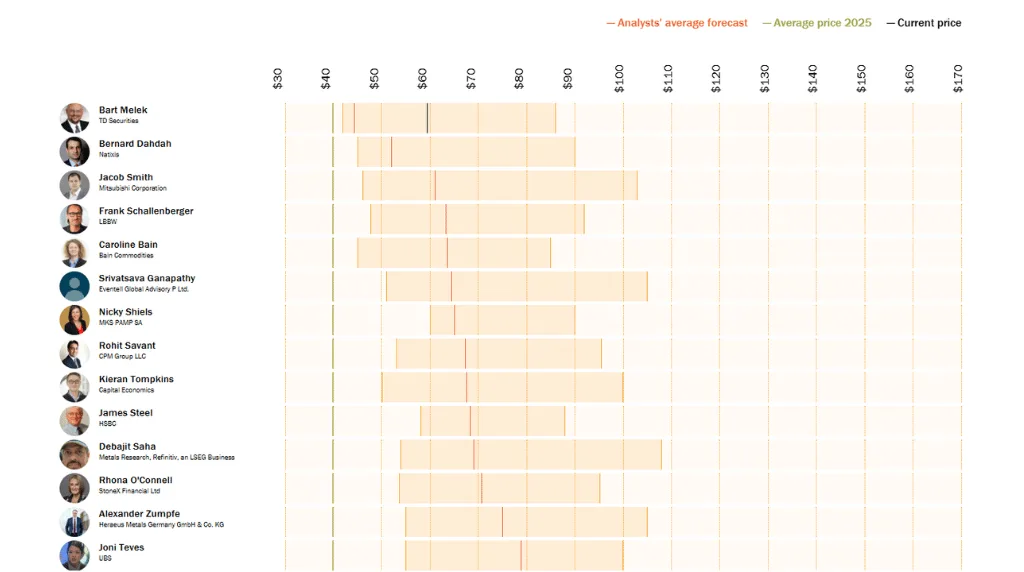
Image credit: LBMA
The Silver Institute expects the cumulative deficit since 2021 to remain substantial, while also noting that high prices can encourage recycling, thrifting, and substitution. Meanwhile, the LBMA’s 2026 analyst forecasts span wide ranges and repeatedly emphasise volatility, demonstrating that informed analysts can disagree materially about the path ahead.4
| Silver May Be More Suitable When: | Silver May Be Less Suitable When: |
| The holding is one part of a diversified portfolio. | The money may be needed at short notice. |
| The investor can tolerate substantial price swings. | Capital stability or predictable income is the priority. |
| The time horizon allows a market cycle to unfold. | The decision depends on a short-term price forecast. |
| The chosen product’s fees, storage, and liquidity are understood. | The investor does not understand leverage, tracking, or counterparty risk. |
For traders focused on shorter-term price movements, silver contracts for difference (CFDs) provide another way to access XAG/USD without owning physical silver. As leveraged instruments, silver CFDs allow long and short positions, but leverage can amplify both potential gains and losses. Spreads, overnight funding, execution, counterparty, and margin close-out risks also apply.
If you understand these risks, explore silver CFD trading by opening a Vantage Live Account.
What Are 5 Potential Benefits of Investing in Silver?
The following characteristics can strengthen the case for silver, but each benefit is conditional rather than guaranteed.
1. Portfolio Diversification
Silver may behave differently from shares and bonds during some market environments. Correlations change over time, so diversification should be assessed across the whole portfolio rather than assumed from a label.
2. Industrial Demand
Silver’s electrical and thermal conductivity supports demand across solar technology, electronics, vehicles, and infrastructure. This can act as a long-term demand channel beyond jewellery and investment buying.
3. Precious-Metal Demand
Some market participants seek silver during periods of inflation concern, geopolitical uncertainty, or reduced confidence in financial assets. That behaviour can support demand, but investors should note that silver has not acted as a reliable hedge in every period.
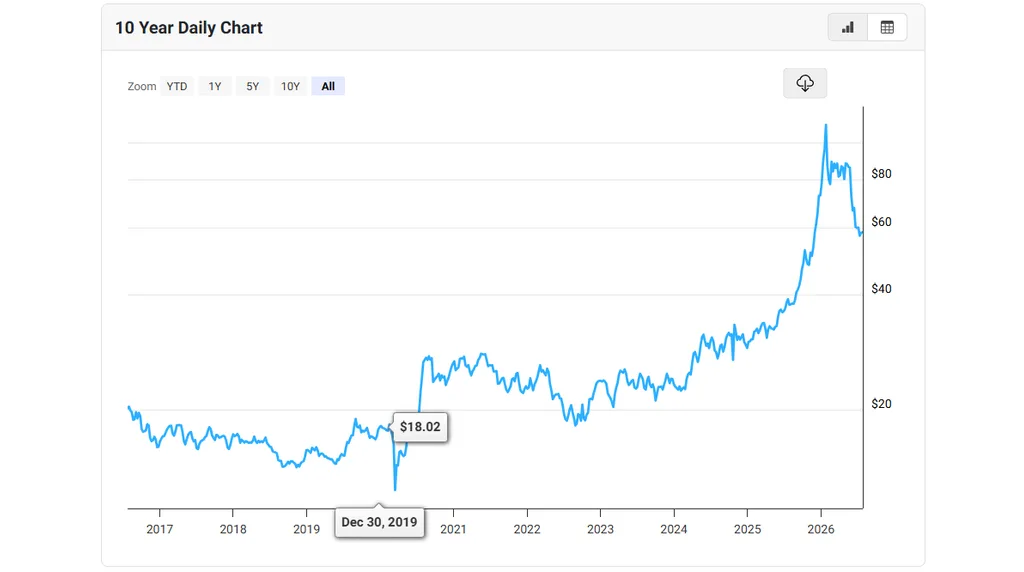
Image credit: Macrotrends
4. A Lower Unit Price Than Gold
A silver coin or small bar generally requires less capital than an equivalent gold product, which can make physical precious-metal purchases more divisible. Premiums and storage costs may nevertheless represent a larger percentage of a small purchase.
5. Multiple Routes to Exposure
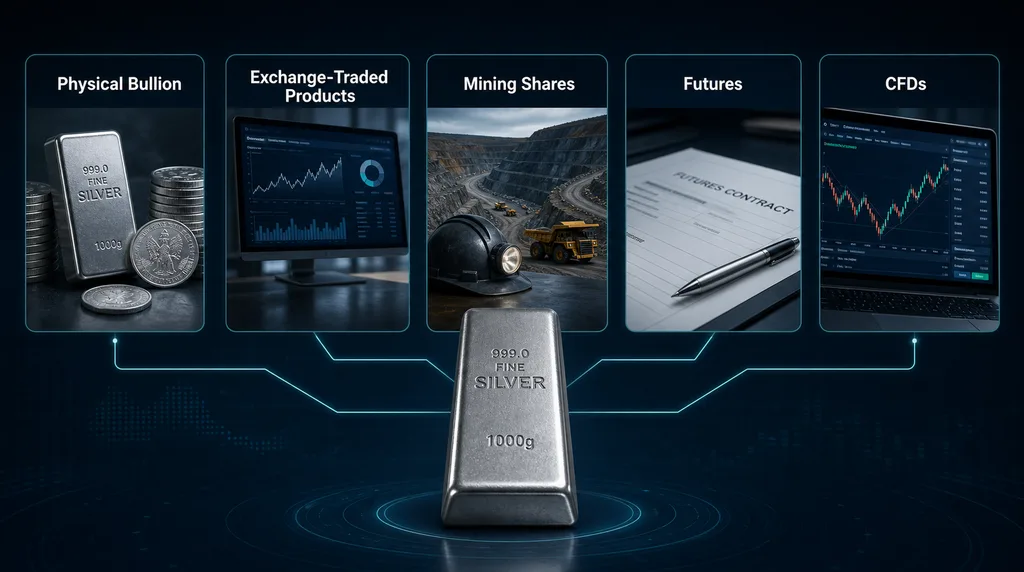
Investors and traders can use several silver instruments such as:
- Physical bullion
- Exchange-traded products
- Mining shares
- Futures
- Derivatives like contracts for difference (CFDs)
The variety improves access for silver investors, but every structure can introduce risks unrelated to the silver price.
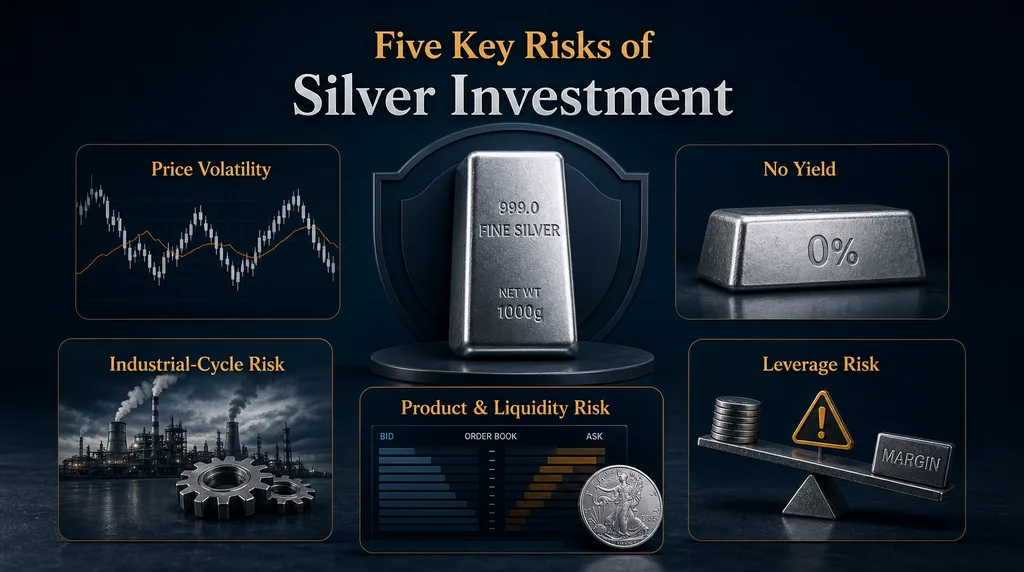
What Are 5 Key Risks of Investing in Silver?
Aside from the allure of investing in silver, it’s essential to note that silver investment comes with its fair share of risks as well.
1. High Price Volatility
Silver can move sharply in both directions. The LBMA’s second-quarter 2026 report has shown how quickly a strong market can reverse, so a recent rise should not be mistaken for a lower-risk trend.
2. No Yield From Physical Metal
Silver bars and coins do not pay interest or dividends. Any return depends on the sale price exceeding the purchase price plus dealer premiums, storage, insurance, taxes, and other costs.
3. Industrial-Cycle Risk
Manufacturing weakness can reduce silver demand, while high prices can accelerate thrifting or substitution. A structural deficit can narrow without mine supply rising if users reduce the amount of silver used in each product.
4. Product and Liquidity Risk
An exchange-traded product may carry fees and tracking differences, mining shares add company and equity-market risk, and physical products may sell at a discount to the retail purchase price.
5. Leverage Risk
Futures and CFDs can provide exposure with less upfront capital, but leverage magnifies both potential gains and potential losses. Positions may be closed at a loss if margin requirements are not met. CFDs are also more commonly used for short-term trading rather than for investment purposes in the medium to long term.
Why Silver Is a Bad Investment in the Eyes of Some Investors
Some investors regard silver as a poor investment because it combines commodity volatility with no contractual income stream.
Unlike bonds and profitable companies, physical silver pays no interest and dividend respectively. The owner therefore depends on a future buyer paying enough to cover the purchase price, dealer premium, storage, insurance, taxes, and resale spread.
The price history also challenges the idea that silver is automatically defensive. As seen from the LBMA’s statistics, silver prices have declined in the second quarter of 2026, despite supportive discussion around physical supply.
Critics commonly focus on the following weaknesses:
- Silver has an opportunity cost because cash and high-quality bonds may offer income, while bullion relies entirely on price appreciation.
- Its smaller market and historically higher volatility than gold can amplify sentiment-driven movements, forced selling, and speculative reversals.
- Industrial demand is economically sensitive because weaker manufacturing can affect consumption, while high prices can encourage users to reduce silver loadings or substitute other materials.
- A reported market deficit does not guarantee an immediate shortage or price rise because above-ground inventories, investor selling, recycling, and changing demand can bridge the gap.
- Physical silver is bulky relative to its value, so meaningful holdings may involve more storage space, handling, and insurance than gold.
- Retail premiums and resale discounts can create a substantial break-even hurdle, particularly for small bars, popular coins, and collectible products.
There is also a behavioural risk to consider.
A dramatic price target or shortage narrative can encourage concentration after a rapid rally, when the probability and impact of a correction may be greater. The World Silver Survey 2026 states that healthy physical investment demand after violent first-quarter price swings “cannot be taken for granted”.5
These objections do not prove that silver is always a bad investment. But they do show why the precious metal’s suitability depends on entry price, position size, time horizon, opportunity cost, product structure, and the role it’s expected to play alongside other assets in your portfolio.
How to Invest in Silver
The best way to invest in silver would depend on your individual objective(s), such as:
- Direct ownership
- Long-term market exposure
- Company exposure
- Hedging
- Short-term speculation
Each method introduces risks beyond the silver price itself, so investors should compare structure, costs, liquidity, and holding period before choosing.
| Instrument | How It Works | Main Considerations |
| Silver bullion (bars or coins) | Direct ownership of silver. | Dealer premium, authenticity, storage, insurance, and resale spread. |
| Silver exchange-traded product | Exchange-traded price exposure without home storage. | Fees, tracking, structure, liquidity, and jurisdiction-specific availability. |
| Silver-mining shares | Equity exposure to companies involved in silver production. | Company execution, mine, country, cost, and broad share-market risks. |
| Silver futures | Standardised exchange-traded derivative exposure. | Expiry, margin, leverage, and contract-size risk. |
| Silver CFDs | Over-the-counter exposure to price movements without owning silver. | Leverage, spread, overnight funding, margin, and counterparty risk. |
In the next few sections, we share what are the common ways for investing in silver.
1. Investing in Silver Stocks
Silver stocks usually refer to shares in miners, royalty and streaming companies, or businesses whose earnings have meaningful exposure to silver. Their prices can respond more strongly than bullion when higher silver prices expand operating margins, but the relationship is not one-for-one. That’s because one or more of the following factors can outweigh the metal price:
- Production volumes
- Ore grades
- Energy and labour costs
- Financing
- Management decisions
- Political conditions
- Environmental obligations
- Broader equity-market sentiment
Investors can research individual companies or use a diversified mining fund. In either case, useful checks include the proportion of revenue actually generated from silver, the cost of sustaining production, debt levels, reserve life, jurisdiction mix, hedging policy, and whether new projects require substantial capital. A company described as a silver miner may produce much of its revenue from gold, lead, zinc, or copper.
2. Investing in Silver ETFs
A silver exchange-traded fund (ETF) or other exchange-traded product can provide market exposure through a brokerage account without requiring home storage. Physically backed products generally hold allocated or unallocated bullion through custodians, while futures-based products obtain exposure through derivatives. Mining-share funds are different again because they hold company securities rather than silver.
Before investing, review the legal structure, underlying holdings, annual expense ratio, trading spread, fund size, average volume, custody arrangements, tracking difference, currency exposure, and any premium or discount to net asset value. A low headline fee does not eliminate trading costs or tracking differences, and tax treatment varies by jurisdiction.
3. Investing in Silver Coins
Silver coins offer direct, divisible ownership and may be easier to sell in small quantities than a large bar. Bullion coins derive most of their value from metal content, whereas numismatic coins (aka collectible silver coins) can carry additional value based on rarity, condition, provenance, and collector demand. Mixing these categories can make it harder to judge whether the purchase is an investment in silver or a collectible.
Silver investors typically compare the dealer’s selling price with the live metal value, then ask for the indicative buy-back price before purchasing. That difference reveals more about the break-even hurdle than the spot price alone. Authentication, secure storage, insurance, local taxes, and dealer reputation also matter; unsolicited offers and promises of guaranteed appreciation should be treated cautiously.
4. Investing Silver Futures
Silver futures are standardised exchange-traded contracts to buy or sell a specified quantity at a future date.
Commercial participants may use them to hedge price exposure, while traders may use them to express a directional view. Futures provide transparent exchange pricing and central clearing, but they require an understanding of contract size, tick value, expiry, margin, settlement, and the process of closing or rolling a position.
Margin is collateral rather than the full purchase price, so a relatively small cash deposit can control a much larger notional position. This makes potential gains and losses large relative to the capital committed, and margin requirements can rise during volatile conditions. Investors who only want unleveraged long-term exposure may find that futures introduce more operational complexity and risk than they need.
For investors and traders focused on shorter-term market moves, silver CFDs can be another alternative. CFDs provide leveraged exposure to XAG/USD without ownership or futures expiry, and they allow long or short positions. However, spreads, overnight funding, margin close-out, execution, and counterparty risk mean they should be assessed as active trading products rather than passive silver investments. The next section compares those differences in detail.
For more detail on short-term execution mechanics, read Vantage’s guides to trading silver through XAG/USD as well as trading gold and silver.
How Can You Invest in Silver?
The best way to invest in silver would depend on whether your objective is ownership, long-term market exposure, company exposure, hedging, and/or short-term speculation.
| Instrument | How It Works | Main Considerations |
| Physical bars or coins | Direct ownership of silver | Dealer premium, authenticity, storage, insurance, and resale spread. |
| Silver exchange-traded product | Exchange-traded price exposure without home storage | Fees, tracking, structure, liquidity, and jurisdiction-specific availability. |
| Silver-mining shares | Equity exposure to companies involved in silver production | Company execution, mine, country, cost, and broad share-market risks. |
| Silver futures | Standardised exchange-traded derivative exposure. | Expiry, margin, leverage, and contract-size risk. |
| Silver CFD | Over-the-counter exposure to price movements without owning silver. | Leverage, spread, overnight funding, margin, and counterparty risk. |
Note: A personal view on silver can still produce a poor outcome if fees, leverage, currency moves, tracking differences, or company-specific risks are overlooked.
What Are 4 Ways Silver CFDs Differ From Silver Investments?
Silver CFDs, like XAG/USD CFD, can provide an alternative way to take a view on silver prices, but they should not be confused with investing in the metal. For those who are new to the term, a contract for difference is an agreement with a broker to exchange the difference between a position’s opening and closing prices.
The trader does not own silver bars, coins, exchange-traded product units, or shares in a mining company. Instead, a trader can take a long position when anticipating a rise or a short position when anticipating a fall. Either position can lose money, and leverage can cause losses to build faster than the movement in the underlying silver price.
| Feature | Silver Investment | Silver CFD |
| Underlying ownership | Physical metal provides direct ownership; funds or shares provide ownership of units or securities. | No ownership of silver; the position is a contract with the CFD provider. |
| Typical objective | Longer-term allocation, diversification, or ownership. | Shorter-term trading, tactical positioning, or hedging. |
| Market direction | Most conventional holdings benefit primarily when their value rises. | Long and short positions are available, although both carry loss risk. |
| Upfront capital | Usually the full purchase price, unless separate borrowing or margin is used. | Margin provides a larger notional exposure than the cash deposited. |
| Ongoing costs | May include storage, insurance, fund fees, dealing costs, or custody. | May include spread, commission, and overnight funding (where applicable). |
| Main additional risks | Premiums, tracking, custody, liquidity, currency, or company risk. | Leverage, margin close-out, execution, overnight funding, and counterparty risk. |
| Holding-period fit | Can be better aligned with medium- or long-term exposure, depending on the product. | Funding costs and leverage can make prolonged holding more demanding and expensive. |
The following features explain why some market participants consider silver CFDs as an alternative to buying silver, as well as why they require a different risk framework.
1. No Physical Storage or Ownership
Because a CFD tracks price movement without transferring ownership of metal, the trader does not arrange delivery, authentication, insurance, or vault storage. This removes practical bullion costs, but it also means there is no physical asset to retain if the broker relationship ends or the position is closed.
2. Long and Short Market Access
A long CFD position gains value when the quoted silver price rises and loses value when it falls, subject to costs.
A short position works in the opposite direction. Short access can be useful for expressing a bearish view or managing another exposure, but losses on either side remain possible, and a short position can be particularly exposed to abrupt upward moves.
3. Leveraged Exposure
CFD margin is only a fraction of the position’s notional value. That can make market access more capital-efficient, but it does not make the underlying exposure smaller. Percentage gains and losses on the cash committed can be much larger than the silver price movement, and adverse moves may trigger margin close-out.
4. Trading and Funding Costs
The visible silver price is not the trader’s only cost. The bid-ask spread affects entry and exit, commissions may apply depending on the account, and positions held beyond the daily cut-off may incur overnight funding.
Spreads can widen during volatile periods, major economic announcements, thin liquidity, or market transitions, which can affect execution.
What Could a Leveraged Silver CFD Move Look Like?
Assume a trader deposits $1,000 as margin for a hypothetical $10,000 XAG/USD CFD position with a leverage of 1:10. If silver moves 3% against the position, the market loss would be approximately $300 before spread, commission, overnight funding, slippage, or currency effects. That’s a significant 30% loss relative to the $1,000 margin, even though the silver price itself moved only 3%.
| Illustrative Input | Calculation | Result |
| Notional CFD exposure | — | $10,000 |
| Margin deposited | — | $1,000 |
| Adverse silver move | $10,000 × -3% | -$300 |
| Loss relative to margin | -$300 ÷ $1,000 | -30% |
A favourable 3% move would produce an equivalent $300 gross movement in the other direction, but that symmetry should not be read as an expected return. Real results depend on execution, costs, position adjustments, and whether the trade remains open. Losses can exceed the amount initially expected where market gaps, volatility, or account conditions prevent an exit at the intended price.
Before trading silver CFDs, a trader can use a Vantage Demo Account to practise order placement, position sizing, stop-loss use, and margin monitoring with virtual funds. Take note that demo trading cannot fully reproduce live liquidity, slippage, funding, or the behavioural pressure of real losses.
Silver Investment vs. Silver CFD Trading: Which Is More Suitable For You?
The decision to go with silver investments or silver CFDs should begin with defining your objective. Someone seeking direct ownership or a long-term portfolio allocation may find physical silver or an unleveraged exchange-traded product more aligned with their goals. Someone seeking a shorter-term view, the ability to trade falling prices, or a tactical hedge may consider a silver CFD, provided that they fully understand the leverage and funding risks involved.
How to choose a silver instrument that matches your individual goals and risk tolerance:
- Choose the investment route when holding silver itself, avoiding daily funding, or maintaining a longer time horizon is central to the objective.
- Consider an exchange-traded route when operational simplicity and market liquidity matter more than taking delivery of the metal.
- Consider a CFD only when the objective is active price exposure and the trader can monitor leverage, margin, execution, and ongoing costs.
- Avoid treating a CFD as a passive silver allocation because its funding and leverage profile can make it behave very differently from an unleveraged holding.
How Much Difference Can Position Size Make?
Consider a hypothetical $10,000 portfolio. If 5% is allocated to unleveraged silver exposure, the starting silver position is $500. A 15% fall in silver would reduce that position by $75, equivalent to 0.75% of the original portfolio, before fees and movements in the other holdings.
| Assumption | Calculation | Illustrative Result |
| Portfolio value | — | $10,000 |
| Silver allocation | $10,000 × 5% | $500 |
| Silver price move | $500 × -15% | -$75 |
| Portfolio-level effect | -$75 ÷ $10,000 | -0.75% |
The same market move can have a much larger effect when leverage is used.
Is Silver Better Than Gold?
Contrary to public debate, neither metal is universally better.
Gold is typically the larger, more established monetary and reserve asset, while silver has greater industrial sensitivity and often higher volatility. The choice therefore depends on whether the priority is relative stability within precious metals, industrial upside, affordability of physical units, or tolerance for larger swings.
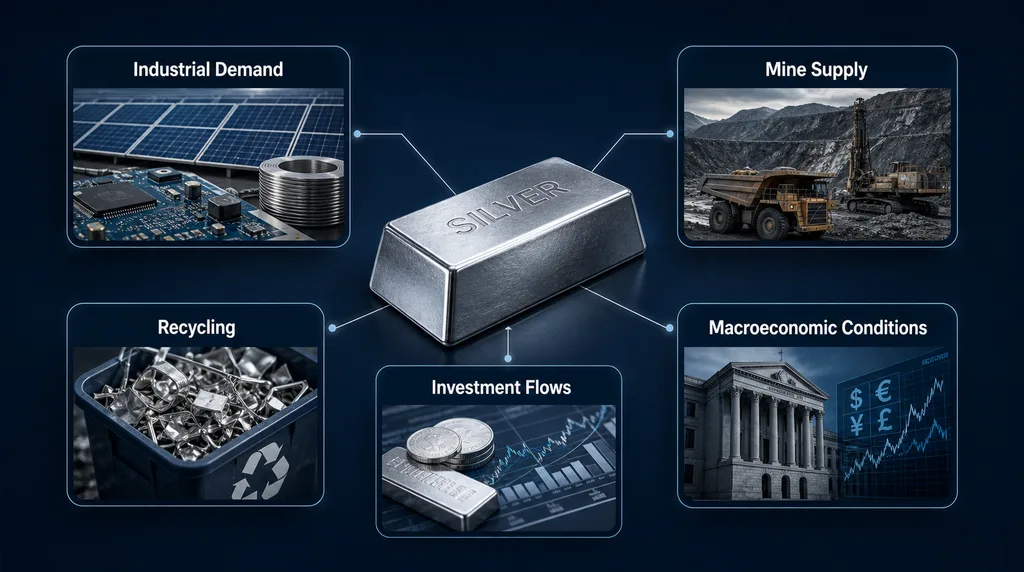
What Could Affect Silver Over the Long Term?
No reliable method can determine what silver will be worth in five or 10 years. A long-term assessment is more strategically built around observable drivers rather than a single target price.
- Industrial demand may be influenced by solar installations, vehicle production, electronics, grid investment, data-centre infrastructure, and the pace of material substitution.
- Mine supply may respond slowly because much silver is produced alongside lead, zinc, copper, and gold rather than from primary silver mines.
- Recycling may increase when prices rise enough to encourage the return of jewellery, silverware, industrial scrap, and investment products to the market.
- Investment flows may react to real interest rates, the US dollar, inflation expectations, geopolitical risk, and momentum in precious-metal markets.
- Product costs, taxes, currency exposure, and local rules may determine an investor’s realised result even when the global silver price rises.
When Might Silver Fit a Broader Plan?
Silver may fit an investor’s broader plan when its role is defined in advance, the position is sized so that a large decline is tolerable, and the selected product matches the intended holding period. It may be less appropriate when the objective is predictable income, short-term capital security, or a concentrated bet based on a forecast.
If your aim is to understand short-term price behaviour rather than own the underlying metal, you can explore silver CFD trading with a Vantage Live Account, provided that you are fully aware CFDs carry a high risk of rapid losses due to leverage.
FAQs
Is silver a good investment for the long term?
For some investors, silver might have a place in a long-term portfolio because it combines precious-metal and industrial demand. However, it can experience long periods of weakness and sharp drawdowns, and silver investors should note that physical silver produces no income.
Suitability would depend on the investor’s objectives, time horizon, product choice, and tolerance for volatility.
Is silver a good investment in 2026?
The case for silver investment in 2026 includes a multi-year market deficit and continued industrial relevance, but also high prices, demand substitution, recycling, and pronounced volatility. These factors can support or restrain the market at different times, and the year alone does not make silver suitable for every investor.
Is it a good time to buy silver?
There is no risk-free time to buy silver, and short-term prices are difficult to forecast. Staggering purchases may reduce dependence on one entry price, but it cannot prevent losses. Costs, holding period, and position size should be considered alongside the market outlook.
Are silver coins a good investment?
Silver coins provide direct ownership and may appeal to people who value portability and divisibility. Their dealer premiums, storage needs, authenticity checks, insurance costs, and resale spreads can reduce returns. Collectible coins may also be driven by rarity and physical condition rather than the silver price alone.
Are silver CFDs an investment in silver?
No. Silver CFDs provide exposure to price movements without transferring ownership of silver. They are leveraged trading products with spread, funding, execution, margin, and counterparty risks, so they should be evaluated separately from physical metal or unleveraged silver funds.
Can silver reach $100 an ounce?
Silver can move substantially, but no specific future price can be guaranteed. The LBMA’s wide analyst forecast ranges illustrate uncertainty rather than a dependable target. Industrial demand, investor flows, interest rates, currency moves, supply, recycling, and market sentiment would all influence any such move.
What is the best way to invest in silver?
There is no single ‘best’ way to invest in silver. Physical silver typically prioritises ownership, exchange-traded products may simplify market exposure, mining shares can add company risk, and futures or CFDs introduce derivative and leverage risks. The most appropriate structure depends on the individual investor’s objective, jurisdiction, experience, costs, and risk tolerance.
RISK WARNING: CFDs are complex financial instruments and carry a high risk of losing money rapidly due to leverage. You should ensure you fully understand the risks involved and carefully consider whether you can afford to take the high risk of losing your money before trading.
Disclaimer: The information is provided for educational purposes only and doesn’t take into account your personal objectives, financial circumstances, or needs. It does not constitute investment advice. We encourage you to seek independent advice if necessary. The information has not been prepared in accordance with legal requirements designed to promote the independence of investment research. No representation or warranty is given as to the accuracy or completeness of any information contained within. This material may contain historical or past performance figures and should not be relied on. Furthermore estimates, forward-looking statements, and forecasts cannot be guaranteed. The information on this site and the products and services offered are not intended for distribution to any person in any country or jurisdiction where such distribution or use would be contrary to local law or regulation.
References
- “LBMA Precious Metals Market Report: Q2 2026 – LBMA” https://www.lbma.org.uk/articles/lbma-precious-metals-market-report-q2-2026. Accessed on 27 July 2026.
- “World Silver Survey 2026 – The Silver Institute” https://silverinstitute.org/wp-content/uploads/2026/04/World-Silver-Survey-2026.pdf. Accessed on 27 July 2026.
- “Silver Industrial Demand Reached a Record 680.5 Moz in 2024 – The Silver Institute” https://silverinstitute.org/silver-industrial-demand-reached-a-record-680-5-moz-in-2024/. Accessed on 27 July 2026.
- “Analysts’ Forecasts 2026 – LBMA” https://www.lbma.org.uk/forecast-survey-2026/analysts-forecasts. Accessed on 27 July 2026.
- “World Silver Survey – The Silver Institute” https://silverinstitute.org/wp-content/uploads/2026/04/World-Silver-Survey-2026.pdf. Accessed on 28 July 2026.