


 Updated
Trading forex as a beginner comes down to a repeatable sequence: choose a regulated broker and open an account, decide how much to start with, choose a currency pair, read the price on your platform, select an order type, size your position, set your risk controls, and close it when your plan says so.
Forex is traded in pairs — you are always buying one currency while selling another — and most retail traders access these price movements through Contracts for Difference (CFDs) rather than by owning the underlying currencies.
The steps below follow that order, with plain examples and the mechanics that matter before any real money is involved. Because CFDs are leveraged, the same moves that can work in your favour can just as easily work against you, so risk control runs through every step rather than sitting at the end.
Key Points
- Forex is traded in currency pairs, and most beginners access it through forex CFDs, which track a pair’s price movement without requiring ownership of the underlying currencies.
- The workflow is the same on every trade: choose a regulated broker, decide how much to start with, choose a pair, read the platform, pick an order type, size the position, set stop-loss and take-profit levels, then open and later close the position.
- Leverage magnifies both gains and losses, so deciding how much of your account you are willing to risk on a single trade matters as much as choosing the right pair or order type.
What You Are Actually Trading
When you trade forex, you are speculating on the exchange rate between two currencies — a currency pair such as EUR/USD or GBP/USD. The first currency is the base, the second is the quote, and the price shows how much of the quote currency it takes to buy one unit of the base. If EUR/USD trades at 1.0850, one euro is worth 1.0850 US dollars.
Most retail traders do not exchange the actual currencies. Instead, they trade a Contract for Difference (CFD), an agreement to exchange the difference in a pair’s price between the point a position is opened and the point it is closed. A forex CFD tracks the pair’s price movement and lets you take a position in either direction, and it uses leverage, which magnifies both gains and losses and can result in significant losses.
Retail traders typically access forex through this spot-based CFD mechanic, but professional and institutional markets also use forward contracts, futures, and options on currency pairs. A forward locks in an exchange rate for settlement on a future date, a futures contract standardises that same idea on an exchange, and a currency option gives the buyer the right, but not the obligation, to exchange at a set rate. Those markets exist mainly for hedging and institutional use — the spot-based CFD mechanics covered in this guide are what a beginner-friendly account actually needs.
The market itself is large and continuous. Global foreign exchange turnover averaged US$9.6 trillion per day in April 2025, up 28% from three years earlier, according to the Bank for International Settlements [1].
It trades 24 hours a day, five days a week, moving between financial centres as different sessions open. That liquidity is part of why spreads on major pairs can be narrow. At the time of writing, EUR/USD CFD spreads on Vantage’s Raw ECN account can start from 0.0 pips, with a commission charged per standard lot per side. Refer to the latest product specifications for current pricing.
Step 1 — Choose a Regulated Broker and Open an Account
A regulated broker is a firm licensed by at least one recognised financial authority — such as the Financial Sector Conduct Authority (FSCA) in South Africa, the Australian Securities and Investments Commission (ASIC), or the Vanuatu Financial Services Commission (VFSC) — to hold client funds and facilitate CFD trading. Before opening an account anywhere, check the broker’s licence number against the regulator’s own public register rather than relying on the broker’s own website, since register listings confirm the licence is current and matches the entity you are dealing with.
Regulatory strength varies. Tier 1 regulators typically require brokers to keep client funds in segregated accounts, separate from the firm’s own operating capital, and may mandate additional protections such as negative balance protection, which prevents a client’s account from falling below zero after a sharp market move. Brokers regulated in other jurisdictions can offer different account terms, leverage caps, and investor protections, so it is worth reading the specific terms attached to the entity you would be opening an account with, rather than assuming all regulated brokers offer identical protections.
Beyond regulation, three things are worth comparing across brokers: the spread and commission structure on the pairs you intend to trade, the account types on offer, and which platforms the broker supports. Account types usually list minimum deposits, spread versus commission trade-offs, and platform access side by side, which makes comparing costs easier before committing any funds.
Fee transparency is worth checking directly on the broker’s pricing page: spreads quoted “from” a certain level are typically the tightest available under specific conditions, not a guaranteed rate on every trade, and commission-based accounts add a separate per-lot charge on top of the spread. Comparing the all-in cost — spread plus commission — on the pair you plan to trade most gives a more accurate picture than comparing headline spread numbers alone.
Opening an account with a regulated broker generally follows three steps: submitting an application with personal and financial details, completing identity verification — known as Know Your Customer (KYC) checks — by uploading a form of photo identification and proof of address, and funding the account through a supported payment method. Verification can take anywhere from a few minutes to a couple of business days depending on the broker and the documents supplied.
Most brokers also offer a demo account alongside the live one, letting you test the platform with simulated funds before deciding whether to fund a live account — a step covered in more detail later in this guide.
Step 2 — Decide How Much to Start With
There is no universal minimum to start trading forex — it depends on the broker, the account type, and the position sizes you intend to trade. What the deposit needs to support is the position size on your chosen lot type, not a fixed entry fee.
Micro lots (1,000 units) keep each pip worth around US$0.10 on EUR/USD, which means a US$100 account trading micro lots can absorb a run of small losses without being wiped out on a single move, though the position sizes available at that balance are correspondingly small. A US$1,000 account trading mini lots (10,000 units, roughly US$1 per pip) has more room to size positions while still keeping any single trade to a modest fraction of the account.
A practical way to frame the decision: work backwards from how much of the account you are willing to risk on one trade — many traders reference a 1–2% cap, covered in more detail under risk controls below — and choose a starting balance and lot size where that percentage still buys a workable stop distance. An account too small for the lot size being traded forces either an oversized risk per trade or a stop placed so tight it gets triggered by ordinary price noise rather than an actual change in the trade’s premise.
This is general information only and does not constitute financial advice. Individual circumstances vary.
Step 3 — Choose Your First Currency Pair
The pair you trade shapes how much it moves, how tightly it is priced, and how much news you will need to follow. Beginners often start with the major currency pairs — combinations of the US dollar with other heavily traded currencies, such as EUR/USD, USD/JPY and GBP/USD.
Majors tend to have the highest liquidity and the narrowest spreads, which usually means lower entry costs and fewer sudden price gaps than minor or exotic pairs.
Liquidity affects cost: the more actively a pair trades, the tighter its spread tends to be, so a beginner focused on keeping costs low often stays with one or two majors rather than spreading attention thinly.
Volatility affects risk: a pair that moves 100 pips in a session offers more room for both profit and loss than one that moves 30, so the pair should match how much price movement you are prepared to sit through.
Rather than watching dozens of pairs, many newer traders follow a single major closely enough to recognise how it behaves around economic releases and session changes. Depth on one pair is generally more useful early on than shallow coverage of many.
Step 4 — Understand Your Trading Platform
Before placing a trade, it helps to know what you are looking at. A forex trading platform such as MetaTrader 5 shows each pair with two prices: the bid, the price you can sell at, and the ask, the price you can buy at. The gap between them is the spread. A price chart plots the pair’s movement over your chosen timeframe, while the order ticket, the window where you enter a trade, is where you set direction, size, and any stop or limit levels.
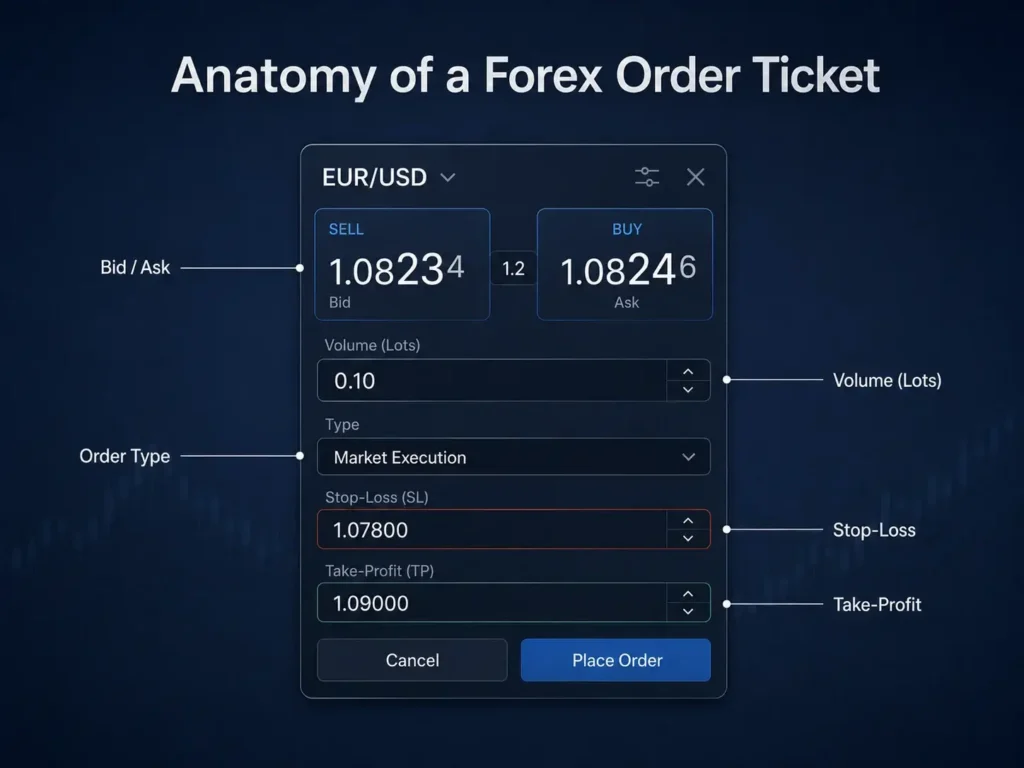
Three areas are worth finding first. The market watch lists the pairs available and their live bid and ask prices. The chart lets you switch timeframes, from one-minute candles up to daily or weekly views, so you can see the trend you are trading into. The order ticket confirms the pair, the volume in lots, the order type, and the estimated margin required before you commit.
Spending time in a demo account, where the platform behaves identically but the funds are simulated, is a common way to get familiar with placing and closing orders without risking capital — the next section covers this in more depth. The mechanics you practise there are the same ones you use live.
Step 5 — Place Your First Trade
With a pair chosen and the platform familiar, placing a trade breaks into three decisions: which order type to use, whether to buy or sell, and how large the position should be. Each one affects your risk before the trade is even open.
Order Types: Market, Limit and Stop
An order type is the instruction that tells the platform when and at what price to execute your trade. The three you will use most are set out below.
| Order type | What it does | Often used when |
|---|---|---|
| Market order | Opens the position immediately at the current price | You want to enter now at the prevailing price |
| Limit order | Enters only at a set price more favourable than the current market | You want a better entry than the price on offer now |
| Stop order | Triggers an entry once the price passes a set level | You want to join a move once it is already underway |
Beginners frequently start with market orders for their simplicity, then add limit and stop orders as they plan entries more precisely. The full range of order types a platform supports gives finer control over exactly where a position opens.
Going Long vs Going Short
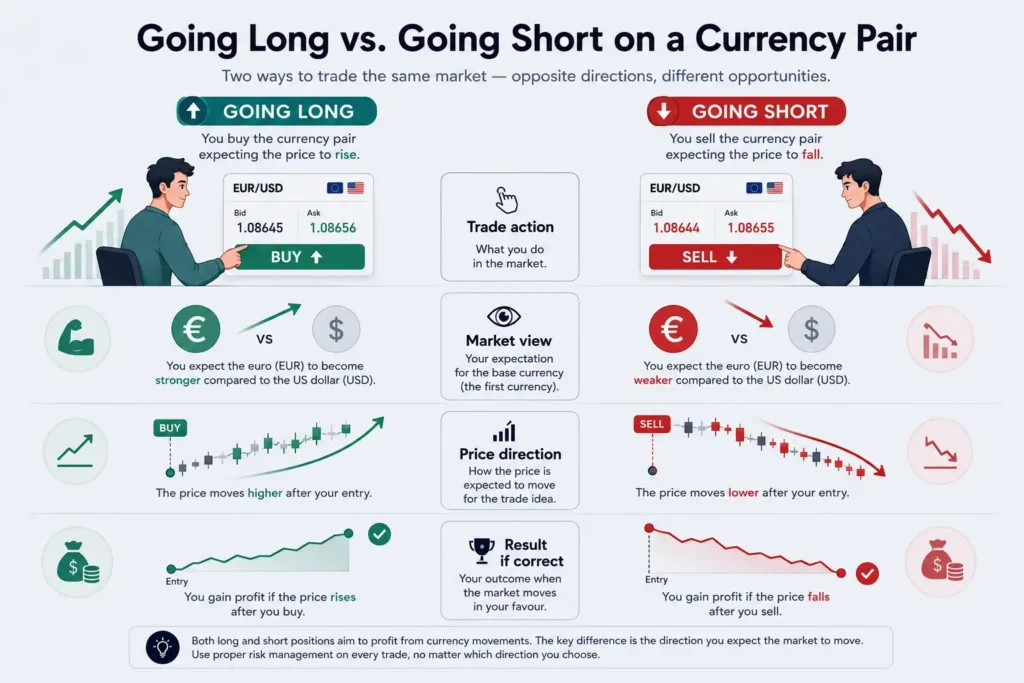
Every forex CFD position is either long or short. Going long means buying the pair because you expect the base currency to strengthen against the quote. Going short means selling the pair because you expect the base to weaken.
Because a CFD lets you open in either direction, falling prices are as tradeable as rising ones, though a move against your position produces a loss at the same rate a favourable move would produce a gain. The buy and sell buttons on the order ticket set this direction, and the platform then tracks your unrealised profit or loss as the price moves.
Deciding Your Position Size
Position size is measured in lots, and the lot you choose sets how much each pip is worth.
| Lot size | Units of the base currency | Approx. pip value on EUR/USD |
|---|---|---|
| Standard lot | 100,000 | about US$10 |
| Mini lot | 10,000 | about US$1 |
| Micro lot | 1,000 | about US$0.10 |
A pip is the standard unit of price movement — the fourth decimal place for most pairs (0.0001), or the second decimal for yen pairs (0.01) — so a smaller lot keeps the monetary value of each move low while you learn. Many beginners trade micro or mini lots for exactly this reason.
Leverage and margin sit alongside size. Leverage lets you control a larger position with a smaller deposit, called margin. In this illustrative example, assuming leverage of 30:1, opening a position worth US$10,000 requires about US$333 in margin, yet the profit or loss is calculated on the full US$10,000. Available leverage varies depending on the broker, account type and jurisdiction. A 2% move against you would cost roughly US$200, close to 60% of that margin.
That asymmetry is why leverage magnifies both gains and losses, and why size is a risk decision as much as a profit one. Working through how leverage works, and how lot sizes, pips and risk-to-reward interact, before trading live makes the numbers concrete.
This is general information only and does not constitute financial advice. Individual circumstances vary.
Step 6 — Set Your Stops and Limits
Risk controls decide how much a trade can cost you before it is closed. How far to place a stop is where position sizing and risk meet.
As a general reference point, some traders limit the amount risked on any single position to a small percentage of account equity, with figures between 1% and 2% often cited, though the right amount varies by individual circumstances and no fixed rule suits everyone. On a US$5,000 account, a 1% cap means risking US$50 on a trade, which in turn sets how wide the stop can be for a given position size.
Structured risk management approaches build on exactly this idea.
Standard Stop-Loss Orders
A stop-loss is an order that closes a position automatically once the price reaches a set level against you, capping the loss on that trade, though in fast-moving markets it may execute at a slightly worse level than set, a gap known as slippage.
Trailing Stops
A trailing stop is a stop-loss that moves automatically in the trade’s favour as the price advances, staying a fixed distance behind the market rather than sitting at a single fixed level. If EUR/USD moves up after a long position is opened, a 30-pip trailing stop moves up with it, locking in more of the gain as the price advances; if the price reverses, the stop stays at its most recent level rather than moving back down. Trailing stops can help lock in a moving position’s gains without needing to adjust the stop manually, though a fast reversal can still trigger the stop before the position captures the full move.
Guaranteed Stops
A guaranteed stop-loss, where offered by a broker, executes at the exact level set regardless of gapping or slippage in fast-moving markets, unlike a standard stop, which can fill at a worse price during a sharp move. This certainty typically comes at a cost: brokers that offer guaranteed stops often charge a premium, either as a fee for using the guarantee or built into a wider spread on the position. Guaranteed stops matter most around scheduled high-impact events — interest rate decisions, non-farm payrolls, or unscheduled shocks — where price can gap past a standard stop level before it fills. Availability and pricing for guaranteed stops vary by broker and account type, so check the specific terms before assuming a standard stop-loss carries the same protection.
Take-Profit and Limit Exit Orders
A take-profit does the reverse of a stop-loss, closing the position once a target level in your favour is reached. Setting both when the trade is opened removes the need to watch the screen constantly and takes some emotion out of the exit.
No stop-loss removes risk entirely, and no approach avoids losing trades altogether. Sound risk management is about keeping losses survivable, so that a single position never ends the account.
Step 7 — Monitor and Close Your Position
While a position is open, its unrealised profit or loss updates with every price tick, visible on the platform’s open positions panel alongside the current price, the stop-loss and take-profit levels attached, and the margin still in use. Checking this panel periodically — rather than only at the point of closing — makes it easier to notice when a stop or target level may need adjusting as the trade develops, within whatever plan was set when the position was opened.
Closing a position realises whatever profit or loss has built up while it was open. There are three common ways it happens. You can close manually, selecting the open position and choosing close, or simply placing the opposite trade — selling a long position, or buying back a short — for the same size. Your stop-loss can close it automatically if the price moves against you to your set level. Your take-profit can close it once your target is reached.
Until a position is closed, its profit or loss is unrealised: it moves with every tick and is not yet yours. Closing converts that into a realised result. One cost to keep in mind is the overnight financing charge, or swap, applied to positions held past the daily rollover on applicable accounts.
It can be positive or negative depending on the currency pair, position direction and account type, which makes holding a CFD position for weeks different in cost from holding it for hours.
Practise the Whole Process on a Demo Account First
A demo account mirrors live trading conditions — the same platform, the same live prices, the same order types — but uses simulated funds instead of real capital. Every step covered above, from reading a quote to setting a stop-loss, can be rehearsed there without financial risk.
Running through the full sequence a few times on a demo account — choosing a pair, placing an order, sizing a position, setting a stop and take-profit, then closing the trade — builds the muscle memory that live trading rewards. It also surfaces platform-specific details, such as how margin is displayed or how an order ticket confirms a trade, before any of it happens with real money attached.
There is no fixed length of time to spend on a demo account before switching to live trading; it depends on how quickly the mechanics become familiar and how consistently a plan can be followed under simulated conditions. Many beginners use it until placing and managing a trade no longer requires thinking through each step individually — at which point the mechanics are second nature, even though live trading introduces the additional factor of real money and the emotional response that comes with it.
Bringing the Steps Together
Run through the full sequence enough times and it stops feeling like a checklist: choose a regulated broker, decide how much to start with, choose a pair, read the price, place an order, size the position, set a stop, and close on your terms. None of the individual steps is complicated.
What makes the difference for a beginner is doing them in order and deciding the risk before the trade rather than during it. Forex CFDs move quickly and in both directions, so the traders who last are usually the ones who treat risk control as the first step, not the last.
Frequently Asked Questions
The questions below cover the beginner concerns that come up most often alongside the steps above.
How Do Beginners Start Trading Forex?
Beginners usually start by learning how a currency pair is priced, opening an account with a regulated broker, and practising on a demo account before committing real funds. From there, the routine is the same on every trade: choose a pair, select an order type, size the position, set a stop-loss and take-profit, then open and later close the trade. Starting with micro or mini lots keeps the value of each pip low while the process becomes familiar.
How Much Money Do You Need to Start Trading Forex?
There is no universal minimum; it depends on the broker, the account type, and the position sizes you intend to trade. Because forex CFDs are leveraged, a relatively small deposit can control a larger position, but that same leverage means losses can build quickly, so any funds used should be money you can afford to lose. Many beginners start with a modest balance and trade micro lots so that each trade risks only a small fraction of the account.
How Can a Complete Beginner Learn Forex Trading?
Learning forex trading combines understanding the mechanics — pairs, pips, spreads, leverage and order types — with hands-on practice. A demo account lets you place and close trades in live market conditions without risking money, which is a common way to build familiarity. Following how a single pair behaves around economic releases and session changes tends to be more useful than trying to track the whole market at once.
Can You Make Money Trading Forex as a Beginner?
Forex trading may result in gains or losses, but it carries a high risk of loss and results are never guaranteed; many retail traders lose money, particularly when using leverage without firm risk controls. Any potential profit on a position comes with an equivalent potential loss if the price moves the other way. Treating risk management as central rather than optional is what gives a beginner a realistic chance of lasting long enough to learn.
Which Currency Pair Is Best for a Beginner To Trade?
There is no single best pair, but major pairs such as EUR/USD, USD/JPY and GBP/USD are commonly used by newer traders because they tend to have the highest liquidity and the narrowest spreads. Higher liquidity usually means lower entry costs and fewer sudden price gaps than minor or exotic pairs. Focusing on one major pair at first often makes it easier to recognise how it behaves before adding others.
Is Forex Trading Available to Beginners Everywhere?
Availability of CFD products varies by jurisdiction and may be subject to local regulation, so access and permitted instruments differ from one country to another. Anyone starting out should check what is available and permitted in their own region before opening an account. Regulatory requirements for CFD trading are not the same everywhere, and they can affect which pairs, leverage levels, and account types are available to you.
What Is the 3-5-7 Rule in Forex?
The 3-5-7 rule is an informal risk-management guideline some traders use: risk no more than 3% of account equity on any single trade, keep total exposure across all open trades to 5% or less, and target winning trades where potential profit is at least 7% relative to the capital at risk. It is one of several informal frameworks for capping exposure — not a rule enforced by any regulator or platform — and the specific percentages are commonly adjusted to an individual’s own risk tolerance and account size.
Is Forex Trading Legal in India?
Forex CFD trading availability and permitted instruments vary significantly by jurisdiction, and India applies specific restrictions on which currency pairs and platforms residents may access for margin-based forex trading. Vantage does not offer services to residents of India; readers based there should check current guidance from their own domestic regulator on what is permitted before trading. See Vantage’s regulatory disclosures for the full list of jurisdictions Vantage does and does not serve.
RISK WARNING: CFDs are complex financial instruments and carry a high risk of losing money rapidly due to leverage. You should ensure you fully understand the risks involved and carefully consider whether you can afford to take the high risk of losing your money before trading.
Disclaimer: The information is provided for educational purposes only and doesn’t take into account your personal objectives, financial circumstances, or needs. It does not constitute investment advice. We encourage you to seek independent advice if necessary. The information has not been prepared in accordance with legal requirements designed to promote the independence of investment research. No representation or warranty is given as to the accuracy or completeness of any information contained within. This material may contain historical or past performance figures and should not be relied on. Furthermore estimates, forward-looking statements, and forecasts cannot be guaranteed. The information on this site and the products and services offered are not intended for distribution to any person in any country or jurisdiction where such distribution or use would be contrary to local law or regulation.
References
- “Global FX trading hits $9.6 trillion per day in April 2025 and OTC interest rate derivatives surge to $7.9 trillion: Triennial Survey – BIS” https://www.bis.org/press/p250930.htm Accessed 21 April 2026
References
- Global FX trading hits $9.6 trillion per day in April 2025 and OTC interest rate derivatives surge to $7.9 trillion: Triennial Survey – BIS” https://www.bis.org/press/p250930.htm Accessed 21 April 2026