


 Updated
With daily turnover exceeding USD9.6 trillion, the forex market is one of the most liquid financial markets in the world [1]. For day traders, this liquidity matters because it can support active price movement across major currency pairs, especially during busy trading sessions and around key economic events.
That activity is one reason forex is closely watched by day traders who focus on short-term price movements. These traders often pay close attention to technical indicators, session timing, economic data, and clearly defined risk controls.
However, liquidity does not make forex day trading low risk. Currency prices can still move sharply in response to inflation data, interest rate decisions, central bank commentary, geopolitical developments, and changes in market sentiment.
Key Points
- Day trading forex involves opening and closing all positions within the same trading session, with the goal of capturing intraday price movements rather than longer-term directional moves.
- Successful intraday forex trading depends not only on strategy selection, but also on session timing, pair liquidity, and consistent application of risk management rules.
- No strategy removes the risk of loss in forex day trading — traders who focus on capital preservation and position sizing alongside entry signals tend to approach the market more sustainably.
- Position-sizing math shows why turning a small account into a large, steady income is unrealistic under sound risk management — expectations should scale to the account, not the other way around.
What Is Day Trading Forex?
Day trading forex is an intraday trading approach where all positions are opened and closed within a single trading session — typically within the same day. Unlike swing trading or position trading, day traders do not hold open trades overnight, avoiding the exposure to price gaps and the costs associated with rolling positions past certain cut-off times.
Many retail traders access forex price movements through Contracts for Difference (CFDs). Forex CFDs allow traders to trade on currency pair price movements without owning the underlying currencies. However, CFDs often involve leverage, which can amplify both potential gains and losses.
Day Trading Forex vs Day Trading Stocks
Forex and stocks are both popular markets for day traders, but the trading environment is different enough that habits from one don’t always transfer cleanly to the other.
| Factor | Forex Day Trading | Stock Day Trading |
| Trading hours | Runs continuously from the Sydney open through the New York close across the trading week, spanning the sessions covered below | Limited to each exchange’s official hours (e.g. 9:30am–4:00pm ET on the NYSE and Nasdaq), plus more restricted pre-market and after-hours sessions |
| Liquidity | Very deep in major currency pairs, particularly during session overlaps | Varies widely by company size — large-cap stocks are highly liquid, small-caps can be thin |
| Overnight/weekend exposure | The market closes for the weekend, so positions held into Friday’s close carry some weekend gap risk, though this is generally less pronounced than a single exchange’s overnight close | Positions held overnight are exposed to gaps between one day’s close and the next day’s open |
| Costs | Typically spread-based on standard accounts, with commission-plus-raw-spread pricing on ECN-style accounts | Often commission-based, though many brokers now offer commission-free stock trading |
| Leverage | Frequently available at higher ratios than equities, though the exact cap depends on the regulator and entity a broker operates under | In the US, governed by Regulation T, which historically limits initial margin to 50% of a stock’s purchase price in a standard margin account |
| Day-trading-specific rules | Forex/CFD trading has never been subject to the day-trading account rules that historically applied to US equities | Until June 2026, frequent US stock day traders were classified as “Pattern Day Traders” under FINRA Rule 4210 and required to hold at least $25,000 in account equity |
This last row is worth being precise about, since it’s one of the most commonly searched questions on this topic. Forex and CFD trading were never governed by the US Pattern Day Trader rule in the first place — that rule applied specifically to trading listed securities in a margin account. Separately, FINRA replaced the Pattern Day Trader framework entirely with a new intraday margin standard, effective 4 June 2026, removing the fixed $25,000 threshold and the four-trades-in-five-days classification for stock traders too [2]. So as of today, neither market carries that specific rule — though requirements still vary by broker, account type, and regulator, so it’s worth checking your own account’s terms rather than assuming a rule you’ve read about applies everywhere.
Day Trading vs Scalping vs Swing vs Position Trading
Day trading is one of several trading styles built around different holding periods. Seeing where it sits relative to scalping, swing trading, and position trading helps clarify what forex day trading actually demands.
| Style | Typical holding period | Typical timeframe used | Time commitment |
| Scalping | Seconds to minutes | 1-minute to 5-minute charts | Very high — constant, active monitoring |
| Day trading | Minutes to hours, closed the same day | 5-minute to 1-hour charts | High — focused monitoring during the chosen session |
| Swing trading | Several days to a few weeks | 4-hour to daily charts | Moderate — periodic check-ins rather than constant screen time |
| Position trading | Weeks to months, or longer | Daily to weekly charts | Low — infrequent review, driven by broader trend or fundamental shifts |
Forex day trading sits between scalping and swing trading. It demands closer attention than swing or position trading, since trades are opened and closed within hours rather than days or weeks, but it doesn’t require the split-second execution scalping does. The right style for a given trader usually comes down to how much time they can dedicate to watching the market and how comfortable they are with overnight exposure — day trading removes overnight risk by design, which is one reason some traders prefer it despite the closer attention it demands during the session.
Market Sessions and the Best Times to Day Trade
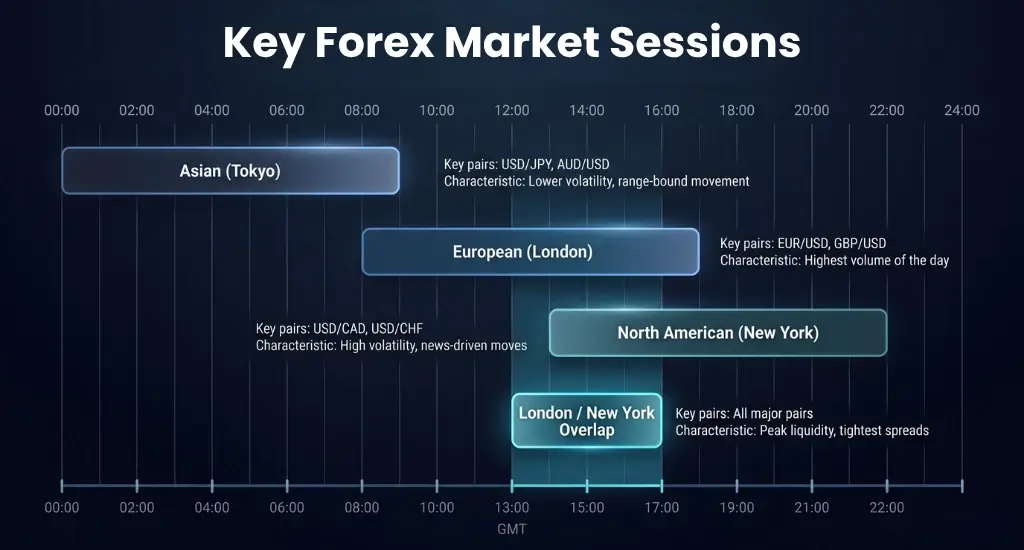
For day traders, these sessions matter because liquidity, volatility, and spreads can vary depending on the time of day. The table below summarises the main forex market sessions and the periods where trading activity is often higher.
| Session | Hours (GMT) | Key Pairs | Characteristic |
| Asian (Tokyo) | 00:00 – 09:00 | USD/JPY, AUD/USD | Lower volatility, range-bound movement |
| European (London) | 08:00 – 17:00 | EUR/USD, GBP/USD | Highest volume of the day |
| North American (New York) | 13:00 – 22:00 | USD/CAD, USD/CHF | High volatility, news-driven moves |
| London/New York Overlap | 13:00 – 17:00 | All major pairs | Peak liquidity, tightest spreads |
How Much Money Do You Need to Day Trade Forex?
There’s no fixed minimum deposit required to day trade forex — many brokers, including Vantage, allow accounts to be opened with a modest amount of capital. But the amount of capital available directly affects position sizing, and position sizing is where a lot of unrealistic expectations run into the math.
A simple position-sizing example
A commonly used guideline is to risk no more than 1–2% of account equity on a single trade. Take a hypothetical $1,000 account risking 1% per trade:
- Risk per trade: $1,000 × 1% = $10
- Suppose the trade setup calls for a 20-pip stop-loss on EUR/USD
- On a standard lot (100,000 units), each pip is worth roughly $10 — far more than the $10 total risk budget
- To keep risk at $10 over a 20-pip stop, the position needs to be sized at roughly 5,000 units, so that each pip is worth about $0.50
This is a simplified, illustrative example. Actual pip values, margin requirements, and available position sizes vary by pair, account currency, and broker. The point isn’t the specific numbers — it’s the relationship between account size, stop-loss distance, and position size. Larger accounts can support larger positions, and larger dollar-value stops, at the same percentage risk.
Why small-account income targets are usually unrealistic
It’s common to see the idea of turning a small deposit into a specific monthly income — for example, aiming for $1,000 a month from a $100 account. Working backwards through the numbers shows why this is difficult under sound risk management: $1,000 a month works out to roughly $45–50 per trading day. Risking 1–2% of a $100 account is $1–$2 per trade, so consistently generating $45 a day from that risk budget would require either an extremely high win rate at a very favourable reward-to-risk ratio sustained over time, or risking far more than the account can safely absorb — and the second option is generally considered poor risk management.
This doesn’t mean small accounts can’t day trade — it means expectations should scale to what the account and the risk management rules can actually support. Many traders use a demo account first to test position sizing and strategy execution without risking real capital.
This is an educational illustration, not financial advice or a projection of likely returns. Trading results vary, and past performance does not guarantee future results.
Step-by-Step Forex Day Trading Process
Forex day trading is a short-term process. It usually begins with selecting a currency pair and market session, then analysing price movement, planning the trade, managing exposure, and closing the position before the trading day ends.
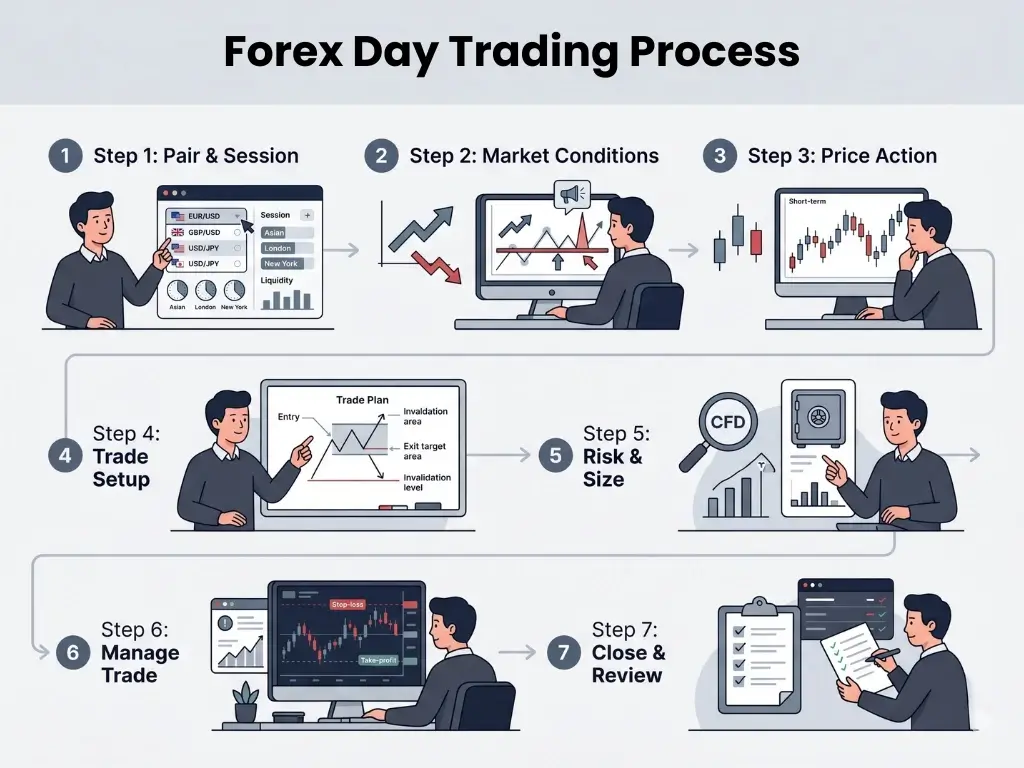
The process is structured, but outcomes are never certain.
- Selecting a Currency Pair and Trading Session: Traders often focus on major pairs such as EUR/USD, GBP/USD, and USD/JPY because they tend to have higher liquidity than minor or exotic pairs. As discussed earlier, the trading session also matters, as activity can vary across the Asian, London, and New York sessions.
- Reading Market Conditions: Traders assess whether the pair is trending, ranging, reacting to news, or trading near a key support or resistance level. This helps provide context before choosing a strategy.
- Analysing Price Action: Price action shows how a currency pair’s exchange rate moves over time. Traders may use candlestick charts, short-term timeframes, and chart patterns to assess intraday movement.
- Defining the Trade Setup: A trade setup outlines the possible entry area, exit area, and the conditions that would make the idea invalid. This helps traders avoid reacting to every short-term price movement.
- Considering Leverage, Margin, and Position Size: Forex is commonly traded through Contracts for Difference (CFDs), which often involve leverage. Leverage can increase exposure to price movements, but it can also amplify losses if the market moves against the position.
- Entering and Managing the Trade: Once a position is opened, traders monitor price movement, market conditions, and any scheduled events that may affect the pair. Stop-loss and take-profit orders may be used, although execution is not guaranteed at the requested price during volatile or low-liquidity conditions.
- Closing and Reviewing the Position: Forex day traders usually close positions before the trading day ends. Afterward, they may review whether the trade followed the original plan, how risk was managed, and what can be learned from the outcome.
Day Trading Strategies
Forex day trading strategies vary by market condition, timeframe, and risk approach. Some focus on trends, while others look at breakouts, news-driven volatility, or short-term price reversals.
Breakout Trading
Breakout trading focuses on price moving beyond a defined support or resistance level. Traders use this approach when they expect the move to continue after price breaks out of a range.
Breakouts often occur around session opens, economic data releases, or periods of rising market activity. Traders may watch consolidation ranges on 5-minute or 15-minute charts and wait for price to close beyond the range before assessing a possible entry.
False breakouts are a common risk. Price may move briefly beyond a level before reversing. For this reason, some traders wait for a candle close or a retest of the broken level before entering.
Key features:
- Often used during session opens or major data releases.
- Requires clear support and resistance levels.
- False breakouts are a common risk.
- Entry confirmation may reduce false signals, but may also result in a less favourable entry level.
Difficulty: Intermediate
Trend Following
Trend following involves identifying the main intraday direction of a currency pair and trading in line with that movement. In an uptrend, traders may look for higher highs and higher lows. In a downtrend, they may look for lower highs and lower lows.
Rather than entering after a sharp move, traders often wait for a pullback towards a moving average, support level, or resistance level. Common tools include the 20-period and 50-period exponential moving averages (EMAs), the Relative Strength Index (RSI), and the Moving Average Convergence Divergence (MACD) indicator.
This strategy is often used during active trading sessions, such as the London or New York session, when directional movement may be more visible. It is generally less suited to choppy or range-bound conditions.
Key features:
- Often used in clear intraday trends.
- Commonly supported by moving averages and momentum indicators.
- May be applied across 15-minute and 1-hour charts.
- Can be less effective when price moves sideways.
Difficulty: Beginner–Intermediate
News Trading
News trading focuses on short-term price movement around major economic releases or central bank announcements. These may include inflation data, employment reports, gross domestic product (GDP) figures, or interest rate decisions.
Currency pairs can move sharply when released data differs from market expectations. Some traders assess the initial reaction, while others wait for price to stabilise before reviewing possible continuation or reversal setups.
This strategy carries higher risk because spreads may widen, liquidity may fall, and price can reverse quickly after the first move. Clear risk controls are especially important during news-driven conditions.
Key features:
- Based on scheduled economic events and market expectations.
- Often involves fast price movement and wider spreads.
- Requires an economic calendar.
- Better suited to traders who closely follow macroeconomic data.
Difficulty: Intermediate–Advanced
Mean Reversion Trading
Mean reversion trading is based on the idea that price may move back towards its average after extending too far in one direction. Traders often use tools such as Bollinger Bands, moving averages, and the RSI to assess whether a currency pair appears overextended.
This strategy is more commonly used in range-bound markets, where price moves between support and resistance rather than trending strongly. In strong trends, prices can remain extended for longer than expected.
For this reason, mean reversion setups are usually assessed together with broader market structure. This helps traders distinguish between a temporary price extension and a stronger directional move.
Key features:
- Often used in range-bound or sideways markets.
- Common tools include Bollinger Bands, moving averages, and the RSI.
- Strong trends can weaken mean reversion setups.
- Requires careful risk control if price continues moving away from its average.
Difficulty: Intermediate
| Strategy | Best Conditions | Typical Timeframe | Difficulty |
| Trend Following | Clear intraday trend | 15-min / 1-hour | Beginner–Intermediate |
| Breakout Trading | Session opens, data releases | 5-min / 15-min | Intermediate |
| News Trading | Major economic releases | 1-min / 5-min | Intermediate–Advanced |
| Mean Reversion | Ranging, low-trend markets | 15-min / 1-hour | Intermediate |
Learn more about different forex trading strategies and how they are commonly used across different trading styles.
Practical Setup: Platform, Tools and Routine
Beyond strategy and risk rules, day trading forex also depends on having the right setup in place before the session starts:
- Charting platform: Most forex day traders use a dedicated charting platform such as MetaTrader 4, MetaTrader 5, or TradingView, which support the timeframes, indicators, and order types referenced throughout this guide.
- Economic calendar: Since news events can move currency pairs sharply (see News Trading above), keeping an economic calendar open during the session helps traders anticipate scheduled releases rather than be caught off guard by them.
- One-click trading and price alerts: Fast execution matters more in day trading than in longer-term styles. One-click order entry and price alerts for key levels help traders react without needing to watch every tick.
- A pre-session routine: Many traders check overnight price action from the Asian session, review the economic calendar, and mark key support/resistance levels before the session they plan to trade begins, rather than reacting to price with no prior context.
Risk Management for Day Traders
Risk management in forex day trading is about controlling how much capital is exposed on each trade. Since day traders may open and close several positions within one session, risk controls help define potential losses before a trade is placed.
Key areas to consider include:
- Position Sizing: This refers to the trade size used for a position. It is usually assessed alongside account equity, stop-loss distance, and the amount of capital a trader is prepared to risk on that trade.
- Stop-Loss Orders: A stop-loss order is used to close a position if price moves against the trade by a defined amount. In forex day trading, stop-loss levels are often placed beyond key areas such as swing highs, swing lows, support, or resistance.
- Take-Profit Orders: A take-profit order defines the price level where a position may be closed if price moves in the intended direction. This helps traders assess the relationship between potential loss and potential return before entering a trade.
Risk management does not remove the risk of loss. However, it helps traders approach forex day trading with clearer limits, more structured decision-making, and a better view of how each trade may affect their account balance.
Building Your Day Trading Plan
A forex day trading plan sets clear rules for how trades are identified, entered, managed, and closed. It may include the currency pairs traded, preferred sessions, entry conditions, exit rules, position size, and risk limits.
The plan should be specific. For example, instead of “trade with the trend”, it may define the exact chart timeframe, indicators, and price conditions needed before a trade is considered.
Review and iteration are also part of the process. Many traders maintain a trading journal that records each trade, including the entry rationale, setup type, result, and any deviations from the plan.
Reviewing this log regularly can help traders identify patterns in their execution. This may include whether certain setups perform differently, whether exits are taken too early or too late, and whether risk management is applied consistently.
What to Keep in Mind
Forex day trading is built around structure, timing, and risk control. It involves reading short-term price movement, choosing suitable market conditions, applying a clear strategy, and closing positions within the same trading day.
No strategy removes risk. Forex prices can move quickly, and leverage can amplify both potential gains and losses. This makes position sizing, stop-loss planning, and trade review important parts of the process.
For traders, the key is not to rely on one setup or one market view. A more sustainable approach comes from following a defined plan, managing exposure consistently, and treating each trade as part of a wider learning process.
Frequently Asked Questions
What is the difference between forex day trading and swing trading?
Forex day trading involves opening and closing positions within the same trading session, so trades are not held overnight. Swing trading has a longer time horizon. Positions may stay open for several days or across multiple sessions, with the aim of capturing broader price movements.
The main difference is pace. Day trading usually requires more active monitoring, faster decisions, and tighter intraday risk control. Swing trading gives traders more time to analyse market conditions, but it also carries overnight exposure, where prices can move while markets are closed or less liquid.
Which currency pairs are best suited to day trading?
Major currency pairs, such as EUR/USD, GBP/USD, and USD/JPY, are commonly used in forex day trading because they tend to have higher liquidity and tighter spreads. Minor and exotic pairs may still be traded, but they often come with wider spreads, thinner liquidity, and less consistent intraday movement.
How does leverage affect forex day trading?
Leverage in forex day trading allows traders to control a position larger than their account capital. While this can amplify potential gains on a trade that moves in the intended direction, it equally amplifies potential losses when price moves against the position.
Higher leverage reduces the capital cushion available to absorb adverse moves, meaning a smaller percentage price movement can result in a proportionally larger account drawdown. Managing leverage alongside stop-loss placement is a key component of intraday risk management.
What is a pip in forex trading?
A pip, or ‘percentage in point’, is a standard unit used to measure price movement in forex.For most currency pairs, one pip is equal to 0.0001. For Japanese yen pairs, one pip is usually equal to 0.01.
Traders use pips to measure price changes, set stop-loss and take-profit distances, compare trade setups, and calculate potential gains or losses based on position size.
What technical indicators are commonly used in forex day trading?
Common indicators in forex day trading include exponential moving averages, the Relative Strength Index (RSI), the Moving Average Convergence Divergence (MACD), and Bollinger Bands.
Each tool serves a different purpose. Moving averages can help identify trend direction. RSI and MACD are often used to assess momentum. Bollinger Bands may help traders observe whether price is moving near the upper or lower end of its recent range.
Do forex day traders need to follow economic news?
Yes, economic news is important in forex day trading. Currency pairs can move sharply after inflation reports, labour market data, central bank decisions, and interest rate commentary. These events may also affect spreads, liquidity, and short-term volatility.
Can forex day trading be done on a part-time basis?
Forex day trading can be done part-time, but it usually works better with a focused approach. Rather than watching the market all day, part-time traders may focus on one active session or a specific trading window. Examples include the London open or the London/New York overlap, when liquidity is often higher. The main limitation is timing. Some of the most active forex periods may overlap with standard working hours, depending on the trader’s location.
Is day trading forex worth it?
Whether day trading forex is “worth it” depends on the individual — their available time, risk tolerance, and expectations. It offers flexibility (no overnight positions, defined session windows) and access to a highly liquid market, but it also demands active time commitment and disciplined risk management. It isn’t inherently more or less “worth it” than other trading or investing approaches; it tends to suit some people’s circumstances and temperament better than others.
Why do most day traders lose money?
Commonly cited reasons for day trading losses include inconsistent risk management (risking too much per trade or abandoning stop-losses), trading without a clear plan, overtrading in unsuitable market conditions, and unrealistic profit expectations that lead to oversized position sizes (see the position-sizing example earlier in this guide). Day trading also involves transaction costs like spreads, which can add up with frequent trading. None of this means losses are guaranteed, but it does mean that consistent risk management and realistic expectations are central to a sustainable approach.
Can you make $1,000 a day trading forex?
It’s possible for an experienced trader with sufficient capital to generate significant returns in a single day, but there’s no fixed answer — it depends entirely on account size, risk management, and market conditions. As shown in the position-sizing example above, generating a specific dollar amount consistently, especially from a small account, usually requires a large account, an unusually high win rate, or oversized risk — and the last of these is generally considered poor risk management. Rather than targeting a fixed daily dollar figure, most experienced traders focus on consistent process and risk control, and let results follow from that.
RISK WARNING: CFDs are complex financial instruments and carry a high risk of losing money rapidly due to leverage. You should ensure you fully understand the risks involved and carefully consider whether you can afford to take the high risk of losing your money before trading.
Disclaimer: The information is provided for educational purposes only and doesn’t take into account your personal objectives, financial circumstances, or needs. It does not constitute investment advice. We encourage you to seek independent advice if necessary. The information has not been prepared in accordance with legal requirements designed to promote the independence of investment research. No representation or warranty is given as to the accuracy or completeness of any information contained within. This material may contain historical or past performance figures and should not be relied on. Furthermore estimates, forward-looking statements, and forecasts cannot be guaranteed. The information on this site and the products and services offered are not intended for distribution to any person in any country or jurisdiction where such distribution or use would be contrary to local law or regulation.
Reference
- “OTC foreign exchange turnover in April 2025 – BIS” https://www.bis.org/statistics/rpfx25_fx.htm Accessed 29 April 2026