


 Updated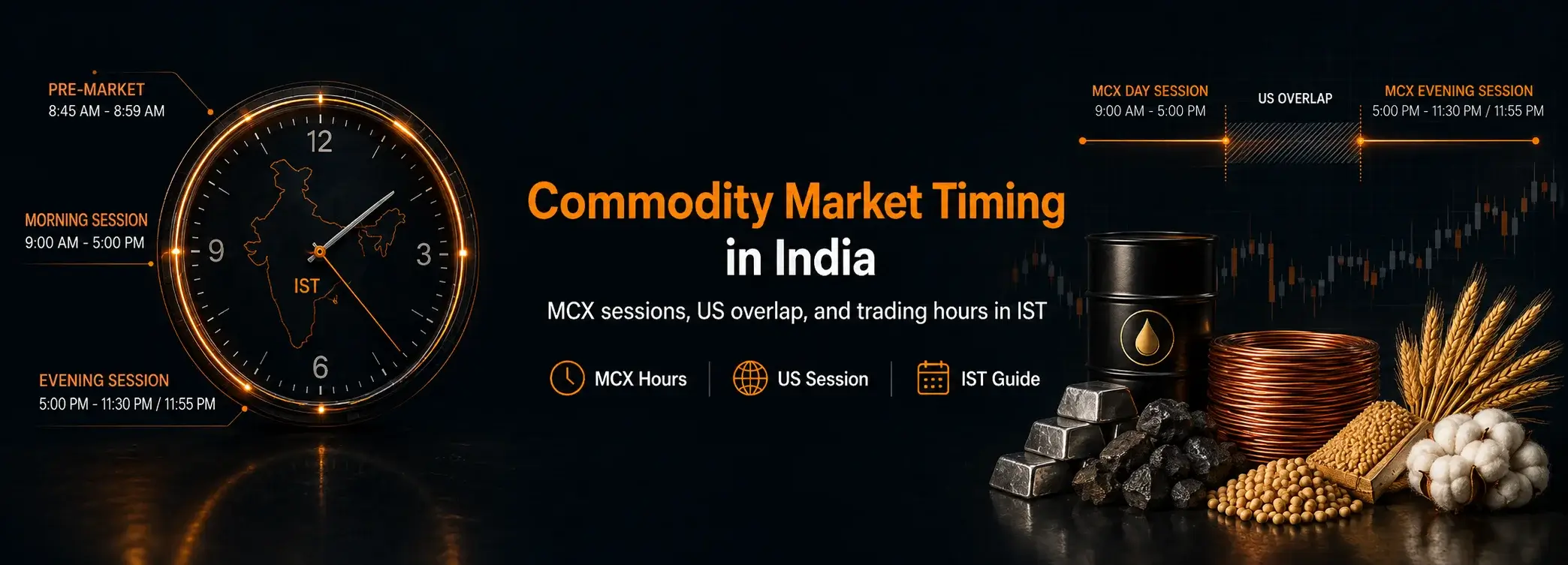
Commodity market timing in India runs from 9:00 AM to 11:30 PM IST, Monday to Friday, extending to 11:55 PM IST in the months when US daylight saving time is not in effect. Agricultural contracts are the exception, closing at 5:00 PM IST.
The active US commodity session sits inside that evening window: roughly 6:30 PM to 12:00 AM IST while American clocks are forward, and 7:30 PM to 1:00 AM IST when they are not. The link is deliberate. MCX runs a second, evening session so that gold, silver and crude oil contracts stay open while New York is trading, which is also why the domestic close shifts twice a year.
Both schedules are set out below in IST, session by session and category by category, with weekend rules, the 2026 exchange holiday calendar and the windows where liquidity tends to concentrate.
Key Points
- Commodity market timing in India covers two linked schedules: the MCX session from 9:00 AM to 11:30 PM or 11:55 PM IST, and the US futures session that sets the reference price for bullion, base metals and energy contracts.
- Agricultural contracts close at 5:00 PM IST, while bullion, base metals and energy run into the evening specifically so they overlap with US price discovery, which is where the heaviest volume of the day tends to sit.
- MCX observes 16 weekday holidays in 2026, and on most of them only the morning session closes, so globally priced contracts still trade through the US overlap on days the market appears shut.
Commodity Market Timing in India at a Glance
Two schedules matter to anyone trading globally priced commodities from India: the domestic exchange session, and the US session that sets the reference price those contracts track. The table below places both in IST, so they can be read against each other rather than converted on the fly.
| Market and session | Opens (IST) | Closes (IST) | Days |
| MCX pre-market (order changes only) | 8:45 AM | 8:59 AM | Monday–Friday |
| MCX agricultural contracts | 9:00 AM | 5:00 PM | Monday–Friday |
| MCX bullion, metals and energy | 9:00 AM | 11:30 PM / 11:55 PM | Monday–Friday |
| US futures — electronic session (NYMEX, COMEX) | 3:30 AM / 4:30 AM Monday | 2:30 AM / 3:30 AM Saturday | Near-continuous |
| US futures — active day session | 6:30 PM / 7:30 PM | 12:00 AM / 1:00 AM | Monday–Friday |
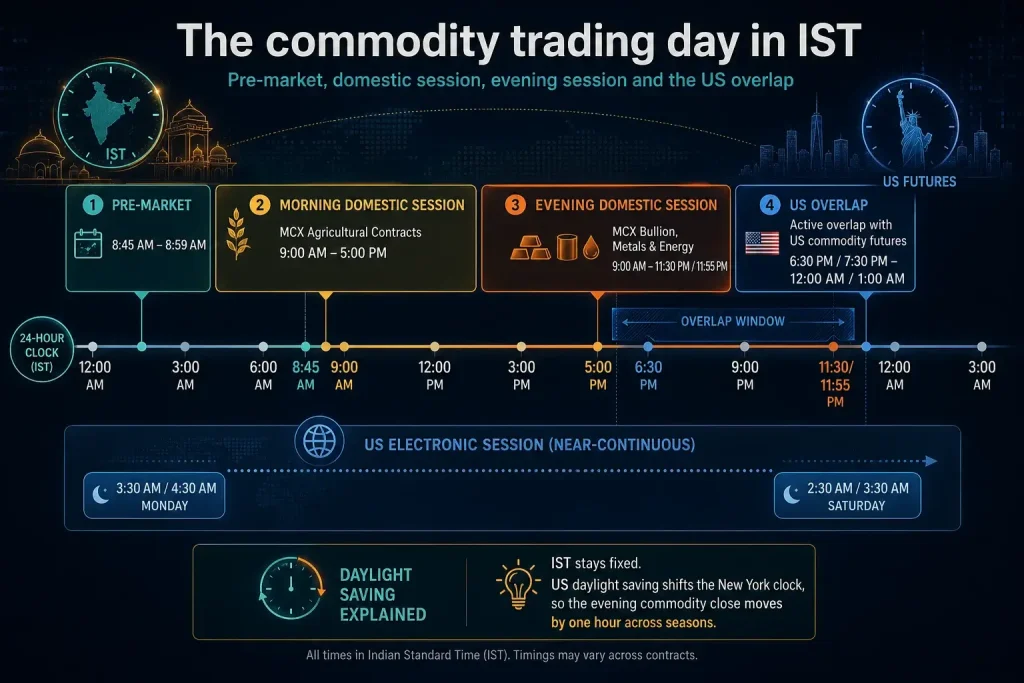
The reason the Indian close moves while the US close does not is daylight saving. IST does not shift with the seasons; the American clock does. Each spring the gap between the two narrows by an hour, and each autumn it widens again, so MCX adjusts its evening close to keep pace with New York.
Traders used to fixed stock market trading hours often find this the single most confusing feature of the commodity calendar. It differs again from forex trading time, which runs unbroken from the Monday open to the Friday close with no daily bell at either end.
MCX Trading Time: Pre-Market, Morning and Evening Sessions
The Multi Commodity Exchange (MCX) is the country’s largest commodity derivatives exchange by traded volume, listing contracts across bullion, base metals, energy and agricultural products.
It trades Monday to Friday and is closed at weekends and on declared holidays. Its trading day is built in three phases, and knowing which phase you are in determines whether an order executes or simply sits.
| Session | Timing (IST) | Days |
| Pre-market | 8:45 AM – 8:59 AM | Monday–Friday |
| Morning session | 9:00 AM – 5:00 PM | Monday–Friday |
| Evening session (US daylight saving active) | 5:00 PM – 11:30 PM | Monday–Friday |
| Evening session (US daylight saving inactive) | 5:00 PM – 11:55 PM | Monday–Friday |
Pre-Market Session (8:45 AM – 8:59 AM IST)
A 14-minute pre-market window runs from 8:45 AM to 8:59 AM IST. During it, traders can review, modify or cancel orders left over from the previous session, but cannot open new positions.
Its practical purpose is narrow but real: overnight moves in US crude and bullion frequently leave resting orders badly placed by the time the domestic market reopens, and this is the only chance to clear them before 9:00 AM. An order left sitting into a gapped open is one of the more avoidable causes of slippage in trading.
Morning Session (9:00 AM – 5:00 PM IST)
The morning session opens at 9:00 AM and runs to 5:00 PM IST. Most agricultural contracts — chana, castor seed, paddy among them — trade only in this window and close at 5:00 PM. Bullion, base metals and energy contracts open alongside them and simply keep going into the evening.
Liquidity and volume are typically heaviest in the first hour after the open, roughly 9:00 AM to 11:00 AM IST, when domestic institutional flow and the day’s first reaction to overnight news arrive together. Activity then thins noticeably through the early afternoon.
Evening Session (5:00 PM – 11:30 PM / 11:55 PM IST)
The evening session is where non-agricultural contracts do most of their work. Gold, silver, copper, crude oil and natural gas all trade through it, and it overlaps first with European hours and then with the US day session — the stretch that usually produces the day’s widest ranges and deepest order books.
The close moves with the American clock. While US daylight saving time is active the session ends at 11:30 PM IST; while it is inactive it runs to 11:55 PM IST. The adjustment keeps the domestic close aligned with the US settlement window regardless of the season, so traders holding positions across a changeover date should expect the last hour of liquidity to arrive an hour later or earlier than the week before.
Dealing costs follow the same curve: spreads are usually tightest while the US market is live and widen again as the book thins towards the close.
Commodity Market Timing in India by Category
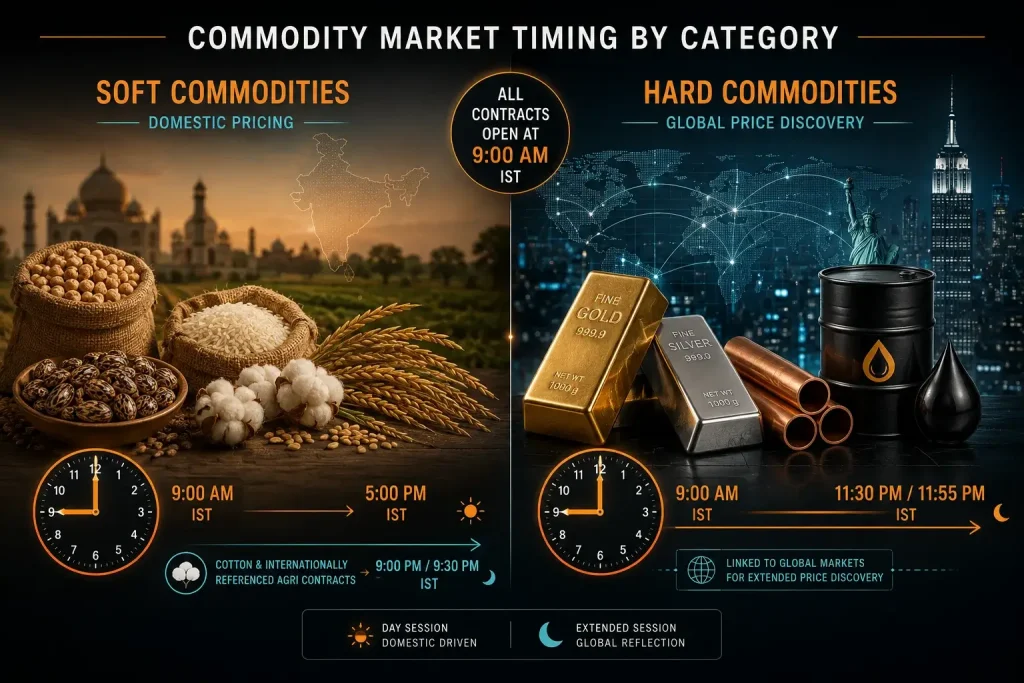
Every MCX contract opens at 9:00 AM IST. What differs is the close, and the dividing line is whether the commodity is priced domestically or globally.
Agricultural products follow domestic supply-and-demand cycles and shut with the standard session at 5:00 PM, the pattern that governs soft commodities generally.
Bullion, metals and energy products are priced on international exchanges, so they need extended hours to capture US price discovery — without them, a domestic position would sit exposed and unhedgeable through the most active hours of the global day.
| Commodity category | Opening time (IST) | Closing time (IST) |
| Agricultural contracts (chana, castor seed, paddy) | 9:00 AM | 5:00 PM |
| MCX Cotton futures | 9:00 AM | 9:00 PM |
| Internationally referenced agricultural contracts | 9:00 AM | 9:00 PM / 9:30 PM |
| Bullion, base metals and energy | 9:00 AM | 11:30 PM / 11:55 PM |
Crude Oil Trading Time in India
Crude oil trades on MCX from 9:00 AM to 11:30 PM IST, extending to 11:55 PM IST when US daylight saving is inactive. Because it is globally priced, the morning session is largely a holding pattern: contracts tick along on Asian flow and carry-over positioning, and the meaningful moves arrive after the US market opens.
The most active window is roughly 6:30 PM to 11:30 PM IST while American clocks are forward, and 7:30 PM onwards when they are not. One event dominates the week. The US Energy Information Administration publishes its crude inventory figures every Wednesday at 10:30 AM Eastern, which lands at about 8:00 PM IST during US daylight saving and 9:00 PM IST outside it [5].
Prices can move sharply within seconds of the release, and that cuts both ways. The same volatility that widens opportunity also widens spreads and raises the risk of slippage. Traders new to the contract may want to understand how crude oil trading works before positioning around a scheduled release. The grade matters as much as the timing, since WTI and Brent absorb the same report on slightly different schedules.
Gold, Silver and Natural Gas Trading Time
Gold, silver and natural gas follow the same non-agricultural schedule as crude oil: 9:00 AM to 11:30 PM IST, or 11:55 PM IST when US daylight saving is inactive. All three take their price direction from overseas benchmarks, so the domestic session functions largely as an extended access window onto international pricing.
Bullion behaves slightly differently from energy within that window. Gold tends to pick up from around 5:30 PM IST as London traders become active, then again when New York joins; the US gold day session runs 8:20 AM to 1:30 PM Eastern, which is about 5:50 PM to 11:00 PM IST during US daylight saving.
Natural gas is the most weather-sensitive of the three and can move on forecast revisions well outside the usual news calendar. Silver trading typically tracks gold but with wider percentage swings, reflecting its smaller market and industrial demand component.
Anyone building a routine around these hours will find the mechanics of how to trade gold and the question of when the gold market opens worth reading alongside this schedule, since bullion and the wider base metals market keep different liquidity profiles despite sharing a closing bell.
Cotton, NCDEX and the Agricultural Exception
Cotton is the notable exception to the agricultural rule. It is a soft commodity, but it trades from 9:00 AM to 9:00 PM IST rather than closing at 5:00 PM, a reflection of its international price linkage. Contract terms and hours are set by exchange circular and can be revised, so the current contract specification is worth checking before trading rather than assuming last season’s schedule still applies.
The National Commodity and Derivatives Exchange (NCDEX), which specialises in agricultural derivatives, generally trades its agri contracts from 9:00 AM to 5:00 PM IST, Monday to Friday, and publishes its own holiday calendar separately from MCX.
US Commodity Market Timing in Indian Time
US commodity market timing has two layers, and conflating them is the most common mistake made with this schedule. Energy and metals contracts on NYMEX and COMEX, both part of CME Group, trade almost continuously on the CME Globex electronic platform, close to 23 hours a day [3].
Sitting inside that near-continuous window is a much shorter US day session where American volume and genuine price discovery concentrate. When someone asks what time the US commodity market opens in Indian time, the day session is almost always what they mean.
US Commodity Market Opening and Closing Time in IST
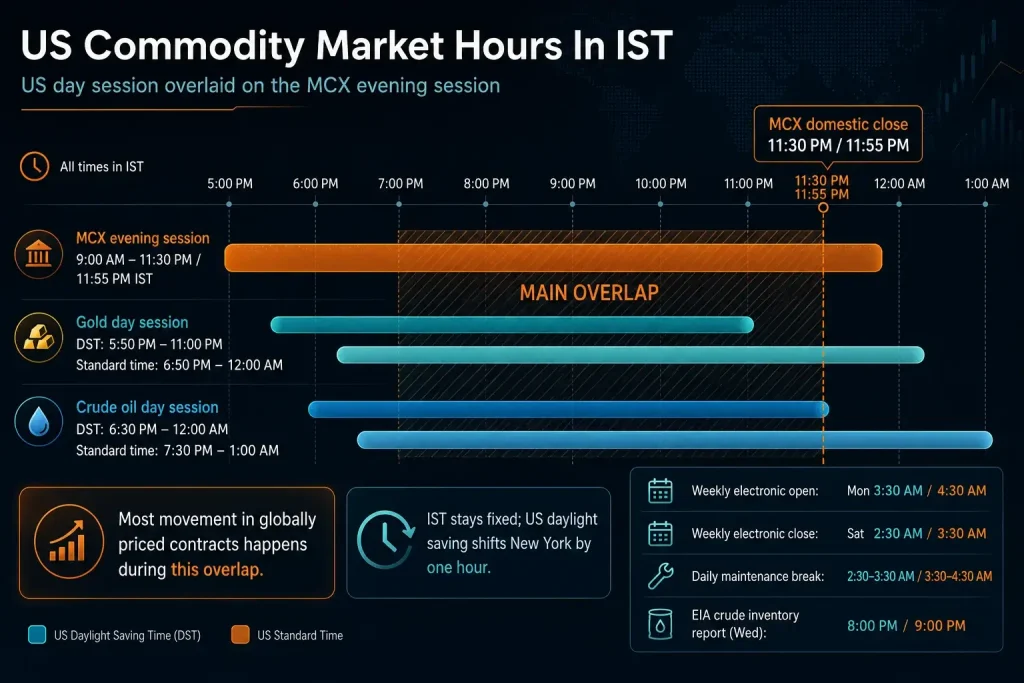
The crude oil day session runs 9:00 AM to 2:30 PM Eastern, which converts to 6:30 PM to 12:00 AM IST while US daylight saving is active and 7:30 PM to 1:00 AM IST while it is not. Gold’s day session starts slightly earlier in New York, at 8:20 AM Eastern. Converted in full, the picture looks like this.
| US session (Eastern Time) | IST — US daylight saving active | IST — US daylight saving inactive |
| Crude oil day session (9:00 AM – 2:30 PM ET) | 6:30 PM – 12:00 AM | 7:30 PM – 1:00 AM |
| Gold day session (8:20 AM – 1:30 PM ET) | 5:50 PM – 11:00 PM | 6:50 PM – 12:00 AM |
| Weekly electronic open (Sunday 6:00 PM ET) | Monday 3:30 AM | Monday 4:30 AM |
| Weekly electronic close (Friday 5:00 PM ET) | Saturday 2:30 AM | Saturday 3:30 AM |
| Daily maintenance break (5:00 – 6:00 PM ET) | 2:30 – 3:30 AM | 3:30 – 4:30 AM |
| EIA crude inventory report (Wednesday 10:30 AM ET) | 8:00 PM | 9:00 PM |
Read against Table 2, the overlap becomes obvious: the US day session opens while the domestic evening session is already several hours old, and the two run together until the domestic close.
That shared window is where most of the day’s movement in globally priced contracts happens. The same pattern governs gold trading hours on international venues.
COMEX and NYMEX Hours: The Near-24-Hour Electronic Session
Outside the day session, US commodity contracts do not stop. CME Group states that WTI crude oil futures trade Sunday through Friday from 5:00 PM to 4:00 PM Central Time, with a one-hour break at 4:00 PM Central each day. Gold and silver on COMEX follow the same electronic schedule.
Converted to IST, the week opens at about 3:30 AM on Monday and closes at about 2:30 AM on Saturday while US daylight saving is active — an hour later in each case when it is not — with a daily one-hour pause at roughly 2:30 AM IST.
Two practical consequences follow.
- First, prices continue to move for several hours after the domestic close, so an overnight position can be repriced before the morning session reopens.
- Second, nothing trades between the Saturday morning close and the Monday morning reopen, which is where weekend gap risk originates: news over a weekend is absorbed in a single jump at the reopen rather than gradually.
These are exchange-traded futures contracts, and their hours are set by the exchange rather than by any individual broker.
Because the electronic session covers hours when most participants are asleep, some automate their response to it entirely, which is much of the reasoning behind AI forex trading systems: they exist to cover time zones a person cannot.
Execution in those thin hours depends on infrastructure as much as strategy, which is why trading server location and latency matter more overnight than at midday. Whichever trading platform you use will list its own session times per instrument, and those are the hours your orders actually obey.
Why the MCX Evening Close Shifts Twice a Year
US daylight saving time runs from the second Sunday in March to the first Sunday in November [4]. In 2026 that means 8 March to 1 November. During those months, US markets sit 9 hours 30 minutes behind IST; outside them, the gap is 10 hours 30 minutes.
Because MCX anchors its evening close to the US settlement window rather than to a fixed local time, that swing is passed straight through: 11:30 PM IST while US clocks are forward, 11:55 PM IST while they are not [1]. The revised timing takes effect from the first trading day after each US changeover, not on the changeover weekend itself. Anyone holding positions across one of those weeks should re-check the closing time for the week ahead rather than working from memory.
MCX Trading Holidays 2026 and Weekend Closures
MCX holidays fall into two categories, and the distinction matters more than the dates themselves.
On a full holiday both sessions are closed. On a partial holiday only the morning session, 9:00 AM to 5:00 PM IST, is closed, and the evening session runs from 5:00 PM as usual, which means globally priced contracts still trade through the US overlap on days the market appears shut.
The 2026 calendar carries 16 weekday holidays: four full closures, eleven partial closures and one reverse case on 1 January, when the morning session was open and the evening session closed to align with global commodity market closures [2].
| Holiday | Date | Day | Sessions closed |
|---|---|---|---|
| New Year’s Day | 1 Jan 2026 | Thursday | Evening only |
| Republic Day | 26 Jan 2026 | Monday | Full day |
| Holi (second day) | 3 Mar 2026 | Tuesday | Morning only |
| Shri Ram Navami | 26 Mar 2026 | Thursday | Morning only |
| Shri Mahavir Jayanti | 31 Mar 2026 | Tuesday | Morning only |
| Good Friday | 3 Apr 2026 | Friday | Full day |
| Dr Baba Saheb Ambedkar Jayanti | 14 Apr 2026 | Tuesday | Morning only |
| Maharashtra Day | 1 May 2026 | Friday | Morning only |
| Bakri Id | 28 May 2026 | Thursday | Morning only |
| Moharram | 26 Jun 2026 | Friday | Morning only |
| Ganesh Chaturthi | 14 Sep 2026 | Monday | Morning only |
| Mahatma Gandhi Jayanti | 2 Oct 2026 | Friday | Full day |
Four further 2026 holidays fall at weekends and create no additional weekday closure: Maha Shivaratri on 15 February, Id-ul-Fitr on 21 March, Independence Day on 15 August and Diwali Laxmi Pujan on 8 November [2].
Diwali Laxmi Pujan carries the one exception to the weekend rule. MCX conducts a special Muhurat trading session that Sunday, with timings notified by exchange circular closer to the date [2]. Festival dates can be revised, so the exchange calendar is worth re-checking before planning around any of them.
US commodity exchanges keep their own, entirely separate holiday calendar. A closure in India does not imply that international prices have stopped moving, which is precisely why the partial-holiday evenings matter.
Best Time to Trade Commodities in India
Liquidity is not spread evenly across the fourteen and a half hours the market is open. It arrives in two concentrations, separated by a long and generally quiet middle.
The first is the opening hour, roughly 9:00 AM to 11:00 AM IST, when domestic institutional orders and the overnight news backlog hit the book together. This window matters most for agricultural and domestically priced contracts, which have no later session to look forward to.
The second, and much larger, is the US overlap. It begins when the American day session opens, about 6:30 PM IST while US clocks are forward and 7:30 PM IST when they are not, and runs to the MCX close. Depth usually builds through the first two hours of that overlap and stays elevated until settlement. This is when gold, silver, crude oil, natural gas and copper see their heaviest volume, and when scheduled US data has the greatest effect. It is also the window covered by gold trading hours on international venues.
Between them, from roughly 1:00 PM to 4:00 PM IST, volumes thin across most categories. The US session has not begun and domestic news flow has largely exhausted itself. Many short-term traders simply avoid it, since thinner books tend to mean wider spreads and less reliable fills rather than calmer prices.
Two scheduled events are worth marking in the diary. The EIA crude inventory report lands each Wednesday at about 8:00 PM or 9:00 PM IST depending on the season, and the industry’s own API crude oil stock change figure precedes it the evening before.
Federal Reserve rate decisions fall in the same overlap window and move bullion in particular, as do the major US labour prints, whose mechanics are covered in trading the non-farm payrolls release. Higher volatility around these releases can widen opportunity and risk in equal measure, which is why position sizing around them tends to matter more than the direction of the view.
Ways to Access Commodity Price Movement
Most retail participation in commodities happens through derivatives rather than physical delivery. A futures contract is an agreement to buy or sell a set quantity at an agreed price on a future date; traders use them to take a view on price without handling the underlying goods. Leverage is built in, which magnifies losses exactly as it magnifies gains; the practical differences between CFDs and futures come down largely to contract size, expiry and how that leverage is applied.
Commodity price movements can also be accessed through Contracts for Difference (CFDs) on international trading platforms. A CFD settles the difference between the opening and closing price of a position, so there is no exchange-listed futures contract to roll and no physical delivery to arrange.
Trading hours for commodity CFDs are set by the provider and generally track the underlying market, which means the same US overlap windows apply. CFDs are leveraged products that carry significant risk and may not be suitable for all investors; losses can exceed the initial outlay.
Availability of CFD products varies by jurisdiction and may be subject to local regulation. Instrument-level trading hours are published in the platform’s market information and can be checked on a demo account without capital at risk, which is the simplest way to confirm when a given contract actually opens.
The spot market sits apart from both. It exists for immediate delivery at the current price and is used principally by commercial participants — refiners, processors, agricultural businesses — managing physical supply rather than speculating on price. For traders whose interest is in price movement alone, gold CFDs, the wider commodities trading range and exchange-traded futures are the practical routes, whether reached through an exchange member or an online CFD broker.
The Evening Overlap Sets the Clock, Not the Opening Bell
The opening time is the least useful number in the Indian commodity trading day. What actually shapes execution is where a contract sits relative to the US session. Agricultural products never touch it and close at 5:00 PM IST, while bullion, base metals and energy exist in their current form precisely so they can reach it.
That is why the MCX close moves twice a year, why the evening session runs past 11:00 PM, and why the quietest stretch of the day sits in the early afternoon rather than at either end. A trader who knows only that the market opens at 9:00 AM will regularly place orders into the thinnest part of the book.
Hours are also not fixed in perpetuity. Exchanges adjust schedules around holidays, special sessions and daylight saving changeovers, and they announce those adjustments by circular. Confirming the current schedule with the exchange or with your broker before holding a position near a close costs a minute; assuming it costs more. Whatever the session, commodity trading carries price risk, and the periods offering the most liquidity are frequently the periods producing the sharpest moves.
Further session and instrument guides are collected in the Vantage Academy.
Frequently Asked Questions
What Time Does the Commodity Market Open and Close in India?
MCX opens at 9:00 AM IST and closes at 11:30 PM IST while US daylight saving is active, or 11:55 PM IST while it is inactive. Agricultural contracts are the exception and close at 5:00 PM IST. The market trades Monday to Friday and is closed at weekends and on declared exchange holidays.
Is the Commodity Market Open Today?
MCX trades on any weekday that is not a declared exchange holiday. In 2026 there are 16 weekday holidays, and on most of them only the morning session is closed while the evening session runs from 5:00 PM IST as usual [2]. Because partial closures are more common than full ones, checking the session status rather than simply the date is the more reliable habit.
What Time Does the US Commodity Market Open in Indian Time?
The active US commodity session, the period when American volume and price discovery peak, runs from roughly 6:30 PM to 12:00 AM IST while US daylight saving is active, and 7:30 PM to 1:00 AM IST while it is not. Outside those hours NYMEX and COMEX contracts continue to trade electronically for close to 23 hours a day, from about 3:30 AM Monday to 2:30 AM Saturday IST, but on much thinner volume [3].
Do commodities trade on Saturday and Sunday?
No. MCX is closed all day Saturday and Sunday. US commodity futures also close for the weekend, ending their week in the early hours of Saturday IST and reopening in the early hours of Monday IST. Nothing trades in between, which is why prices can gap at the Monday reopen if significant news breaks over a weekend.
What Is the Commodity Market Timing for Crude Oil in India?
Crude oil trades on MCX from 9:00 AM to 11:30 PM IST, or to 11:55 PM IST when US daylight saving is inactive. Activity is heavily concentrated in the evening: the most active window is roughly 6:30 PM to 11:30 PM IST during US daylight saving and 7:30 PM onwards outside it. The weekly EIA inventory report, released each Wednesday at 10:30 AM Eastern, arrives at about 8:00 PM or 9:00 PM IST and is routinely the sharpest scheduled move of the week [5].
What Is the MCX Trading Time for Gold and Other Non-Agricultural Commodities?
Non-agricultural contracts, gold, silver, crude oil, natural gas, copper and zinc among them, trade from 9:00 AM to 11:30 PM IST during months when US daylight saving is active, and from 9:00 AM to 11:55 PM IST when it is not. The extended evening session exists so these globally priced contracts remain open while US exchanges are setting the reference price. Gold in particular tends to pick up from around 5:30 PM IST as London becomes active.
What Is the Pre-Market Session in MCX?
The pre-market session runs for 14 minutes, from 8:45 AM to 8:59 AM IST each weekday. Traders can review, modify or cancel orders carried over from the previous session during this window, but cannot open new positions. It exists so that resting orders can be adjusted for overnight moves in international prices before regular trading begins at 9:00 AM.
RISK WARNING: CFDs are complex financial instruments and carry a high risk of losing money rapidly due to leverage. You should ensure you fully understand the risks involved and carefully consider whether you can afford to take the high risk of losing your money before trading.
Disclaimer: The information is provided for educational purposes only and doesn’t take into account your personal objectives, financial circumstances, or needs. It does not constitute investment advice. We encourage you to seek independent advice if necessary. The information has not been prepared in accordance with legal requirements designed to promote the independence of investment research. No representation or warranty is given as to the accuracy or completeness of any information contained within. This material may contain historical or past performance figures and should not be relied on. Furthermore estimates, forward-looking statements, and forecasts cannot be guaranteed. The information on this site and the products and services offered are not intended for distribution to any person in any country or jurisdiction where such distribution or use would be contrary to local law or regulation.
References
- “Market Operations: Trade Timings – MCX” https://www.mcxindia.com/market-operations/trading-survelliance Accessed 11 Aug 2026
- “Market Holidays – MCX” https://www.mcxindia.com/ Accessed 11 Aug 2026
- “WTI Crude Oil Product Overview – CME Group” https://www.cmegroup.com/education/courses/introduction-to-crude-oil/product-overview/wti-overview Accessed 11 Aug 2026
- “Daylight Saving Time – National Institute of Standards and Technology” https://www.nist.gov/pml/time-and-frequency-division/popular-links/daylight-saving-time-dst Accessed 11 Aug 2026
- “Weekly Petroleum Status Report Schedule – U.S. Energy Information Administration” https://www.eia.gov/petroleum/supply/weekly/schedule.php Accessed 11 Aug 2026