


 Updated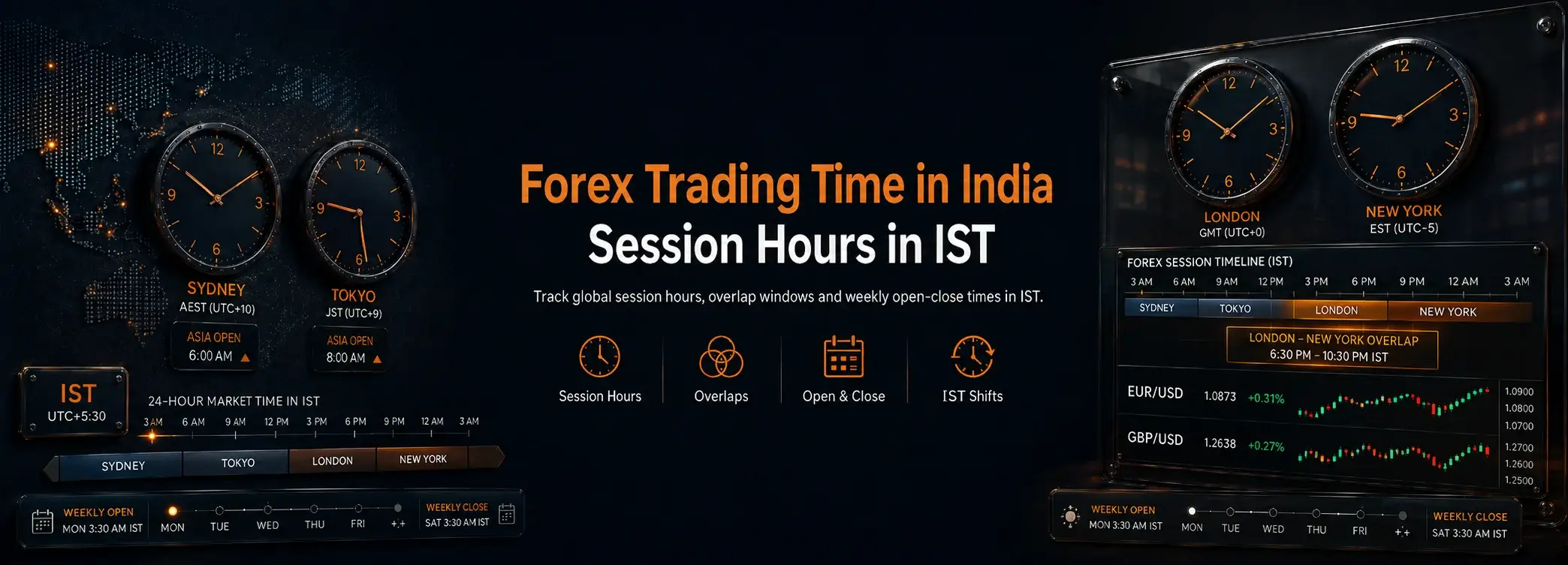
Forex trading time in India is best read in two layers. The global forex market runs almost continuously from around 3:30 AM IST on Monday to about 3:30 AM IST on Saturday, moving through four sessions — Sydney, Tokyo, London and New York — while INR pairs listed on Indian exchanges trade in a fixed eight-hour window.
Which layer matters depends on what you trade. Both shift twice a year when London and New York change their clocks, because IST never does.
Every session below is converted to Indian Standard Time, along with the weekly open and close by day, the overlap windows, and the short periods each year when the timings you memorised stop working.
Key Points
- The global forex market opens at around 3:30 AM IST on Monday and closes at around 3:30 AM IST on Saturday, shifting an hour earlier while London and New York observe daylight saving.
- The London–New York overlap, roughly 6:30 PM to 10:30 PM IST in standard time, is the most active window of the trading day — UK and US desks together handled about 57% of global forex turnover in April 2025 [1,2].
- INR pairs on Indian exchanges trade from 9:00 AM to 5:00 PM IST, a fixed window that closes before the busiest global hours begin [3].
Forex Trading Time in India at a Glance
Forex trading time in India spans the full 24-hour cycle, because no single exchange runs the market. It is an over-the-counter market that passes between banks in Sydney, Tokyo, London and New York, and each centre keeps its own business hours. Retail traders typically access these global pairs through Contracts for Difference (CFDs) rather than by dealing in the underlying currencies.
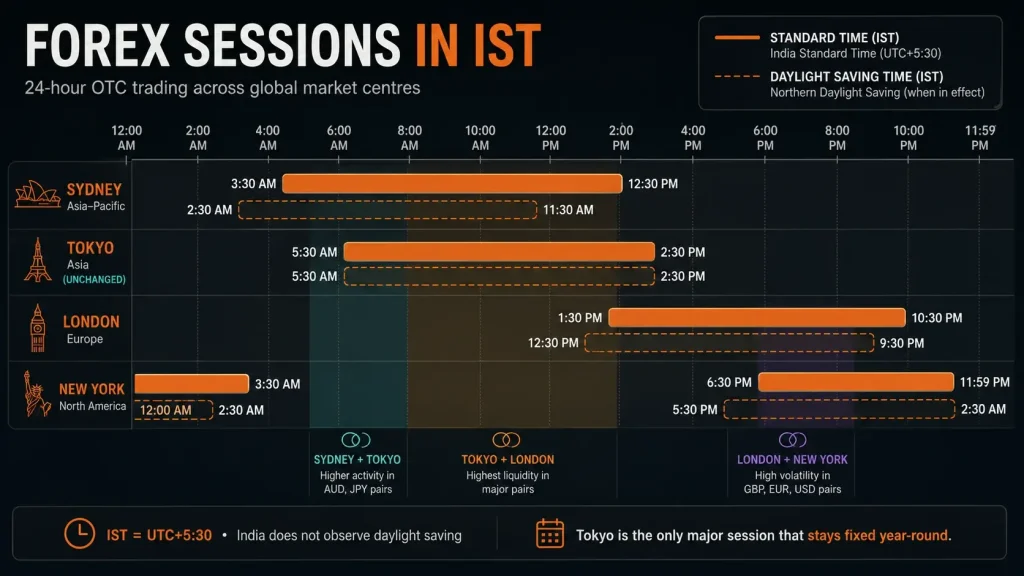
Converted to Indian Standard Time — a fixed UTC+5:30, with no seasonal adjustment — the four forex trading sessions fall like this.
| Session | Standard IST Hours | IST Hours During Northern Daylight Saving | Commonly Active Pairs |
| Sydney (Pacific) | 3:30 AM – 12:30 PM | 2:30 AM – 11:30 AM | AUD/USD, NZD/USD, AUD/JPY |
| Tokyo (Asian) | 5:30 AM – 2:30 PM | 5:30 AM – 2:30 PM (unchanged) | USD/JPY, AUD/JPY, USD/SGD |
| London (European) | 1:30 PM – 10:30 PM | 12:30 PM – 9:30 PM | EUR/USD, GBP/USD, EUR/GBP |
| New York (US) | 6:30 PM – 3:30 AM | 5:30 PM – 2:30 AM | EUR/USD, GBP/USD, USD/CAD |
Two things follow from that table. The Indian working day covers the tail of the Asian session and the whole of London’s morning, which puts the loudest hours of the market in the evening rather than during office hours. And Tokyo is the only session that never moves — every other row shifts by an hour for part of the year.
Access to these forex CFDs runs on the global schedule, not the Indian exchange schedule. The two are covered separately below.
Forex Session Times in India, Session by Session
Each session carries its own liquidity profile, its own pairs and its own hours in IST.
Asian Session Forex Time in India
The Asian session forex time in India runs from about 5:30 AM to 2:30 PM IST, anchored on Tokyo. It is the quietest of the four windows. Activity concentrates in JPY, AUD and NZD pairs, and daily ranges are usually narrower than during London or New York hours.
For anyone on a standard office schedule, this is the session that fits around a morning routine rather than a late night. Movement often picks up at the Tokyo open and again when Australian and Chinese data lands mid-morning. Japan does not change its clocks, so these hours hold all year. Memorise them once.
London Session Time in India
The London session time in India is 1:30 PM to 10:30 PM IST during standard time, and 12:30 PM to 9:30 PM IST while British Summer Time is in force. London is the largest venue in the market by a wide margin: UK-based desks handled $4.75 trillion of the $9.6 trillion traded globally each day in April 2025, or about 38% of the total [1,2].
That concentration shows up in trading conditions. The spread — the gap between the buy and sell price, and the implicit cost of opening a position — often narrows on major currency pairs such as EUR/USD once London is quoting. It can widen just as sharply around European data releases, and the same volatility that produces movement produces risk in both directions.
New York Session Time in India
The New York session time in India is 6:30 PM to 3:30 AM IST in standard time, moving to 5:30 PM to 2:30 AM IST during US daylight time. US-based desks accounted for roughly 19% of global turnover in April 2025 [1].
The first four hours carry most of the weight. That is when New York and London are open together, and when major US economic data releases land — which is a large part of why the window moves. Once London closes, liquidity usually thins for the rest of the session and ranges tend to compress into the early hours IST. Late-night trading is workable for anyone whose schedule suits it, though thin liquidity and fatigue make an awkward pair.
Sydney Session Time in India
The Sydney session time in India opens the trading week at around 3:30 AM IST, or 2:30 AM IST while London and New York are on summer time. It is the thinnest of the four windows, and its significance for most traders lies less in the session itself than in what it carries: the weekly open, when three days of accumulated news is priced in at once.
Gaps between Friday’s close and Monday’s open show up here first, usually in AUD and NZD pairs.
Forex Market Opening and Closing Time in India by Day
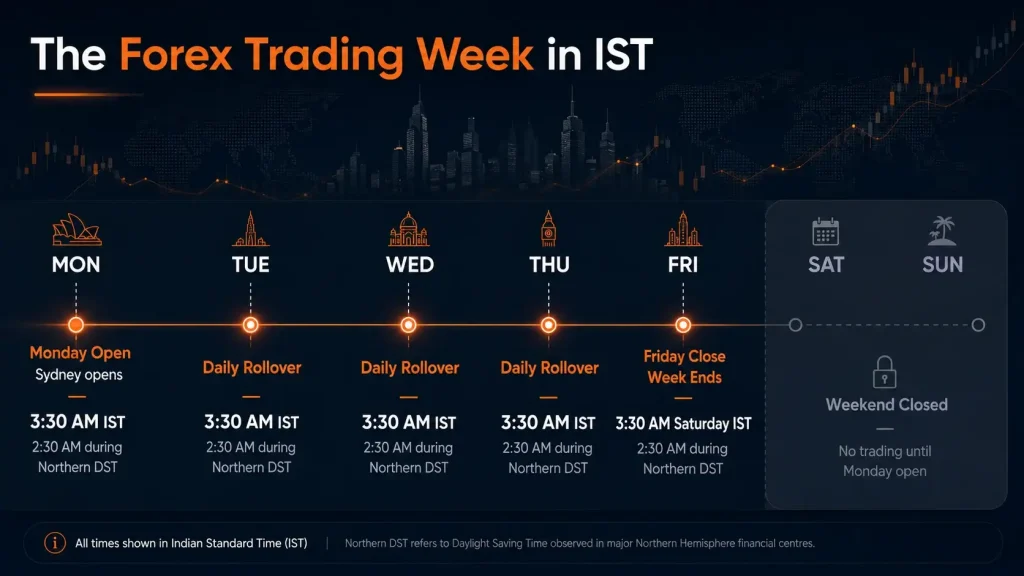
The forex market opening time in India on Monday is around 3:30 AM IST, when Sydney desks begin quoting. The week ends at around 3:30 AM IST on Saturday as New York closes. In between there is no daily bell — only a brief rollover pause on most platforms as the server date changes.
| Point in the Week | What Happens | Approx. IST (Standard) | Approx. IST (Northern DST) |
| Monday open | Sydney opens the trading week | 3:30 AM Monday | 2:30 AM Monday |
| Daily rollover | New York closes; swaps applied, daily candle resets | 3:30 AM | 2:30 AM |
| Friday close | Final session of the week ends | 3:30 AM Saturday | 2:30 AM Saturday |
| Saturday and Sunday | Closed to standard forex CFDs | No trading | No trading |
Two practical consequences come out of this. Positions held across the weekend cannot be closed or adjusted between Saturday morning and Monday morning IST, so anything that breaks in that gap is priced in at the open rather than gradually. And the daily rollover — the point at which swap charges apply and the daily candle resets — falls in the small hours IST, not at midnight local time.
Best Time to Trade Forex in India: Where the Sessions Overlap
Judged on liquidity rather than on any promise of outcome, the best time to trade forex in India is when two major centres are open at once. More participants are quoting, so spreads on majors often narrow and orders tend to fill closer to the requested price. The same conditions produce faster moves against a position as readily as for it, and leverage magnifies whichever direction the move takes.
| Overlap Window | IST (Standard) | IST (Northern DST) | Typical Activity | Commonly Active Pairs |
| London–New York | 6:30 PM – 10:30 PM | 5:30 PM – 9:30 PM | Highest | EUR/USD, GBP/USD, USD/CHF |
| Tokyo–London | 1:30 PM – 2:30 PM | 12:30 PM – 2:30 PM | Moderate | EUR/JPY, GBP/JPY |
| Sydney–Tokyo | 5:30 AM – 12:30 PM | 5:30 AM – 11:30 AM | Low to moderate | USD/JPY, AUD/USD, NZD/USD |
The London–New York overlap is the one most traders in India build a routine around, and the timing explains why: it lands in the evening, after the working day. It is also the window in which the market’s two largest centres — together roughly 57% of global turnover in April 2025 — are quoting side by side [1,2].
Daylight Saving Time and Why Your Session Times Move
India does not observe daylight saving. The UK and the US both do, and they do not switch on the same dates. That is why forex session times in IST move twice a year — and why, for a few weeks each year, they move only halfway.
UK clocks go forward on the last Sunday in March and back on the last Sunday in October, which in 2026 means 29 March and 25 October [4]. US daylight time is set separately under federal statute and runs from the second Sunday in March to the first Sunday in November — 8 March to 1 November in 2026.
The gap between those dates creates two short windows when New York has already sprung forward but London has not, or when London has fallen back and New York has not. During both, the London–New York overlap stretches from four hours to five in IST.
| Period (2026) | London Hours (IST) | New York Hours (IST) | London–New York Overlap (IST) |
| 1 Jan – 8 Mar | 1:30 PM – 10:30 PM | 6:30 PM – 3:30 AM | 6:30 PM – 10:30 PM (4 hours) |
| 8 Mar – 29 Mar | 1:30 PM – 10:30 PM | 5:30 PM – 2:30 AM | 5:30 PM – 10:30 PM (5 hours) |
| 29 Mar – 25 Oct | 12:30 PM – 9:30 PM | 5:30 PM – 2:30 AM | 5:30 PM – 9:30 PM (4 hours) |
| 25 Oct – 1 Nov | 1:30 PM – 10:30 PM | 5:30 PM – 2:30 AM | 5:30 PM – 10:30 PM (5 hours) |
| 1 Nov – 31 Dec | 1:30 PM – 10:30 PM | 6:30 PM – 3:30 AM | 6:30 PM – 10:30 PM (4 hours) |
Three weeks in March and one week at the end of October are the periods worth diarising. Anyone working from a memorised 6:30 PM start will be an hour late to the overlap for most of March, and an hour late again in the final week of October.
Exchange Hours, Platform Clocks and Instrument Timings
Session times describe the market. What you can actually trade, and when, depends on the product and the platform in front of you.
INR Pairs on Indian Exchanges
Currency derivatives listed on Indian exchanges follow fixed hours rather than the global cycle. NSE currency derivatives — including USD/INR, EUR/INR, GBP/INR and JPY/INR — trade from 9:00 AM to 5:00 PM IST, Monday to Friday, excluding exchange holidays [3].
Cross-currency contracts in the same segment close at 5:00 PM IST as well. A 7:30 PM close is still widely quoted online, but that timing was revised by exchange circular in March 2020 [3]. The practical effect is that the exchange-listed window shuts before the London–New York overlap even begins. Equity and index markets keep different hours again, both in India and abroad — see stock market trading hours for those schedules.
Gold and Other CFD Instruments
Gold CFD hours broadly track the forex week rather than the Indian exchange day, running from the Monday open to the Friday close with a short daily break around the New York rollover. Exact gold CFD trading hours vary by product and provider, and instruments such as indices, shares and energies carry their own schedules tied to their home exchange.
Vantage also lists XAUUSD247, a gold CFD available to trade 24 hours a day, seven days a week. Availability varies by region, and its spread and swap conditions differ from the standard gold contract, so the product specifications shown on the platform are the reference point.
What Your Platform Clock Shows
Charts rarely display IST. Vantage’s trading servers run on GMT+2, moving to GMT+3 while daylight saving is in force, so server midnight lines up with the 5:00 PM New York close. To convert, add 3 hours 30 minutes to server time in standard periods, or 2 hours 30 minutes during daylight saving.
That puts the daily candle on an MT4 or MT5 chart at roughly 3:30 AM IST rather than midnight in India. Anyone reading daily candles or building time-based rules around Indian clock hours is working from a different day boundary than the chart is.
Public holidays add a further layer. Indian exchange holidays close the INR-pair window entirely, while the global market usually stays open through them — though liquidity can thin noticeably around major international holidays such as Christmas, New Year and US Thanksgiving. Adjusted instrument hours around those dates are published in advance in Vantage’s trading hour notifications.
Timing Shapes Conditions, Not Outcomes
Knowing that the London–New York overlap opens at 6:30 PM IST tells you when spreads are likely to be tightest and when volume is likely to be heaviest. It says nothing about what price will do inside that window. A busier market is not a safer one — faster movement cuts both ways, and losses are always possible.
What session timing does offer is a way to work with your own schedule rather than against it. A trader who can only watch charts after 9:00 PM IST is looking at a different market from one who trades before lunch, and the pairs, the typical ranges and the spread conditions all differ accordingly. The hours you can realistically give the market are as much a part of the plan as the pairs you choose.
Frequently Asked Questions
What Time Does the Forex Market Open in India on Monday?
The global forex market opens at around 3:30 AM IST on Monday, when Sydney desks begin quoting, shifting to about 2:30 AM IST while London and New York are on daylight saving time. Liquidity is usually thin in those first hours, and price gaps between Friday’s close and Monday’s open are common when significant news has broken over the weekend. INR pairs on Indian exchanges do not open until 9:00 AM IST.
What Time Does the Forex Market Close in India on Friday?
The trading week ends when New York closes, which falls at around 3:30 AM IST on Saturday morning in standard time and 2:30 AM IST during daylight saving. Spreads often widen in the final hour as liquidity providers step back ahead of the weekend. The market does not reopen until Monday, so positions held across the break carry gap risk.
What Is the Best Time to Trade Forex in India?
On liquidity measures, the London–New York overlap is the most active window of the day — roughly 6:30 PM to 10:30 PM IST in standard time, and 5:30 PM to 9:30 PM IST during daylight saving. Spreads on major pairs are often at their tightest here and volume at its highest. Higher activity also means faster adverse moves, so the busiest window is not automatically the most suitable one for every approach or every level of experience.
When Does the London Session Open in India?
The London session opens at 1:30 PM IST during standard time and 12:30 PM IST while British Summer Time is in force, which in 2026 runs from 29 March to 25 October [4]. It closes nine hours later, at 10:30 PM or 9:30 PM IST respectively. London is the single largest forex venue, handling around 38% of global turnover in April 2025 [1,2].
When Does the Asian Session Start in India?
The Asian session starts at about 5:30 AM IST, taking its lead from Tokyo, and runs until roughly 2:30 PM IST. These hours do not move. Japan is the one major centre that does not observe daylight saving, so the session holds the same slot all year while London and New York shift twice. Activity concentrates in JPY, AUD and NZD pairs, and ranges are typically narrower than in the European and US sessions.
What Time Does the Gold Market Open in India?
Gold CFD trading generally follows the forex week rather than Indian exchange hours, opening at around 3:30 AM IST on Monday and closing at around 3:30 AM IST on Saturday, with a short daily break near the New York rollover. Exact hours vary by provider and product, so the platform’s contract specifications are the reliable reference. Extended-hours products exist as separate instruments — Vantage’s XAUUSD247, for example, trades through weekends where available.
RISK WARNING: CFDs are complex financial instruments and carry a high risk of losing money rapidly due to leverage. You should ensure you fully understand the risks involved and carefully consider whether you can afford to take the high risk of losing your money before trading.
Disclaimer: The information is provided for educational purposes only and doesn’t take into account your personal objectives, financial circumstances, or needs. It does not constitute investment advice. We encourage you to seek independent advice if necessary. The information has not been prepared in accordance with legal requirements designed to promote the independence of investment research. No representation or warranty is given as to the accuracy or completeness of any information contained within. This material may contain historical or past performance figures and should not be relied on. Furthermore estimates, forward-looking statements, and forecasts cannot be guaranteed. The information on this site and the products and services offered are not intended for distribution to any person in any country or jurisdiction where such distribution or use would be contrary to local law or regulation.
References
- “OTC foreign exchange turnover in April 2025 – Bank for International Settlements” https://www.bis.org/statistics/rpfx25_fx.htm Accessed 11 August 2026
- “BIS Triennial Survey of Foreign Exchange and Over-the-Counter Interest Rate Derivatives Markets in April 2025 – Bank of England” https://www.bankofengland.co.uk/news/2025/september/bis-triennial-survey-of-foreign-exchange-and-over-the-counter-interest-rate-derivatives-markets Accessed 11 August 2026
- “Market Timings – NSE India” https://www.nseindia.com/static/market-data/market-timings Accessed 11 August 2026
- “When do the clocks change? – GOV.UK” https://gov.uk/when-do-the-clocks-change Accessed 11 August 2026