


 Updated
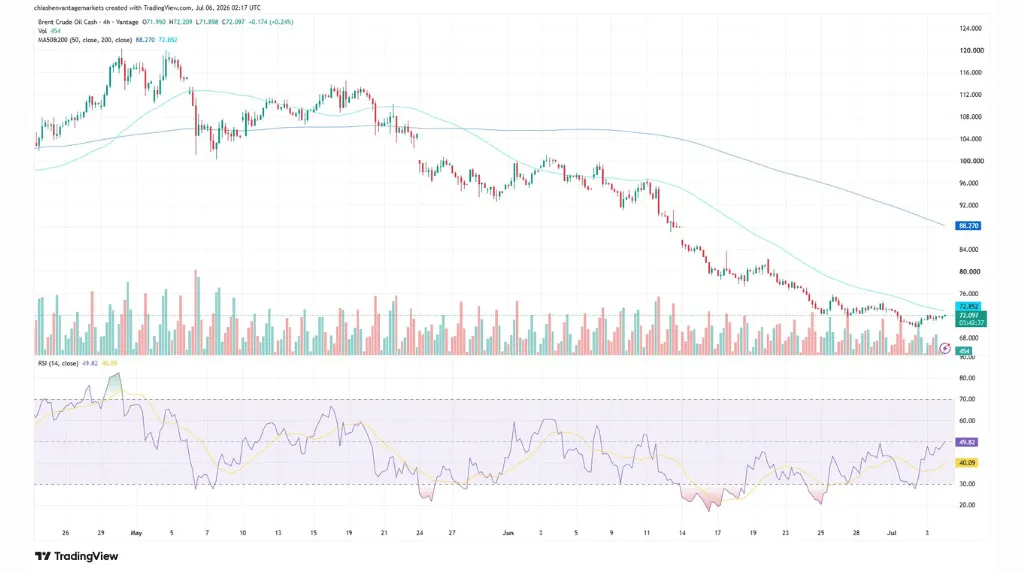
The Brent crude latest price has fallen sharply through the first half of 2026, posting its steepest quarterly decline since 2020 as a war premium tied to the Middle East conflict, involving Israel and Iran and concerns surrounding the Strait of Hormuz, unwound. Brent traded in the low-USD 70s per barrel in early July 2026, well off the 52-week high near USD 126 hit earlier in the year.
Crude oil is a core commodity in the modern world, the raw material behind everything from the fuel in our tanks to the plastics and chemicals that power global industry. Because oil is so central to the global economy, its price is more than a commodity quote. It is an economic barometer that guides markets, sets inflation expectations, and shapes government policy on every continent.
There are two major global crude oil benchmarks: Brent crude and West Texas Intermediate (WTI). Each is based on crude extracted from different regions and carries slightly different physical characteristics. While US-based WTI gets plenty of attention, the international standard is most often set by Brent. This guide covers what Brent crude oil is, what has been moving the Brent crude oil price in 2026, how the futures and CFD markets around it work, and how to approach a Brent crude oil price chart using fundamental and technical analysis.
Key Points
- Brent crude oil, extracted from the North Sea, is a light and sweet benchmark used to price around 78% of the world’s traded physical crude oil, either directly or indirectly, according to ICE.1
- The Brent crude oil price fell sharply through the second quarter of 2026, unwinding a war premium tied to the Middle East conflict and posting its steepest quarterly decline since 2020.
- Trading Brent crude oil spans futures, exchange-traded funds (ETFs), stocks, and Contracts for Difference (CFDs), each suited to a different type of trader and risk appetite.
What is Brent Crude Oil?
What is Brent oil, exactly? Brent crude oil refers to crude oil extracted from the North Sea, off the coast of Europe, from several oil fields including Brent, Ekofisk, Forties, and Oseberg. The Brent crude meaning, in short, comes down to two things: where it is extracted, and how easily it refines.
Crude oil is an essential natural resource that underpins the global economy, and the Brent crude oil price is a key indicator across the global oil market. Around 78% of globally traded physical crude oil is priced off the Brent benchmark, either directly or indirectly, according to Energy Intelligence data cited by ICE.1
So why is Brent crude oil regarded as the global benchmark? The answer lies in how easily it can be refined into petroleum products, which is where most of the commodity’s value is realised.
Brent crude oil is classified as light and sweet, meaning it has a lower density and a sulphur content below 0.5%. These characteristics make it easier to refine than crude oils without these properties.2
History of Brent Crude Oil
The story of Brent crude is the story of the North Sea oil boom. Phillips Petroleum struck oil in the Ekofisk field in 1969, and the Brent field itself was discovered in 1971, followed quickly by Ninian and Oseberg.3
As production ramped up, oils with similar qualities were grouped into a single Brent Blend. Because it was light and sweet, and therefore easily refined into high-value fuels, it became the pricing benchmark through the 1980s and 1990s, particularly in European and Asian markets.
The original fields ran dry by the early 2000s, and the original Brent oil field was decommissioned in 2017, but the benchmark did not disappear. The Brent Blend has since been updated to include oil from Forties, Oseberg, Ekofisk, and Troll (together known as BFOET), with Midland WTI crude from Texas added to the wider Brent complex in 2023.4 Find out the differences between Brent versus WTI crude oil in this guide now!
Why Trade Brent Crude Oil?
Brent crude oil trades via futures contracts on the Intercontinental Exchange (ICE) and NYMEX, as well as through options, ETFs, stocks, and CFDs. Some participants, such as refineries and airlines, use the market to hedge and lock in prices against sudden swings. Others trade it purely to take advantage of the opportunities created by those swings. Here is why it earns a spot in many trading strategies. Discover all crude oil news today here!
Diversification
As a physical commodity, Brent crude generally exhibits a lower and more variable correlation with equities than many financial assets, which can make it a useful portfolio diversifier under certain market conditions. That correlation is not fixed: oil and equities sometimes move together and sometimes move in opposite directions, since oil ultimately operates on its own supply-and-demand fundamentals.
Inflation Hedge
Because energy prices are a major component of inflation, Brent crude has historically performed well during some inflationary periods, although it is not a guaranteed hedge against rising prices. Higher oil prices can just as easily be a cause of inflation as a way to offset it.
Essential Commodity with Long-Term Demand
Although Brent crude is not traditionally regarded as a safe-haven asset in the way gold, US Treasuries, or the US dollar are, it remains an essential global commodity with persistent long-term demand. Oil has historically fallen during recessions, including in 2008, 2020, and the initial reaction to the 2023 SVB banking crisis, as demand expectations weakened. During periods of geopolitical tension rather than demand shocks, however, supply disruptions may support prices even while broader financial markets weaken.
Potential Trading Opportunities
A look back through Brent crude oil price history shows extended periods of volatility, including the swing described later in this guide. That volatility creates opportunities for traders pursuing short-term price moves, though it naturally carries elevated risk too.
Start Trading Today: If you are considering trading Brent crude oil via CFDs, Vantage offers access to Brent crude oil CFD products. CFDs allow traders to gain exposure to price movements without owning the underlying asset. CFDs are leveraged products and carry significant risk.
Historical Trends of the Brent Crude Oil Market
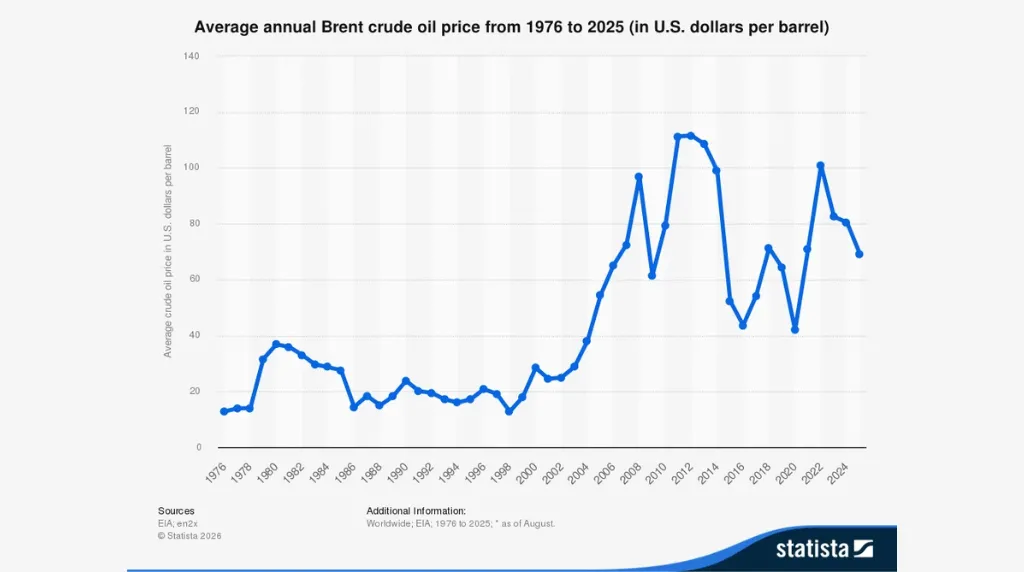
A long-term Brent crude oil price chart shows a market that has rarely stood still. Despite being the global benchmark referenced by around 78% of the world’s oil market, the Brent crude oil price is highly volatile.5
The sections below cover a few periods of extreme volatility in Brent crude oil price history to explain what has driven these swings.
2004 to 2008
Between 2004 and 2008, the Brent crude oil price climbed sharply, hitting nearly USD 100 per barrel at its peak.6
The drivers included a supply-demand mismatch as global oil demand surged faster than producers could ramp up extraction, the long lead times required to bring new production online, and a run of disruptions including worker strikes, militant attacks, and the aftermath of the Iraq War.
The Great Recession of 2008 then triggered a near-overnight collapse in demand. By 2009, the Brent crude oil price had fallen by nearly 40%.
2014 to 2016
Prices recovered after the recession and set new record averages in 2011 and 2012, but this stability did not last. By 2014, a sharp multi-year decline began that ran until 2016.7
A growing supply glut, driven by rising efficiency in US shale production, combined with weakening demand from major oil-importing economies including the US and China, and a run of downgraded long-term price forecasts, drove the market lower.
2020 to 2022
This period reshaped energy markets. Between 2020 and 2022, average Brent crude oil prices swung from USD 41.96 per barrel up to USD 100.93.8
Pandemic lockdowns in 2020 collapsed demand and, combined with disagreements between oil-producing nations, crashed prices to unprecedented lows. As the world reopened, demand rebounded faster than expected. Lockdown-related supply chain bottlenecks, a harsh winter, and the outbreak of the Russia-Ukraine war then combined to push prices sharply higher for two years.
2025 to 2026: War Premium and Unwind
The most recent case study is still playing out. A Middle East conflict that intensified in early 2026 pushed the Brent crude oil price to a 52-week high near $126 per barrel, within a 52-week range of roughly $58.72 to $126.41, as concerns grew over shipping disruption through the Strait of Hormuz.9
Through the second quarter of 2026, that war premium unwound sharply. Diplomatic talks between the US and Iran in Doha, rising export volumes from Iran and Russia, and the resumption of shipping through the Strait of Hormuz each contributed to one of the steepest quarterly declines in the benchmark’s history, with Brent trading back in the low-$70s per barrel by early July 2026. As with most large market moves, no single factor was solely responsible.10
Some analysts revised their outlooks lower during the move. JPMorgan’s commodities team, for example, lowered its year-end Brent forecast to $64 per barrel as the supply picture eased.9 That kind of swing shows how fast a forecast can move once the news changes, not where the Brent crude oil price is headed next.
What Affects Brent Crude Oil Prices?
The historical moves above show that Brent prices do not move at random. They are driven by three main forces: supply and demand, macroeconomic conditions, and geopolitical events. See all latest Brent Crude Oil news here.
Supply and Demand Levels
It sounds intuitive: if demand for oil rises or supply falls, the Brent crude oil price should rise, and vice versa. But most crude oil trade does not happen with physical barrels. It happens in futures markets, where contracts obligate buyers and sellers to transact on a set future date, although most contracts are closed out before physical delivery is due. This means the Brent price chart can diverge from simple supply-and-demand expectations.
For example, in early 2020, oil producers agreed to historic production cuts to stabilise prices, but the collapse in demand from COVID-19 sent the Brent crude oil price to a 20-year low regardless.
Prices are also sensitive to market sentiment, which is amplified by the mechanics of futures contracts. If traders believe prices will rise, they buy futures contracts, which can create a self-fulfilling price move in either direction.11
Macroeconomic Factors
Oil is deeply intertwined with the global economy. When major economies are expanding, shipping increases and factories run at capacity, lifting demand for Brent crude. During a slowdown, industrial and consumer demand falls, pulling the price down with it.
Geopolitical Issues
Geopolitical shocks are behind almost every major disruption in Brent crude oil price history. The main triggers to watch include:
- Conflict in oil-producing regions: Wars and sanctions can choke off supply quickly, as seen when sanctions followed Russia’s invasion of Ukraine.12
- Cartel decisions: As of mid-2026, OPEC consisted of 11 member countries following the UAE’s departure from the group earlier in the year; membership has changed before and may change again. OPEC+ (OPEC plus a group of allied producers including Russia) has historically accounted for a significant share of global oil supply, though that share moves with each round of quota decisions.13
- Government policy: Green initiatives that reduce oil and gas use across industries can lower demand, while supply-side policy shifts can just as easily tighten the market during periods of high seasonal demand.
Types of Brent Crude Oil Trading
Most Brent crude oil trading happens in futures markets, but these contracts are complex, carry high risk, and are generally suited to highly experienced investors. Less experienced retail investors seeking exposure to oil markets may find it more manageable to use ETFs, stocks, or CFDs.
Oil Exchange-Traded Funds (ETFs)
Oil ETFs may track crude oil futures, energy companies, or a combination of related assets, depending on the fund. Some cover companies involved in prospecting, extraction, production, distribution, and retail, while others aim to mirror the spot or futures price more directly.14
- Best for: Broad market exposure and longer-term time frames, since ETFs diversify risk across multiple assets. Traders seeking shorter-term moves may prefer CFDs, discussed below.
Oil and Energy Stocks
Traders who prefer specific companies within the crude oil supply chain can trade oil and energy stocks through an online broker, spanning discovery, extraction, refining, and distribution, as well as related sectors such as petrochemicals. Individual energy stocks also introduce company-specific risks alongside oil price exposure, which is where oil CFDs can offer more direct exposure to the commodity itself.
Oil Contracts for Difference (CFDs)
The volatility in the Brent crude oil price makes it attractive to traders pursuing shorter-term strategies.
- How it works: A CFD lets you trade on the price movement of Brent crude over a time frame of your choosing, without taking physical ownership of the underlying barrels. You trade on the difference between the price when you open the contract and the price when you close it.
- Available instruments on Vantage: UKOUSD tracks the Brent Crude Oil Cash (spot) price, and UKOUSDft tracks the Brent Crude Oil Future price.
Brent Crude Oil Price Today, Chart, and Futures Symbol
Because the Brent crude oil price moves throughout the trading session, a live price chart is the most reliable way to see where the market stands right now, rather than relying on a fixed figure in a guide like this one. Some traders call this the Brent crude oil rate rather than the price, but the two terms mean the same thing.
You can follow Brent crude oil TradingView charts directly, or via the Vantage UKOUSD live price page, which also uses TradingView-powered charting. A CFD price such as UKOUSD tracks the spot market continuously, while an exchange-listed futures price reflects a specific contract month and will differ slightly from the spot price and from other contract months.
| Metric | Detail |
| 52-week price range | Roughly USD 58.72 to USD 126.41 per barrel9 |
| Q2 2026 move | Steepest quarterly decline since 202010 |
| Share of global crude pricing | Around 78% of globally traded physical crude, directly or indirectly1 |
| ICE futures ticker | B (ICE Futures Europe, Brent Crude futures)4 |
| Vantage CFD tickers | UKOUSD (Brent Crude Oil Cash), UKOUSDft (Brent Crude Oil Future) |
What is the Symbol for Brent Crude Oil Futures?
The base ICE Futures Europe symbol for Brent crude oil futures is B. Related cash-settled contracts also trade on NYMEX, including the Brent Last Day Financial Futures contract (symbol BZ) and the Brent Penultimate Financial Futures contract (symbol BB), both of which are priced off the ICE Brent Crude Futures and ICE Brent Index.4 These exchange ticker codes are separate from Vantage’s own CFD tickers, UKOUSD and UKOUSDft, described above.
Where to Download Historical Stock Data for Brent Crude Oil
For research or backtesting, the US Energy Information Administration (EIA) publishes a free, downloadable historical series for the Europe Brent Spot Price, going back decades. Some traders look for this as historical stock data, though Brent is a traded commodity rather than a listed stock. Either way, the EIA series is a useful primary source if you want raw historical data rather than a chart image.15
How to Trade Brent Crude Oil
Start Brent Crude Oil Trading
1. Open a Live Account
If you decide to trade Brent crude oil CFDs, you will need a live Vantage trading account. Once approved, you can fund your account and begin trading. CFDs are leveraged products and carry significant risk.
2. Decide Which Brent Crude CFD to Trade
Vantage offers two types of Brent crude CFDs:
- Brent Crude Oil Cash CFD, which tracks the spot price of Brent crude in real time.
- Brent Crude Oil Future CFD, for price movements in the Brent oil futures market. Oil futures are more complex and tend to suit more experienced traders.
3. Research and Analyse the Brent Crude Oil Market
It is difficult to trade successfully without understanding the market. Researching the characteristics of Brent crude oil, and how it behaves, can help you make more informed decisions. You can stay updated with Market Analysis on Vantage.
4. Build Brent Crude Trading Strategies
As your understanding of the Brent crude oil market grows, and you develop a sense of your own trading style, it can help to build a consistent set of strategies rather than trading on an ad-hoc basis.
How to Buy Brent Crude Oil Futures
Buying an exchange-listed Brent crude oil futures contract directly requires a brokerage account approved for futures trading, since each contract represents 1,000 barrels and is subject to exchange margin requirements. Because of the size and complexity involved, futures are generally better suited to experienced or institutional traders. Retail traders looking for exposure to the same price movements more commonly use CFDs, ETFs, or oil and energy stocks instead, as covered earlier in this guide.
Trade Brent Crude Oil Using Fundamental Analysis
Fundamental analysis is the practice of looking at the real-world factors surrounding an asset. For a global commodity like Brent crude, that means keeping track of macroeconomic trends and geopolitical developments. A historical example shows how real-world news can move the market even without any change to physical supply.
Case Study: The SVB Collapse (Early 2023)
The Brent crude oil price can react sharply to economic news from major economies. When Silicon Valley Bank in the United States collapsed in March 2023 under the weight of prolonged high interest rates, Brent fell more than 6% to its lowest level in over a year, as fears of a wider banking crisis spread through financial markets.16
The collapse deepened concerns about the health of the US economy and the risk of further monetary tightening, and that drop in sentiment coincided with the fall in Brent prices, despite no change to the physical oil market itself.
Trade Brent Crude Oil Using Technical Analysis
Technical analysis relies on chart data and indicators to spot patterns and gauge whether a price trend is likely to continue. By filtering out market noise, it lets traders focus on price action, one of the more widely followed measures of market sentiment. Studying Brent crude oil price history does not guarantee future outcomes, but it is a useful tool for timing entry and exit points.
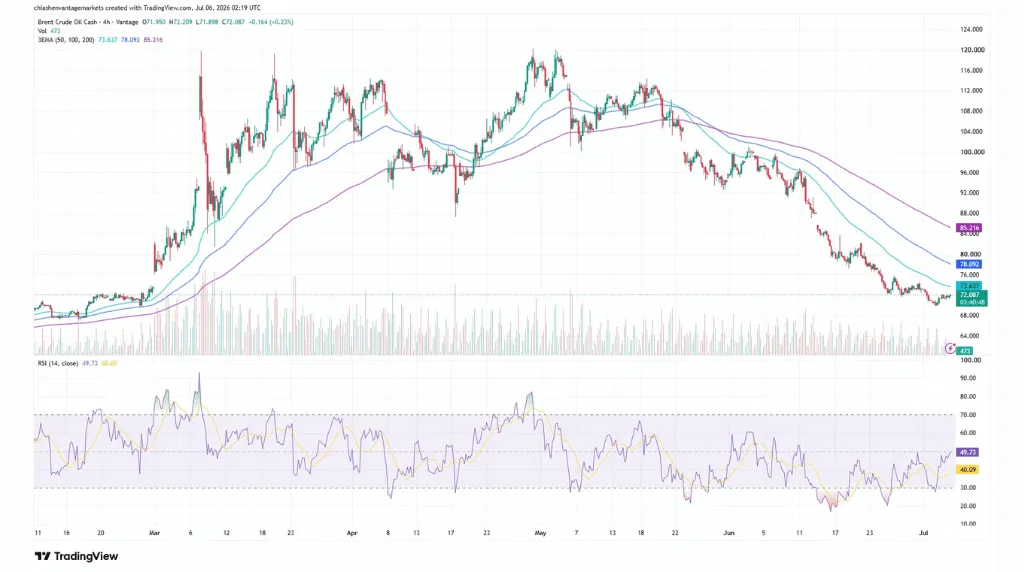
Two popular indicators for reading a Brent crude oil price chart are the Triple EMA (3-EMA) strategy and the RSI. A Brent oil chart with both overlaid is shown below.
Triple EMA Strategy for Brent Crude Oil Trading
A moving average filters out daily noise by creating a constantly updated average price, helping traders confirm broader trends and identify support and resistance. Exponential moving averages (EMAs) place more weight on recent prices, making them more responsive to sudden shifts.
A Triple EMA strategy plots three time frames: a fast (20-day), medium (50-day), and slow (200-day) average. This is distinct from a single 3-period EMA, which is a much faster, single moving average line.
- Bullish signal: When a faster EMA crosses above a slower one.
- Bearish signal: When a faster EMA crosses below a slower one.
Adding a third, longer-term line to a two-line setup can provide stronger confirmation that a trend is genuine, since traders typically wait for the fastest line to cross back above or below the longer-term lines before treating a reversal as confirmed.
RSI for Brent Crude Oil Trading
The Relative Strength Index (RSI) is a momentum oscillator used to show when an asset is over-bought or over-sold. The index ranges from 0 to 100, with 30 and 70 as the customary boundaries.
- Under 30: Traditionally considered oversold, indicating the asset has been heavily sold.
- Over 70: Traditionally considered overbought, indicating the asset has been heavily bought and the price may be stretched.
As with any indicator, RSI readings are specific to the chart setup used and should be read alongside price action and the broader market context, rather than in isolation.
Risk Management When Trading Brent Crude Oil
Crude oil is a highly volatile commodity, and Brent crude oil is no exception. Because the market is highly sensitive to geopolitical events and macroeconomic shifts, forecasting the Brent crude oil price is inherently difficult.
A few core risk management concepts are worth understanding before trading Brent crude oil.
Trade Sizing
It can be tempting to place a large position in the hope of a bigger outcome, but this can also lead to heavier losses. Many risk management frameworks reference limiting exposure per trade to a small percentage of total account equity, often cited as being in the region of 1% to 2%, with some traders reducing this further as an account grows.17
Leverage
Many traders use CFDs to gain exposure to the Brent oil price partly because of the leverage on offer. Leverage allows exposure to a larger position with less upfront capital, but it works both ways: it amplifies losses just as much as gains. Depending on the broker and regulatory jurisdiction, losses may exceed the initial deposit, resulting in a negative account balance, though some regulators require brokers to offer negative balance protection. Leverage is a tool best used with experience and a clear understanding of the added risk involved.
Order Types Used to Manage a Position
Some traders use predetermined price levels to manage when a position closes, aiming to remove emotion from the decision:
- Stop-Loss: Closes a losing position at a specific price, limiting losses to a planned size rather than letting them run.
- Take-Profit: Closes a position once a chosen price level is reached, which can help avoid overtrading by locking in the outcome of a move rather than holding indefinitely.
Brent Crude Oil Trading Hours
Trading hours for Brent crude depend on the instrument. ICE-listed futures open from 11am London time on Sundays, with pre-open from 10am, then run through the exchange calendar all week.18 CFDs, stocks, and ETFs instead follow the hours set by the broker, shown below for Vantage.
| Description | Symbol | Trading time (GMT+2) |
| Brent Crude Oil Cash | UKOUSD | Monday 01:00-24:00; Tue-Fri 03:00-24:00 |
| Brent Crude Oil Future | UKOUSDft | Monday 01:00-24:00; Tue-Fri 00:00-01:00, 03:00-24:00 |
Key Takeaways for Brent Crude Oil Trading
As one of the most actively traded commodities, Brent crude offers plenty for traders and investors to work with. Before diving in, keep these principles in mind:
- Volatility: The Brent crude oil price is highly sensitive to geopolitical events, macroeconomic developments, and breaking market news.
- The futures factor: Because most Brent crude trading happens via futures contracts, market sentiment can be amplified, leading to rapid price swings.
- Match your instrument to your experience: Futures and options carry high risk and are generally unsuitable for beginners. Newer investors, or those with a longer time horizon, may find Brent ETFs or energy stocks a more manageable starting point.
Trading it well tends to come down to staying disciplined, reacting quickly to new information, and managing risk consistently rather than trying to call every swing.
Trade Brent Crude CFDs at Vantage

Vantage offers Brent crude CFDs with competitive spreads and no deposit fees, monthly rollover fees, or hidden charges. Spread costs apply, and overnight financing (swap) charges may apply to positions held overnight, depending on the product and account. Sign up now to open a live account.
- Complete transparency: No deposit fees, no monthly rollover fees, and no hidden charges.
- Choice of platforms: Trade via MetaTrader 4 (MT4), MetaTrader 5 (MT5), or the Vantage mobile app.
- Flexibility: Deploy long and short strategies, alongside a range of risk management tools, whichever way the market is trending.
Frequently Asked Questions (FAQs)
What is the current price of Brent crude oil?
The Brent crude oil price changes throughout every trading session, so the most reliable way to check the Brent crude oil latest price is a live feed rather than a fixed number in an article. You can follow the Brent crude latest price on the Vantage UKOUSD page. As a guide, Brent traded in the low-USD 70s per barrel in early July 2026, within a 52-week range of roughly USD 58.72 to USD 126.41.9 10
What is the difference between Brent and crude oil, and which oil price should I use Brent or crude oil?
Brent is not a separate substance from crude oil. It is one specific type, or benchmark, of crude oil, alongside others such as WTI (West Texas Intermediate) and various regional grades. The difference most people are really asking about is Brent versus WTI, the two most widely quoted benchmarks.
The main difference between Brent crude oil and WTI crude oil is the location of extraction. Brent crude is a blend of light, sweet crudes from the North Sea, while WTI is extracted from fields in the US, including Texas, North Dakota, and Louisiana. Brent is generally treated as the international benchmark, while WTI is the primary US benchmark, and the two also differ in storage, transportation, and exchange listings.
Because both are light and sweet, their prices are correlated, but differences in extraction location, transport, and exchange listings mean one can trade above the other at different times. Which oil price to use, Brent or another benchmark, often comes down to which market you are actually trading. If you are trading a Brent-based instrument such as UKOUSD, the Brent crude oil price is the relevant reference. If you are trading a WTI-based instrument, WTI is the more relevant benchmark.
What is the symbol for Brent crude oil futures?
The ICE Futures Europe symbol for Brent crude oil futures is B. Related NYMEX-listed contracts use the symbols BZ and BB, and Vantage’s own CFD tickers, UKOUSD and UKOUSDft, are separate from these exchange codes.4
How do I buy Brent crude oil futures?
Buying an exchange-listed Brent crude oil futures contract requires a brokerage account approved for futures trading and sufficient margin, since each contract represents 1,000 barrels. Because of the size and complexity involved, futures tend to suit experienced or institutional traders. Many retail traders instead choose CFDs, ETFs, or energy stocks to gain exposure to the same underlying price moves.
Where can I find historical Brent crude oil price data?
The US Energy Information Administration publishes a free, downloadable historical series for the Europe Brent Spot Price. It is a useful primary source for research or backtesting, in addition to the charting tools available on your trading platform.15
What are the risks of Brent crude oil trading?
Brent crude oil prices are highly volatile, which is a major consideration for investors and traders. As the main benchmark for the world’s most important commodity, Brent crude can be affected by a wide range of events, some more visible than others. Wild price swings are not uncommon in Brent’s historical prices, so proper risk management is important, and traders should expect to invest time in understanding the market and to be wrong sometimes.
Can I practice Brent crude oil trading?
Yes. Traders and investors who want to practise Brent crude trading and test strategies on paper can do so with a free Vantage demo account. There are no fees or minimum deposit required to practise Brent oil trading with a demo account.
RISK WARNING: CFDs are complex financial instruments and carry a high risk of losing money rapidly due to leverage. You should ensure you fully understand the risks involved and carefully consider whether you can afford to take the high risk of losing your money before trading.
Disclaimer: The information is provided for educational purposes only and doesn’t take into account your personal objectives, financial circumstances, or needs. It does not constitute investment advice. We encourage you to seek independent advice if necessary. The information has not been prepared in accordance with legal requirements designed to promote the independence of investment research. No representation or warranty is given as to the accuracy or completeness of any information contained within. This material may contain historical or past performance figures and should not be relied on. Furthermore estimates, forward-looking statements, and forecasts cannot be guaranteed. The information on this site and the products and services offered are not intended for distribution to any person in any country or jurisdiction where such distribution or use would be contrary to local law or regulation.
References
- “Brent: the world’s crude benchmark – ICE”. https://www.ice.com/insights/market-pulse/brent-the-worlds-crude-benchmark. Accessed 1 July 2026.
- “Energy Investing Basics: WTI vs. Brent Crude Oil – Charles Schwab”. https://www.schwab.com/learn/story/energy-investing-basics-wti-vs-brent-crude-oil. Accessed 5 April 2024.
- “The North Sea, A Long and Proud History – TheWayAhead”. https://jpt.spe.org/twa/the-north-sea-a-long-and-proud-history. Accessed 5 April 2024.
- “Brent Crude – Wikipedia”. https://en.wikipedia.org/wiki/Brent_Crude. Accessed 1 July 2026.
- “Navigating Oil Price Risk – ICE”. https://www.ice.com/insights/market-pulse/navigating-oil-price-risk. Accessed 1 July 2026.
- “The 2008 Oil Price Shock: Markets or Mayhem? – Resources for the Future”. https://www.resources.org/common-resources/the-2008-oil-price-shock-markets-or-mayhem/. Accessed 5 April 2024.
- “What triggered the oil price plunge of 2014-2016 – World Bank Blogs”. https://blogs.worldbank.org/en/developmenttalk/what-triggered-oil-price-plunge-2014-2016-and-why-it-failed-deliver-economic-impetus-eight-charts. Accessed 5 April 2024.
- “Average annual Brent crude oil price from 1976 to 2024 – Statista”. https://www.statista.com/statistics/262860/uk-brent-crude-oil-price-changes-since-1976/. Accessed 7 April 2024.
- “Brent Crude Oil Futures Price Today – Investing.com”. https://www.investing.com/commodities/brent-oil. Accessed 1 July 2026.
- “Brent crude oil – Price, Chart, Historical Data, News – Trading Economics”. https://tradingeconomics.com/commodity/brent-crude-oil. Accessed 1 July 2026.
- “What Determines Oil Prices? – Investopedia”. https://www.investopedia.com/articles/economics/08/determining-oil-prices.asp. Accessed 5 April 2024.
- “Oil Market and Russian Supply – IEA”. https://www.iea.org/reports/russian-supplies-to-global-energy-markets/oil-market-and-russian-supply-2. Accessed 5 April 2024.
- “Short-Term Energy Outlook, Table 3d: World Crude Oil Production – US Energy Information Administration”. https://www.eia.gov/outlooks/steo/tables/pdf/3dtab.pdf. Accessed 1 July 2026.
- “Oil ETF: What It Is, How It Works, and Challenges – Investopedia”. https://www.investopedia.com/terms/o/oil-etf.asp. Accessed 5 April 2024.
- “Europe Brent Spot Price FOB – US Energy Information Administration”. https://www.eia.gov/dnav/pet/hist/rbrted.htm. Accessed 1 July 2026.
- “Oil falls more than 6% to lowest in more than a year as banking fears mount – CNBC”. https://www.cnbc.com/amp/2023/03/15/oil-prices-bounce-back-helped-by-stronger-opec-outlook-for-china.html. Accessed 6 July 2026.
- “Risk Management Techniques for Active Traders – Investopedia”. https://www.investopedia.com/articles/trading/09/risk-management.asp. Accessed 5 April 2024.
- “Brent Crude Futures – ICE”. https://www.ice.com/products/219/Brent-Crude-Futures. Accessed 5 April 2024.