


 Updated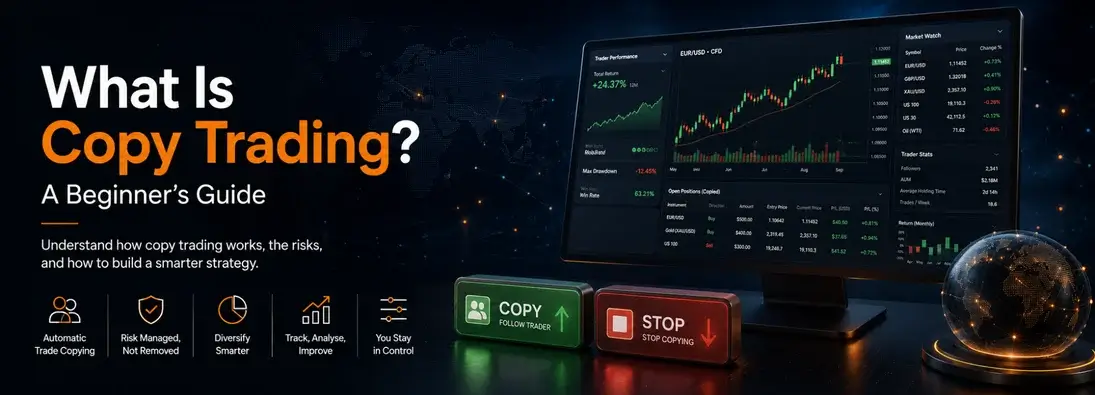
Copy trading lets you automatically replicate another trader’s positions in your own account, so their trades open and close in yours in real time. Once a niche feature, it has become a mainstream part of retail trading and is now documented in mainstream investor-education resources [1].
The market for copy trading and related platforms was estimated at around $2.62 billion in 2025. Some industry reports forecast it could reach approximately $3.77 billion by 2030, although forecasts are inherently uncertain [2]. For beginners, one attraction is the ability to automatically replicate another trader’s CFD positions without making every trading decision yourself.
This guide covers how copy trading and the platforms behind it work, who takes part, its benefits and real risks, how followers build a strategy, and what to weigh before copying anyone — though it does not recommend who to copy.
Key Points
- Copy trading automatically mirrors a chosen trader’s Contract for Difference (CFD) positions in your account, scaled to the funds you allocate, rather than requiring you to place each trade yourself.
- It can save time and open the markets to less experienced traders, but it does not remove risk — losses are copied just as faithfully as gains, and past performance never guarantees future results.
- Choosing whom to copy, sizing your allocation, and reviewing performance are the decisions that shape your outcome, which is why copy trading is better treated as active oversight than a hands-off shortcut.
What Is Copy Trading and How Does It Work?
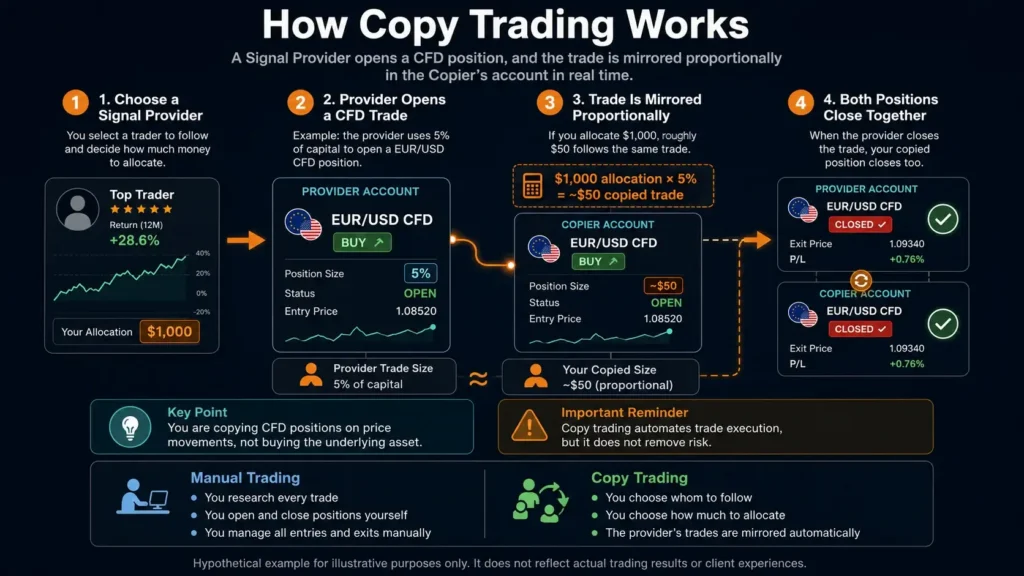
Copy trading is a method of trading in which the positions of one trader are automatically replicated in another trader’s account. When the trader being copied opens or closes a position, the same move is mirrored in your account, scaled to the amount you have chosen to allocate. Because the instruments involved are Contracts for Difference (CFDs), you are copying positions on the price movement of an asset rather than buying the asset itself.
The replication is proportional, not identical.
If a trader you copy commits 5% of their capital to a EUR/USD CFD position and you have allocated $1,000 to copying them, roughly $50 of your allocation follows that trade. When they close it, your copied position closes too.
This example is hypothetical and for illustrative purposes only. It does not reflect actual trading results or client experiences.
This is what separates copy trading from trading manually. With manual trading, you research, open, and close every position yourself and carry the full result. With copy trading, you keep control over whom you follow and how much you commit, but hand the individual entries and exits to the trader you copy.
The Two Roles: Signal Providers and Copiers
Copy trading involves two roles. Signal Providers are traders who make their positions available for copying. Depending on the platform’s fee structure, they may receive a share of profits generated by Copiers who have agreed to the applicable profit-sharing arrangement. Copiers are traders who mirror a Signal Provider’s live CFD positions, gaining market exposure without deciding each trade themselves.
A Copier can follow more than one Signal Provider at a time, and an experienced trader can do both — copying some strategies while sharing their own. If you want to understand the earning side in more detail, Vantage’s guide to becoming a Signal Provider walks through how profit sharing works.
How Do Copy Trading Platforms Work?
Copy trading runs on platforms that connect the traders being copied with those doing the copying. Once you fund an account and choose someone to follow, the platform handles the replication automatically — matching each of their CFD positions to your account in proportion to your allocation, and closing them when they do.
Most platforms give you a profile for each trader you can copy, so you can review how they have performed before committing. Those figures describe past activity only; none of them predicts future results.
| Profile Metric | What It Shows | What to Keep in Mind |
| Historical return | Percentage gain or loss over a set period | A strong past return does not carry forward |
| Risk band | A rating of how much volatility the trader takes on | A higher band means larger swings, up and down |
| Winning percentage | Share of past trades that closed in profit | A high win rate can still hide a few large losses |
| Maximum drawdown | The largest peak-to-trough fall in the account | Shows how deep a losing run has already been |
Platforms also give you controls of your own. You can usually set a stop loss and take profit before you start, decide how much to allocate, and stop copying at any time.
Costs vary — some platforms charge through spreads, others take a share of profit for the trader being copied — so it is worth checking the fee structure before you begin. The way these live positions are shared is explained in Vantage’s guide to copy trading signals.
Benefits and Limitations of Copy Trading
Copy trading has clear draws for newer traders, but each benefit comes with a matching limitation. Weighing both sides is part of using it sensibly.
Potential Benefits
- Diversification: Copying several traders with different styles and instruments can spread exposure across more of the market than a single account usually would. The caveat is that copying several traders who all trade the same way is not true diversification — overlapping positions can move together.
- Time efficiency: Because trades are executed automatically, copy trading suits people who cannot watch the markets all day. It still needs regular review, so it saves time rather than removing the work entirely.
- Accessibility: Copy trading can make it easier for people who are new to CFDs to participate while they learn, although it does not reduce the risks involved. That accessibility can also create a false sense of safety — automation does not shield you from losses.
- A way to learn: Observing how other traders enter, size, and exit positions may help some users build their understanding over time. The value depends on actually reviewing those decisions rather than treating the account as fully passive.
Limitations and Risks
- You inherit another trader’s risk: A copied position mirrors losses as faithfully as gains. If the trader you follow has a poor run, your account follows it down in proportion to your allocation.
- Limited control: You choose whom to copy and how much to allocate, but not the individual entries and exits. Once you are copying, the strategy is in the Signal Provider’s hands.
- Past performance is not predictive: A strong historical track record does not lock in future results. A trader’s edge can fade, and the drawdowns are copied in full. Past performance is not a reliable indicator of future results.
- Leverage magnifies both directions: CFDs are leveraged, so a copied position can amplify gains and losses alike. A small adverse move on a leveraged position can consume a large share of the margin behind it.
Copy Trading Strategies: Building and Managing Your Approach
Copying a single trader ties your outcome to one person’s decisions. Many followers instead build a small portfolio of copies and manage it over time. The approaches below describe what traders commonly do — not a recommendation to follow any particular mix.
Diversifying Across Signal Providers
Spreading a copy allocation across several traders with different styles and instruments can reduce reliance on any one strategy. The catch is correlation: copying three traders who all trade the same major forex pairs the same way is not real diversification, because their positions tend to move together.
Followers often look for a mix — for example, one trader focused on forex CFDs and another on indices or commodities — so a weak run in one market does not sink the whole allocation.
Sizing Your Allocation and Risk Limits
How much you allocate to each trader shapes how much a losing run can cost you. Allocating a smaller share to higher-risk providers and a larger share to steadier ones is one way followers try to keep drawdowns manageable.
Setting a stop loss on a copy caps how far a single strategy can fall before it closes. This is general information only and does not constitute financial advice; individual circumstances vary.
Reviewing and Rotating Your Copies
A copy that suited your goals six months ago may not fit today. Followers typically review performance on a set schedule — monthly, for instance — and stop copying a trader whose risk band has crept up or whose approach has drifted.
Rotating out of an underperforming copy is part of managing the risk you have taken on, not a sign the whole approach failed. Past performance is not a reliable indicator of future results.
How Copy Trading Works on Vantage
On the Vantage copy trading platform, Copiers browse Signal Providers and replicate their trades across more than 1,000 CFDs spanning forex, shares, indices, metals, and commodities. Copying can start from as low as USD 50, and positions can be managed from the app or web platform.
Eligible Signal Providers may be required to make a minimum deposit of USD 500, may operate up to 10 strategies, and may set a profit-sharing ratio of up to 50%, subject to the platform’s terms and conditions.
This is how the two roles connect: Copiers gain access to a strategy, and eligible Signal Providers may receive a share of profits generated by Copiers who have agreed to the applicable profit-sharing arrangement, subject to the platform’s terms and conditions.
Each Signal Provider’s profile shows the same kind of past-activity metrics covered earlier — time period, historical return, risk band, and winning percentage — none of which is a forecast.
You can set a stop loss and take profit before you copy, and stop copying at any time. Strategies can also be copied on desktop platforms; Vantage’s guide to copy trading on MetaTrader 4 and 5 explains that setup.
Past performance is not a reliable indicator of future results.
How to Get Started With Vantage Copy Trading
Getting started is less about speed and more about a few considered decisions. The steps below describe what traders commonly work through, rather than a recommendation to copy anyone in particular.
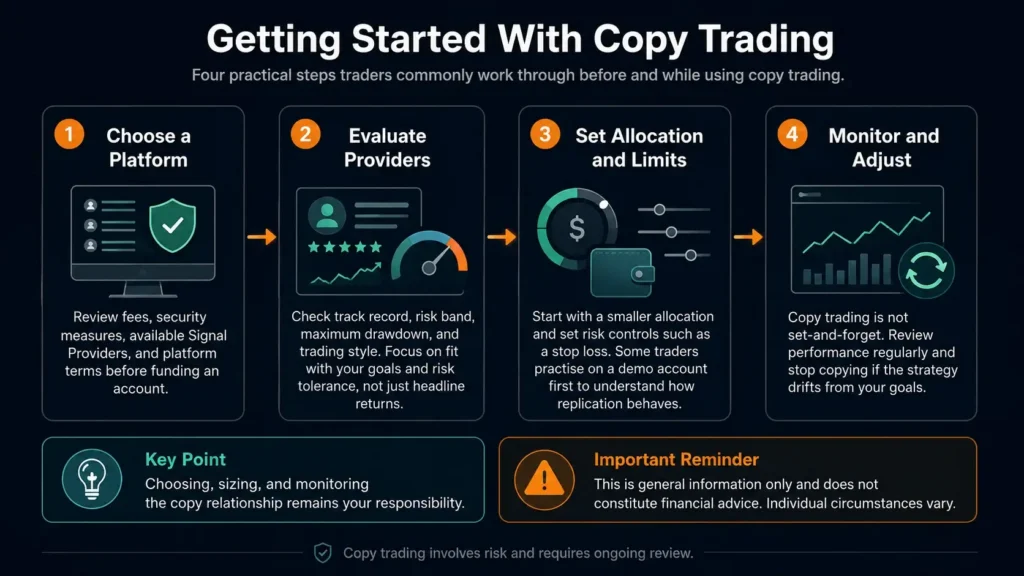
- Choose a platform and understand its terms: Look at the fee structure, the security measures, and the range of Signal Providers available. Reading the platform’s terms before funding an account avoids surprises later.
- Evaluate potential Signal Providers: Traders often review track record, risk band, maximum drawdown, and trading style, checking whether these fit their own goals and risk tolerance rather than chasing the highest headline return.
- Decide your allocation and set risk limits: Allocating a smaller amount to begin with, and setting a stop loss, keeps early exposure contained. Some traders first practise on a demo trading account to see how replication behaves before committing real funds. This is general information only and does not constitute financial advice; individual circumstances vary.
- Monitor and adjust: Copy trading is not set-and-forget. Reviewing performance regularly, and stopping a copy when a strategy drifts from your goals, is part of managing the risk you have taken on.
Copy Trading Shifts the Work, Not the Risk
Copy trading changes who makes the trading decisions — it does not remove the risk of loss. The automation is real, and so is the appeal for anyone short on time or still learning. But the outcome still rests on the choices you keep: whom you copy, how you build and size your allocation, and how closely you review it.
Treated as active oversight rather than a passive shortcut, copy trading is a way to participate in the markets while continuing to develop your own understanding of the markets — with the same risk warnings that apply to any leveraged CFD trading.
Frequently Asked Questions
What Is Copy Trading in Simple Terms?
Copy trading is a way of trading where another trader’s positions are automatically copied into your account. When they open or close a CFD position, the same happens in yours, scaled to the amount you allocate. It lets you automatically replicate another trader’s CFD positions without deciding each trade yourself, though you still carry the risk of any losses.
What Is Copy Trading in Forex?
Forex copy trading applies the same idea to currency CFDs, such as EUR/USD or GBP/USD. You copy a Signal Provider who trades forex, and their currency positions are mirrored in your account in proportion to your allocation. Because currency markets can move quickly, the risks — including leverage — apply just as they would to trading forex CFDs yourself.
How Do I Choose a Trader to Copy?
Traders usually start with a Signal Provider’s profile, weighing historical return against risk band, maximum drawdown, and how long the track record runs. The aim is to find a style and risk level that match your own goals rather than simply picking the highest past return. No metric guarantees future results, so many followers spread their allocation across more than one trader.
Is Copy Trading Suitable for Beginners?
Copy trading is often used by beginners because it lowers the barrier to taking part in the markets and offers a way to learn by observation. It is not risk-free, however. A beginner still needs to choose a trader carefully, allocate an amount they can afford to lose, and review performance rather than leaving the account unattended.
How Much Money Do I Need to Start Copy Trading?
The minimum depends on the platform and account currency. On Vantage, Eligible clients may be able to start copying from as little as USD 50, subject to account type, platform availability and jurisdiction. Starting small is one way traders limit early exposure while they see how a strategy performs, but a smaller allocation does not remove the risk of loss.
Can I Stop Copying a Trader at Any Time?
Yes. On most platforms, including Vantage, you can stop copying a Signal Provider whenever you choose, and you can set a stop loss and take profit before you begin. Being able to exit does not undo losses already incurred, so monitoring an open copy still matters.
Does Copy Trading Guarantee a Profit?
No. Copy trading does not guarantee success, and past performance is not a reliable indicator of future results. Even a trader with a strong history can have losing periods, and those losses are copied in full. Any decision to copy should account for the risk of losing money.
RISK WARNING: CFDs are complex financial instruments and carry a high risk of losing money rapidly due to leverage. You should ensure you fully understand the risks involved and carefully consider whether you can afford to take the high risk of losing your money before trading.
Disclaimer: The information is provided for educational purposes only and doesn’t take into account your personal objectives, financial circumstances, or needs. It does not constitute investment advice. We encourage you to seek independent advice if necessary. The information has not been prepared in accordance with legal requirements designed to promote the independence of investment research. No representation or warranty is given as to the accuracy or completeness of any information contained within. This material may contain historical or past performance figures and should not be relied on. Furthermore estimates, forward-looking statements, and forecasts cannot be guaranteed. The information on this site and the products and services offered are not intended for distribution to any person in any country or jurisdiction where such distribution or use would be contrary to local law or regulation.
References
- “Copy Trading – Investor.gov” https://www.investor.gov/introduction-investing/investing-basics/glossary/copy-trading Accessed 15 July 2026
- “Social Trading Platform Market Report 2026 – Research and Market” https://www.researchandmarkets.com/report/social-trading-market Accessed 15 July 2026