


 Updated
Yes, forex trading itself is legitimate. The foreign exchange market moves around $9.6 trillion a day, according to the Bank for International Settlements’ latest triennial survey, making it the largest financial market in the world [1].
But that doesn’t mean every broker, app, or “opportunity” claiming to offer forex trading is genuine. Scams built around forex rarely resemble the real market — they typically involve guaranteed returns, pressure to deposit quickly, or a provider with no verifiable licence.
So the more useful question usually isn’t “is forex real?” It’s “is this specific broker or offer genuine?” This guide covers the common types of forex scams, the warning signs of a fake provider, how to check a broker’s regulatory status against an official register, and what to do if you’ve already been targeted.
Key Points
- Forex trading takes place in an established global market but that does not make every broker, app, or offer genuine.
- Common warning signs include guaranteed returns, pressure to deposit, unclear company details, and withdrawal problems.
- A stronger legitimacy check starts with the legal entity, licence details, public records, risk disclosure, and withdrawal terms.
Why People Question Whether Forex Trading Is Legit
Most people do not doubt that currency markets exist. What they question is how forex is presented to them. That concern often starts with the retail experience, where losses can happen quickly, leverage can increase exposure, and some promotions make trading look simpler than it is.
In many cases, access is offered through forex contracts for difference (CFDs). These are complex products with a high level of risk. That alone does not suggest fraud. A legitimate product can still lead to poor outcomes, especially when the risks are not fully understood.
Fraud typically involves something different. It often includes deception, false claims, fake account activity, or withdrawal problems. High risk and fraud are not the same, although they are sometimes confused.
Common Types of Forex Scams
The warning signs below describe how a scam behaves. It also helps to know the shapes these scams usually take, since fraudulent operators tend to reuse a small number of proven patterns rather than inventing new ones.
Fake or Unregulated Brokers
The most common pattern is a provider that looks like a broker — professional website, trading dashboard, live-looking price feeds — but has no genuine licence with any recognised regulator, or uses a licence number that belongs to a different, unrelated company. These operators are often built to accept deposits and stall or block withdrawals rather than to offer real market access at all.
Signal-Seller and “Account Manager” Scams
Here, someone offers to trade on your behalf, or sell you “guaranteed” signals, often after unsolicited contact on social media or messaging apps. The track record shown is usually fabricated or drawn from a single lucky period, and the arrangement typically asks you to fund an account the “manager” then controls — with no way to independently verify trades actually took place.
Ponzi and Pyramid Schemes
These promise steady, above-market returns funded not by real trading profit but by money from newer participants. They frequently come bundled with a referral or recruitment structure — a reward for bringing in the next depositor — which is itself a warning sign, since a genuine trading product doesn’t need you to recruit other traders for it to work.
Fake Trading Apps
A newer and increasingly common pattern: contact begins on a social media or messaging platform, moves to a slick-looking app or web dashboard, and the account appears to show consistent profits. Problems surface only at withdrawal — funds are frozen, and the user is told they must first pay a “release fee,” “tax,” or “verification deposit” to access their own money. This pattern has been flagged by banks and regulators in multiple markets as one of the fastest-growing forex-adjacent scam types.
Warning Signs of a Forex Scam
If a forex-related offer appears polished at first glance, that does not automatically make it genuine. Many scam cases follow familiar patterns.
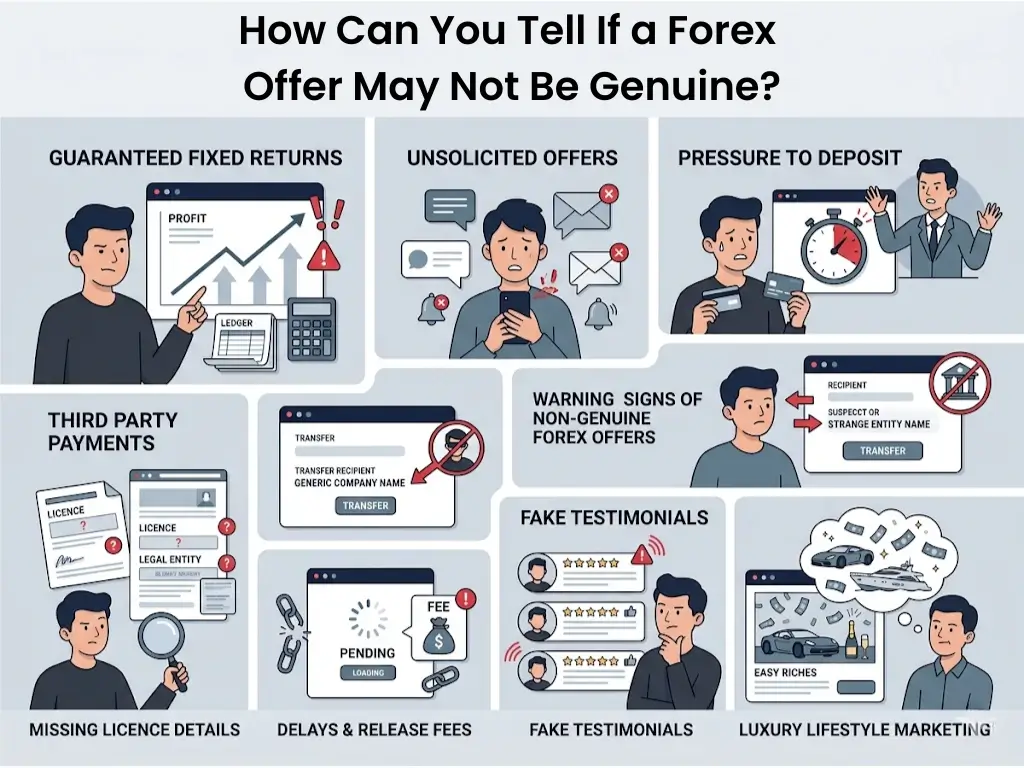
- Guaranteed or fixed returns: Any claim that returns are predictable, fixed, or guaranteed — including claims that a strategy “never loses” or works in “any market, even a downturn” — is a major warning sign. Forex trading involves market risk, so outcomes are never certain.
- Unsolicited messages on social or messaging apps: Cold calls, direct messages, or repeated contact from someone pushing a deposit or urgent decision can be a warning sign. A genuine provider should generally give users space to review the company, product terms, and risks without pressure.
- Pressure to deposit quickly: Urgency is often used to stop people from checking the provider properly. Claims that a limited-time opportunity will disappear unless money is sent immediately should be treated carefully.
- Requests to send money to a personal account or unrelated third party: A provider that asks users to transfer funds to an individual, an unrelated company, or an unclear payment recipient deserves closer scrutiny. Payment instructions that do not clearly match the stated business can be a warning sign.
- No clear legal entity or licence details: A site may talk about trading opportunities while giving little detail about the company behind the service. If the legal entity, address, or regulatory information is unclear, that is a serious concern.
- Withdrawal delays or extra release fees: Problems often become clearer when a withdrawal is requested. Delays, unexplained verification hurdles, or demands for extra release fees can indicate that the service is not operating transparently.
- Fake testimonials or lifestyle-driven marketing: Luxury imagery, screenshots of returns, and “done for you” claims are often used to create trust quickly. These tactics rely more on emotion than verifiable information.
- Pressure to recruit other depositors: Being offered a bonus, commission, or “level-up” for bringing in new depositors is a hallmark of Ponzi and pyramid structures — a genuine broker’s product doesn’t depend on you recruiting other traders.
A real market can still attract dishonest operators. The more of these warning signs appear together, the more carefully the offer should be assessed.
How to Check Whether a Forex Broker Appears Legitimate
A professional-looking website or app does not, by itself, confirm that a provider is genuine. A more useful approach is to check the business step by step.
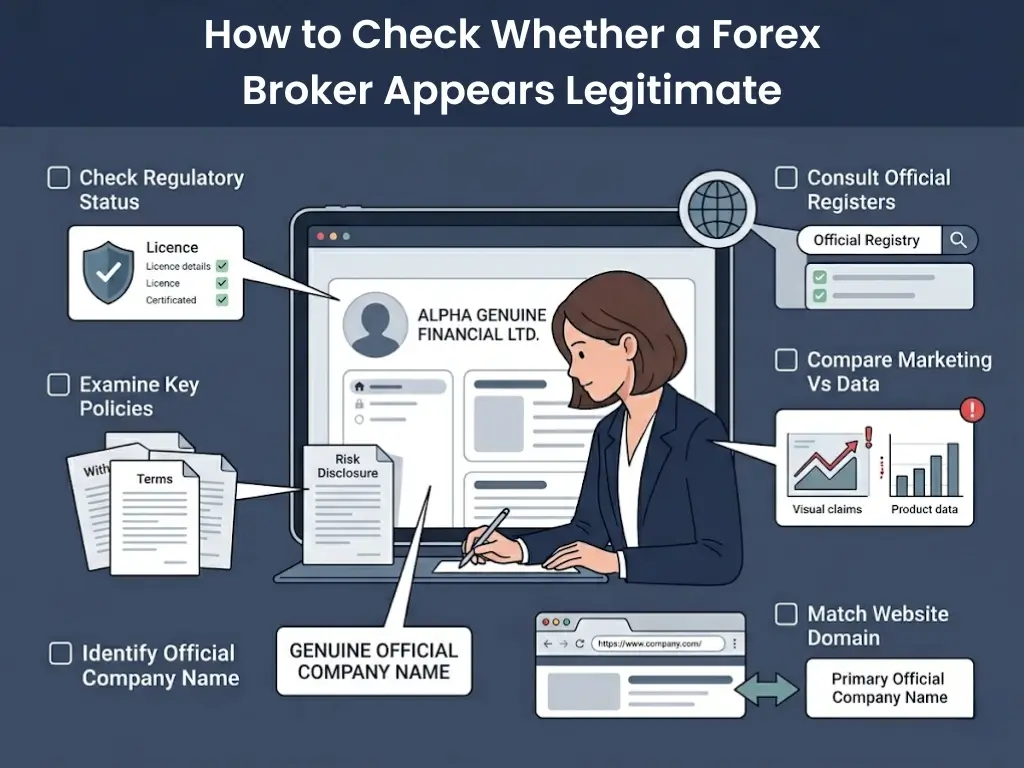
1. Review the Regulatory Status and Licence Details
A provider that appears legitimate will usually state the legal entity behind the service, the jurisdiction it operates under, and any licence or registration details it relies on. Vague phrases such as “fully licensed” or “trusted worldwide” are not enough on their own.
2. Confirm the Firm in an Official Register
Do not rely only on the provider’s own website. Search the company name, licence number, and stated jurisdiction in the relevant official register, rather than a third-party listing site. A few starting points:
- UK: FCA Financial Services Register
- Australia: ASIC Professional Registers Search
- South Africa: FSCA Entity Search
- US: CFTC forex fraud advisory (includes guidance on checking NFA registration)
If you’re evaluating an offer aimed at Indian residents specifically, the RBI’s Alert List of unauthorised forex platforms and SEBI’s register of recognised intermediaries are the relevant places to check, since forex and CFD trading through unauthorised platforms carries separate legal risk under FEMA in that market.
Compare the legal name, website domain, and licence status with what the firm is claiming publicly.
3. Examine the Legal Entity, Risk Disclosure, and Withdrawal Terms
A genuine provider should make its legal identity, product information, terms, and client-facing policies easy to find. It should also explain the risks clearly and set out ordinary withdrawal procedures in a way that is easy to review. If these details are hidden, incomplete, or inconsistent, that deserves caution.
4. Compare the Marketing Claims With the Actual Offering
This is where problems often become easier to spot. If the marketing promises certainty, managed returns, or simple income, but the legal documents describe a high-risk leveraged product, the gap itself is useful information.
Simple broker verification checklist
In practice, a provider that appears legitimate will usually show clear company details, standard onboarding, transparent product information, and balanced risk language. Suspicious offers often rely on urgency, vague branding, and weak disclosure.
These same checks are also relevant when comparing forex trading platforms more broadly, particularly when reviewing transparency, product information, and overall user experience.
What to Do If You’ve Been Scammed
If you think you’ve sent money to a fake broker, a signal-seller, or a fake trading app, acting quickly and in the right order matters more than acting fast in a panic.
- Stop sending any further money. This includes any request framed as a “release fee,” “tax,” or “final payment to unlock your funds” — legitimate providers never require an additional payment before you can withdraw your own money.
- Document everything. Save screenshots of the app or platform, chat logs, transaction records, and any promotional material you were shown. This will matter for both your bank and any regulator you report to.
- Contact your bank or payment provider immediately. Ask about a chargeback or fraud claim — most have a limited window in which a reversal is possible, so this step is time-sensitive.
- Report it to the relevant regulator. Options include the CFTC or FCA depending on where the provider claimed to operate, or your local cybercrime reporting portal.
- Be alert to “fund recovery” follow-up scams. It’s common for a second operator to contact people who’ve already lost money, claiming they can recover it for an upfront fee. This is almost always a second scam targeting the same victim.
The Verdict: Forex Is Legit — With Caveats
The foreign exchange market is real, but legitimacy at market level does not automatically make every broker, app, or service trustworthy.
The more useful question is often not simply whether forex is legit, but whether the provider in front of the user appears genuine. Clear company details, balanced risk language, and verifiable public records often say more than the marketing ever will.
That is why forex can feel confusing to many people. A real market can still sit alongside misleading promotions, weak disclosure, and providers that deserve closer scrutiny. If you’d like to see what the kind of disclosure this guide describes actually looks like in practice, Vantage’s own regulatory and legal documents page is a working example of the entity, licence, and jurisdiction detail this checklist asks you to look for.
FAQs
Is forex trading real or fake?
Forex trading refers to participation in the foreign exchange market, which is an established global market where currencies are exchanged. However, the existence of the market does not confirm that every broker, app, or service linked to it is trustworthy.
How do I check whether a forex broker is regulated?
A practical starting point is to review the broker’s legal entity, jurisdiction, and licence details on its website, then compare that information against the relevant official register. If the details are vague, inconsistent, or difficult to confirm, caution is justified.
Why do some people say forex is a scam?
People often say this because scam activity is common around the market. Fake brokers, signal sellers, social-media-led schemes, and misleading promotions can all make the space appear illegitimate, even though the market itself is real.
Can I get my money back if I’ve been scammed by a forex broker?
It depends on the provider and jurisdiction. If the broker was genuinely regulated, your national regulator or a financial ombudsman/dispute-resolution scheme may be able to help. If the “broker” was unregulated or based offshore with no verifiable licence, recovery is much harder. Be cautious of any “fund recovery” service that contacts you afterward — these are frequently a second scam targeting people who already lost money once.
Why do most forex traders lose money?
This is a separate issue from fraud. Leveraged products like CFDs are genuinely difficult to trade profitably, and regulators require brokers to publish the share of retail accounts that lose money — figures across the industry commonly fall in the 70–85% range. That’s a reflection of the product’s difficulty and leverage risk, not evidence of a scam. It’s one reason “risky” and “fraudulent” get confused: a fully regulated, legitimate broker can still see most of its retail clients lose money.
Are forex signals, bots, and account managers legitimate?
Some may appear legitimate, while others may not. The key issue is whether the provider is transparent, verifiable, and realistic about risk. Promises of guaranteed returns or pressure to deposit quickly are warning signs
RISK WARNING: CFDs are complex financial instruments and carry a high risk of losing money rapidly due to leverage. You should ensure you fully understand the risks involved and carefully consider whether you can afford to take the high risk of losing your money before trading.
Disclaimer: The information is provided for educational purposes only and doesn’t take into account your personal objectives, financial circumstances, or needs. It does not constitute investment advice. We encourage you t seek independent advice if necessary. The information has not been prepared in accordance with legal requirements designed to promote the independence of investment research. No representation or warranty is given as to the accuracy or completeness of any information contained within. This material may contain historical or past performance figures and should not be relied on. Furthermore estimates, forward-looking statements, and forecasts cannot be guaranteed. The information on this site and the products and services offered are not intended for distribution to any person in any country or jurisdiction where such distribution or use would be contrary to local law or regulation.
Reference
- “Global FX trading hits $9.6 trillion per day in April 2025 and OTC interest rate derivatives surge to $7.9 trillion: Triennial Survey – BIS” https://www.bis.org/press/p250930.htm Accessed 10 April 2026
- “Fraud Advisory: Foreign Currency (Forex) Fraud” – U.S. Commodity Futures Trading Commission https://www.cftc.gov/LearnAndProtect/AdvisoriesAndArticles/fraudadv_forex.html
- “Financial Services Register” – UK Financial Conduct Authority https://www.fca.org.uk/firms/financial-services-register
- “Professional Registers Search” – Australian Securities and Investments Commission https://www.asic.gov.au/online-services/search-asic-registers/professional-registers-search/
- “Alert List of Unauthorised Forex Trading Platforms” – Reserve Bank of India https://www.rbi.org.in/Scripts/BS_PressReleaseDisplay.aspx?prid=58949
- “Recognised Intermediaries” – Securities and Exchange Board of India https://www.sebi.gov.in/sebiweb/other/OtherAction.do?doRecognised=yes