


 Updated
When you place a trade, the price you see is not always the price you get. That gap has a name: slippage. It shows up most in fast markets — a central bank decision, an economic release, a thin overnight session — where prices can move in the milliseconds between clicking and filling. Slippage can work against you or, less often, in your favour, but either way it changes what a trade actually costs. This guide explains what slippage is, why it happens, how positive and negative slippage differ, and the practical steps traders and brokers use to reduce it when trading Contracts for Difference (CFDs).
Key Points
- Slippage is the difference between the price you request and the price your order actually fills at; it can be negative (a worse price) or positive (a better one).
- It clusters in two conditions — high volatility around major news and low liquidity in thin markets or off-peak hours — both of which widen the gap between the quoted and executed price.
- Slippage cannot be removed entirely, but limit orders, slippage-tolerance settings, avoiding major news windows, and faster execution can all reduce how often and how far an order slips.
What Is Slippage in Trading?
Slippage in trading is the difference between the price a trader requests when placing an order and the price at which that order is actually filled. In simple terms, it happens when the market moves — or runs short of available volume — in the brief moment between sending an order and completing it.
Most of the time that gap is small. Foreign exchange is the largest and most liquid market in the world: average daily turnover reached USD 9.6 trillion in April 2025, up 28% from three years earlier, according to the Bank for International Settlements 1. Depth like that means orders in major currency pairs usually fill close to the quoted price.
The gap widens when liquidity thins or prices move quickly. If you send a market order to buy and the best available price shifts before the order completes, it fills at the new level — not the one you saw. When a trade size exceeds the volume available at the quoted price, part of the order may fill at the request and the rest at progressively worse levels as the platform sources more liquidity.
Retail traders usually access these markets through CFDs, which allow speculation on price movements without owning the underlying asset. Because a CFD’s price tracks the underlying market, the same execution dynamics — and the same slippage — apply.
Slippage, then, is less a fault in the system than a by-product of how fast prices and liquidity can change.
Positive vs Negative Slippage: Is It Good or Bad?
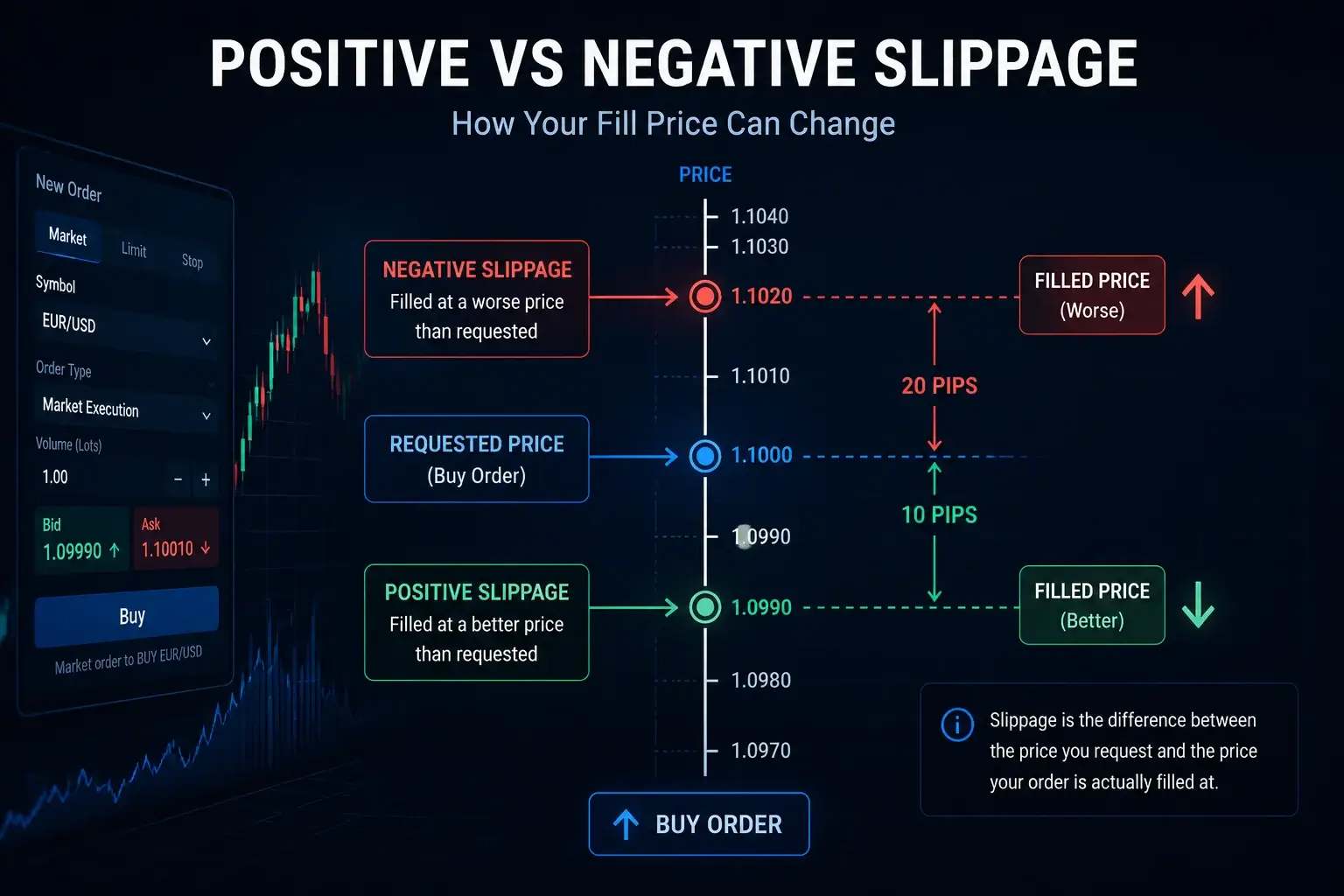
Slippage is neither good nor bad by definition. It simply measures how far the fill drifted from the request, and that drift can move in either direction — against the trader (negative) or in their favour (positive).
What Is Negative Slippage?
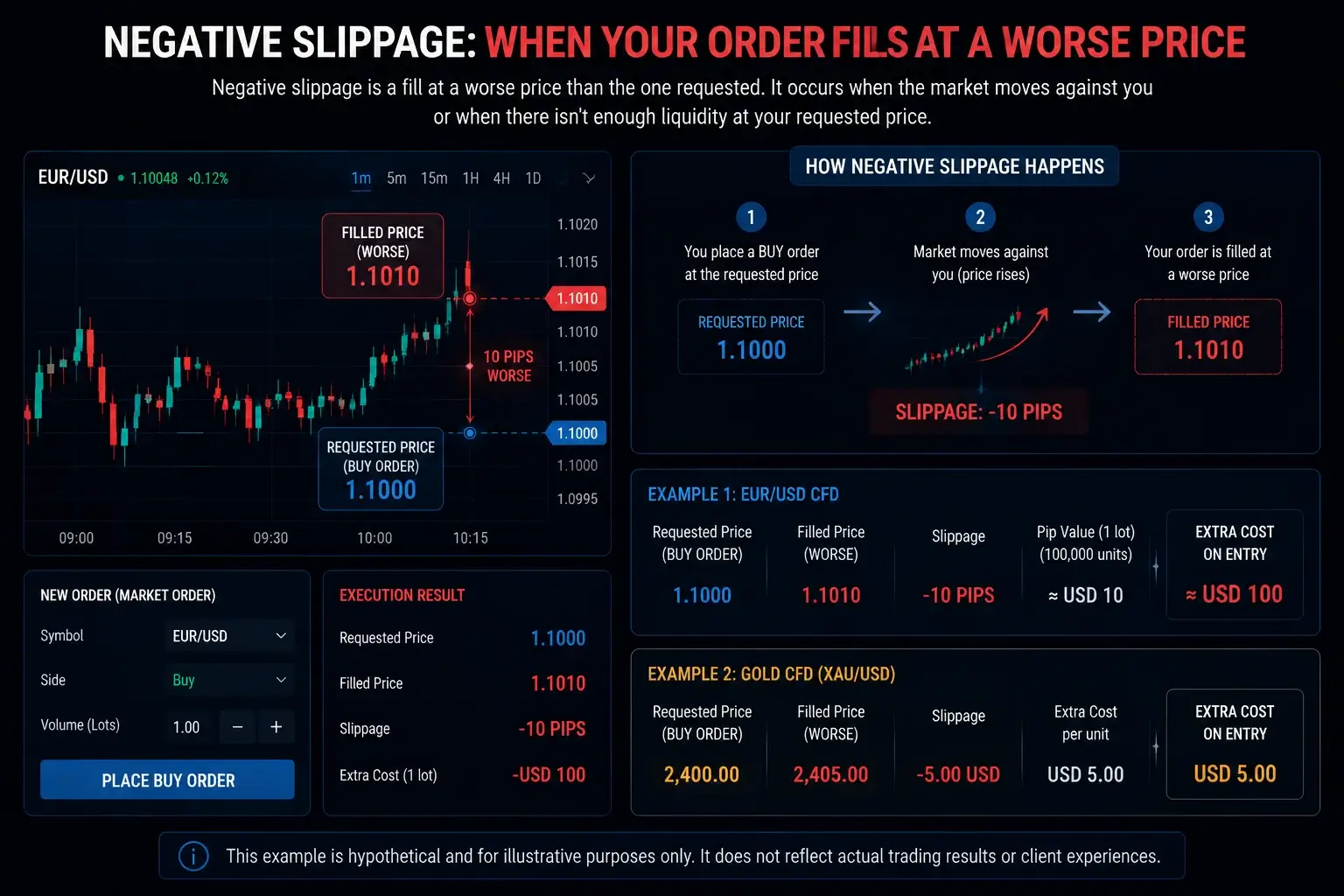
Negative slippage is a fill at a worse price than the one requested. Say you send a market order to buy a EUR/USD CFD at 1.1000, but by the time it completes the best available price is 1.1010 — a 10-pip difference. On one standard lot (100,000 units), where each pip is worth roughly USD 10, that is about USD 100 of extra cost on entry.
The same idea applies to other markets. A gold CFD order expected to fill at USD 2,400 that instead fills at USD 2,405 costs USD 5 more per unit — small on a single trade, but a drag that compounds across many.
What Is Positive Slippage?
Positive slippage is a fill at a better price than expected. A buy order placed at 1.1000 that instead fills at 1.0990 gives a slightly better entry, and a sell order at 1.1000 filled at 1.1005 provides a slightly better exit. It can happen when prices move in the trader’s favour in the instant before execution.
Positive slippage is generally less common than negative slippage, and it cannot be relied on — it is an occasional benefit of fast execution, not a strategy. Some brokers pass positive slippage straight to the client; others do not, so it is worth checking how yours handles it.
| Slippage type | How the fill compares to your request | Effect on the trade |
| Negative slippage | Worse than the requested price | Increases cost or widens a loss |
| Positive slippage | Better than the requested price | Reduces cost or improves an entry/exit |
| No slippage | Matches the requested price | Order fills exactly as expected |
What Causes Slippage in Financial Markets?
Slippage traces back to two forces: how fast prices are moving and how much liquidity is available to absorb an order. Three practical causes cover almost every case.
1. High Market Volatility
Slippage is most common during sharp price swings, when the market moves faster than orders can be filled at the requested level. This often happens around major economic releases and policy decisions — US Non-Farm Payrolls, central bank interest rate decisions, or sudden geopolitical developments.
The clearest illustration is a shock event. On 15 January 2015, the Swiss National Bank unexpectedly scrapped its cap of 1.20 francs per euro; within minutes the franc soared around 30% against the euro, briefly trading past parity before settling roughly 13% higher 3. Orders resting in that market could not fill anywhere near their intended levels — the price had already gapped straight through them. Most volatility is far milder, but the mechanism is the same.
2. Low Market Liquidity
Slippage also occurs when there are not enough buyers or sellers at the desired price. Orders then fill at the next available level in the order book, often at a less favourable price. Liquidity tends to be thinner during off-peak trading sessions, such as the Asian hours for EUR/USD, and in naturally thin markets like exotic currency pairs, small-cap share CFDs, or low-volume commodities.
Recognising when liquidity is thin helps traders anticipate slippage and adjust order size or timing accordingly.
3. Execution Delays (Broker and Technology Factors)
Even small delays between a trading platform and its liquidity providers can cause slippage, because prices can shift in milliseconds. Faster, more direct order routing narrows the window in which the price can change. Infrastructure matters here: low-latency networks and trading servers placed close to major venues reduce the time an order spends in transit.
Volatility, liquidity, and execution speed rarely act alone — the largest slippage usually appears when a fast market and a thin one coincide.
Slippage vs Spread: What’s the Difference?
Slippage and the spread are both execution costs, but they are not the same. The spread is the difference between the buy and sell price quoted at the same moment — a cost you can see before you trade. Slippage is the difference between the price you request and the price you receive — a cost that appears at the point of execution, and only when the market moves in the interim.
A single trade can carry both: you pay the spread on entry, and you may also experience slippage if prices shift while the order is processed. Separating the two helps you judge execution quality. A consistently wide gap between requested and filled prices, on top of the spread, is a signal to review order types, timing, or the liquidity of the market being traded.
How CFD Brokers Help Reduce Slippage
Slippage cannot be eliminated, but the execution setup a broker runs can influence how often and how far orders slip. Three areas make the most difference.
1. Order Execution Speed

Reliable CFD brokers invest in trading infrastructure built for fast execution and reduced latency — high-performance servers, low-latency networks, and direct connections to liquidity providers. At Vantage, live trading servers sit in major financial hubs including London and New York, with fibre-optic connectivity through Equinix to support low-latency execution.
Vantage also uses the oneZero™ MT4 Bridge, a price aggregator that connects clients to its liquidity pool while handling high order volumes with minimal delay. Where positive or negative slippage does occur, Vantage passes it directly to clients, which keeps execution transparent in both directions.
2. Access to Deep Liquidity Pools
By connecting to a broad network of Tier 1 banks and non-bank liquidity providers, a broker can aggregate liquidity and source competitive prices even on larger trades. Deeper market access means orders are more likely to fill efficiently and closer to the quoted level, which reduces the room for slippage.
3. Risk-Management Tools
Some brokers offer tools that give traders more control during volatile periods, such as Guaranteed Stop Loss Orders (GSLOs) and slippage-control settings. A GSLO closes a position at the exact level set, regardless of gapping, though it typically carries a premium and availability varies by broker and instrument. These tools can help manage risk, but no tool removes it — all trading carries the risk of loss.
The broker’s job is to shorten the odds on slippage; the trader’s own order choices do the rest.
How to Reduce Slippage in Trading
Slippage cannot be fully avoided, but a few practical habits can reduce how often it affects your fills and by how much.
1. Use Limit Orders
A limit order executes only at a specified price or better, which protects against unfavourable fills during sudden moves. The trade-off is that the order may not execute at all if the market never reaches the set level, so it prioritises price certainty over guaranteed entry.
2. Set a Slippage Tolerance
Many platforms let you set the maximum price deviation you are willing to accept — often called slippage tolerance or maximum deviation. If the market moves beyond that band before the order fills, the order is rejected rather than filled at a far worse price. A tight tolerance limits negative slippage but raises the chance of a rejected order in fast conditions; a wider one fills more often but allows more slip.
3. Be Cautious with Stop Orders
Stop orders, including stop-losses, convert into market order types once their trigger price is reached. In fast markets this can expose them to slippage, because the fill price may differ from the stop level. Placing stops with volatility, market depth, and liquidity in mind can help — though in a gapping market a standard stop can still fill well beyond its level.
4. Time Around High-Impact News
Major releases and policy announcements often trigger the sharp volatility that drives slippage. Reviewing an economic calendar and avoiding order placement during high-impact news windows can reduce the likelihood of a poor fill, particularly for manual traders without ultra-fast execution.
| Order type | How it fills | Slippage exposure |
| Market order | Fills at the best available price now | Highest — takes whatever price the market offers |
| Limit order | Fills only at the set price or better | None on price, but may not fill at all |
| Stop order | Becomes a market order once triggered | Exposed once triggered, especially on gaps |
| Guaranteed stop-loss (GSLO) | Closes at the exact level set | None on the stop, but usually carries a premium |
Slippage Is Managed, Not Eliminated
Slippage is a permanent feature of fast-moving markets, not a flaw to be fixed. It reflects the reality of changing prices and shifting liquidity, and it can move for or against a trader. What separates a manageable cost from a damaging one is preparation: the order types chosen, the timing of trades, and the execution quality behind them.
That preparation matters because CFDs are high-risk products — analysis by EU regulators around ESMA’s 2018 product intervention found that between 74% and 89% of retail CFD accounts lose money 2, and execution costs like slippage are one factor among many. Combining sensible risk management with a broker focused on execution quality can help keep slippage’s impact in check over time.
Traders can explore Vantage’s execution features through a live account, or practise first in real market conditions with a demo account.
Frequently Asked Questions
Does Slippage Happen in Every Market?
Slippage can occur in any market with fast-moving prices or thin liquidity, including forex, share CFDs, indices, and commodities. It tends to be smaller in deep, actively traded markets and larger in volatile or low-volume ones, so the same order can slip very differently depending on where and when it is placed.
What Causes Slippage in Forex Trading?
In forex, slippage is usually driven by volatility around major news — such as central bank decisions or employment data — and by thin liquidity during off-peak sessions. Execution speed also plays a part: the longer an order takes to reach a liquidity provider, the more the price can move before it fills.
How Much Slippage Is Normal?
There is no fixed figure. In calm, liquid conditions slippage is often negligible, while during major news or in thin markets it can be substantial. A useful benchmark is your own history: comparing requested prices with actual fills over many trades shows what is typical for the markets and times you trade.
Is Positive Slippage a Good Thing?
Positive slippage means an order fills at a better price than requested, which lowers cost or improves an entry or exit. It is a welcome outcome when it happens, but it is less common than negative slippage and cannot be relied on, so it should not form part of a trading plan.
Can a Broker With Fast Execution Eliminate Slippage Completely?
No broker can eliminate slippage entirely, because it is an inherent part of trading in dynamic markets. However, faster execution and low-latency infrastructure can meaningfully reduce how often and how far orders slip by processing them more quickly, especially during periods of high volatility.
How Can I Reduce Slippage in Fast-Moving Markets?
Common approaches include using limit orders to cap the price you accept, setting a slippage tolerance so orders are rejected rather than filled far from your level, and avoiding order placement during major news releases. Trading more liquid instruments and reducing size in thin conditions can also help.
How Can I Measure the Impact of Slippage on My Trades?
Reviewing your trade confirmations or execution reports is the simplest method. By comparing your requested prices with the actual executed prices over time, you can see whether slippage is consistently affecting your entries and exits, and adjust your order types or timing in response.
RISK WARNING: CFDs are complex financial instruments and carry a high risk of losing money rapidly due to leverage. You should ensure you fully understand the risks involved and carefully consider whether you can afford to take the high risk of losing your money before trading.
Disclaimer: The information is provided for educational purposes only and doesn’t take into account your personal objectives, financial circumstances, or needs. It does not constitute investment advice. We encourage you to seek independent advice if necessary. The information has not been prepared in accordance with legal requirements designed to promote the independence of investment research. No representation or warranty is given as to the accuracy or completeness of any information contained within. This material may contain historical or past performance figures and should not be relied on. Furthermore, estimates, forward-looking statements, and forecasts cannot be guaranteed. The information on this site and the products and services offered are not intended for distribution to any person in any country or jurisdiction where such distribution or use would be contrary to local law or regulation.
References
- “Global FX trading hits $9.6 trillion per day in April 2025: Triennial Survey – BIS” https://www.bis.org/press/p250930.htm Accessed 18 Aug 2026
- “ESMA agrees to prohibit binary options and restrict CFDs to protect retail investors – ESMA” https://www.esma.europa.eu/press-news/esma-news/esma-agrees-prohibit-binary-options-and-restrict-cfds-protect-retail-investors Accessed 18 Aug 2026
- “Swiss franc soars, stocks tank as euro peg scrapped – CNBC” https://www.cnbc.com/2015/01/15/swiss-franc-sours-stocks-tank-as-euro-peg-scrapped.html Accessed 18 Aug 2026