


 Updated
In January 2026, gold set a record high of around US$5,405 per ounce on the LBMA benchmark, capping a two-year climb that carried it past US$3,000 and US$4,000 for the first time [1].
Prices have since cooled, trading near US$4,100–4,200 by early July 2026 [2] — yet the rally left many people asking a basic question: why is gold valuable in the first place?
Gold is valuable because it is scarce, virtually indestructible, universally recognised and widely trusted to hold its worth when other assets fall — qualities that have supported its value for thousands of years. Those same qualities explain gold’s everyday uses, why its price reacts the way it does, and the different ways people gain exposure to it.
Key Points
- Gold’s value rests on four durable qualities — scarcity, resistance to corrosion, universal acceptance and a long history as money — rather than on any single industrial use.
- The gold price is driven mainly by real interest rates, the US dollar, central bank buying and safe-haven demand during economic or geopolitical stress, not by consumption alone.
- People gain exposure to gold in different ways — physical bullion, gold exchange-traded funds (ETFs) and mining shares for ownership, or derivatives such as futures and Contracts for Difference (CFDs) for price speculation — each carrying its own risks.
Uses of Gold
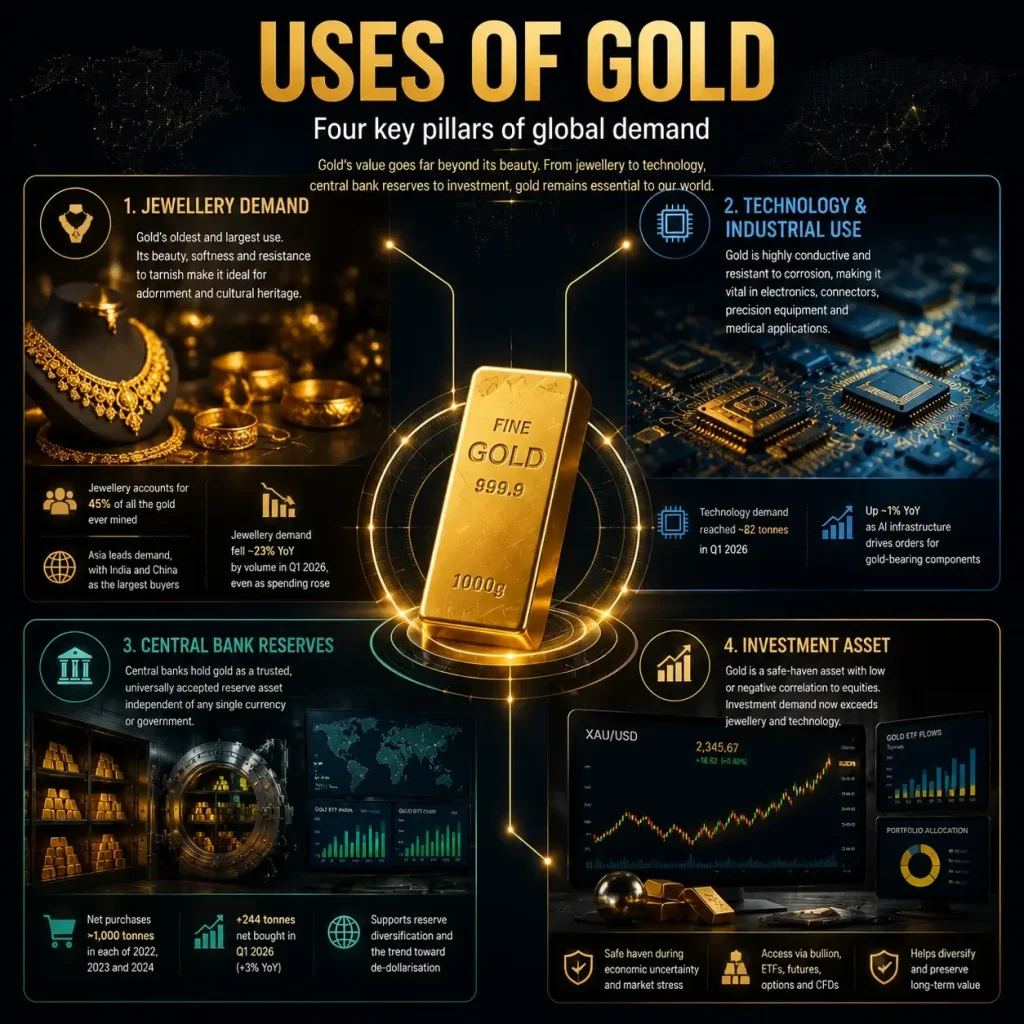
Gold has four main sources of demand: jewellery, industrial and technological use, official reserves held by central banks, and investment. According to the World Gold Council data, jewellery accounts for roughly 44% of all the gold ever mined, while central banks hold about 18% of it [3].
Gold as Jewellery
Jewellery is gold’s oldest and largest use. Its shine, softness and resistance to tarnish make it ideal for adornment, and a large share of the metal ever mined now sits in jewellery boxes and vaults. Asian markets dominate demand, with India and China the two largest jewellery buyers globally [3]. As prices surged, buyers grew more cautious: World Gold Council figures show jewellery demand fell around 23% year-on-year by volume in the first quarter of 2026, even as the amount spent rose [1].
Gold for Industrial and Technological Use
Beyond its appearance, gold is highly conductive and strongly resistant to corrosion, which makes it useful in sensitive electronics and precision equipment. You will find it in computer circuits, connectors and some high-end audio hardware. It is also inert and non-toxic, so it can be used inside the body — in dental work, for example, and in some medical treatments. Technology demand reached about 82 tonnes in the first quarter of 2026, edging up 1% as the build-out of artificial intelligence infrastructure supported orders for gold-bearing components [1].
Gold as Central Bank Reserves
Central banks hold gold as part of their foreign exchange reserves because it is universally accepted and independent of any single government’s promise to pay. Official-sector buying has been a defining feature of the recent market: net purchases exceeded 1,000 tonnes in each of 2022, 2023 and 2024, and central banks added a further 244 tonnes on a net basis in the first quarter of 2026 alone, up around 3% year-on-year [1]. Much of this reflects reserve diversification — a desire among some countries to reduce reliance on a single currency, a trend often described as de-dollarisation [5]. Sustained buying of this kind can put upward pressure on the price. You can read more about how central bank policies shape markets in our related guide.
Gold as an Investment Asset
Gold is also held and traded as an investment. It is widely regarded as a safe-haven asset with historically low, and sometimes negative, correlation to equities, which is part of why investors turn to it when markets are stressed. Investment demand now exceeds the amount used in fabrication such as jewellery and technology [1]. The practical ways to gain exposure — from bullion to gold as a safe-haven holding — are covered later in this article.
Why Is Gold Valuable
Gold’s value comes from a mix of physical properties and the meaning societies have attached to it over millennia. A few factors do most of the work:
- Scarcity and difficult extraction: Gold is rare. Almost 220,000 tonnes have been mined in all of human history — enough to fill a cube only about 22.5 metres on each side — with a combined value of roughly US$31 trillion at the end of 2025 [3]. The US Geological Survey estimates only about 64,000 tonnes of economically mineable reserves remain underground [3]. Because mining is capital-intensive and new discoveries are hard to come by, supply grows slowly, which supports the metal’s scarcity value.
- Durability and universal acceptance: Gold does not rust, tarnish or corrode, so almost every ounce ever mined still exists in some form. It is recognised and accepted across borders and cultures, which lets it hold value independently of any local economy or political system.
- A long history as money: From the earliest coins to the gold standard, gold has backed currencies and international payments. The gold standard tied the value of major currencies directly to the metal until the 20th century. Although that system was abandoned, the legacy still underpins gold’s reputation as a reliable store of value.
- A hedge in uncertain times: Unlike fiat currencies, gold cannot be printed, so it is often used as a hedge against inflation and currency debasement. It has tended to hold its purchasing power when confidence in other assets weakens. It is worth remembering, though, that gold pays no interest or dividend and its price can still fall, sometimes sharply.
Why Gold Prices Have Hit Record Highs
Gold’s recent record run reflects several forces pulling in the same direction rather than one single cause. Understanding them also answers a common follow-up question — why is gold so expensive right now? The main drivers have been:
- Central bank buying: Steady official-sector demand, described above, has provided a durable floor under the price that differs from short-term speculation [1][5].
- Safe-haven demand: Heightened geopolitical tension and bouts of market stress have pushed investors toward gold, which has stayed among the strongest-performing major assets over the past year [4].
- Investment inflows: Bar and coin demand rose 42% to 474 tonnes in the first quarter of 2026 — the second-highest quarter on record — while gold-backed ETFs added around 62 tonnes over the same period [1].
- Interest-rate and currency expectations: Because gold pays no yield, it tends to become more attractive when real interest rates fall or the US dollar weakens, and less so when rates rise.
Looking ahead, J.P. Morgan Global Research has forecast that gold could average around US$6,000 per ounce by the final quarter of 2026, while cautioning that investor demand has cooled and that stronger growth, higher rates or a firmer dollar could send prices lower [5]. Past performance is not a reliable indicator of future results.
What Affects the Gold Price
Periods of Economic Uncertainty or Financial Crises
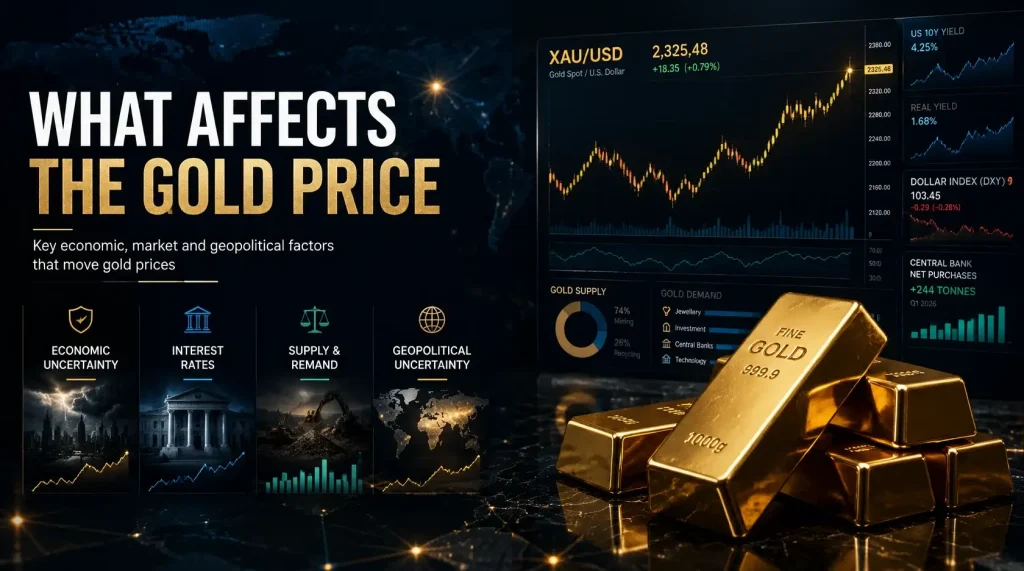
Gold is often seen as a defensive asset during economic uncertainty or financial crises. In periods of recession or market turmoil, demand for gold can rise as investors look for stability, which may push the price up. In calmer, growth-driven conditions, investors may prefer riskier assets that offer higher potential returns, which can weigh on gold instead. This broadly inverse relationship is a large part of gold’s reputation as a hedge.
Interest Rates Set by Central Banks
Interest rates play a pivotal role. When rates rise, the opportunity cost of holding gold increases, because gold yields no interest or dividend; this can lead to selling and downward pressure on the price. When rates are low or expected to fall, gold can become more attractive, which may support higher prices. Interest-rate expectations are therefore one of the most closely watched signals for the gold market.
Supply and Demand
The basic principles of supply and demand apply as they do to any market. On the supply side, gold comes from a mix of mining (around 74%) and recycling (around 26%), and no single region produces more than a quarter of global output [3]. On the demand side, jewellery, technology, central bank purchases and investment all compete for a slow-growing pool of metal. When demand rises faster than supply, the price tends to climb; when demand softens or recycling picks up, it can ease.
Geopolitical Uncertainty
Political instability, international conflict and trade tensions often drive investors toward assets perceived as neutral, and gold is a common choice. During such periods demand can surge and prices can rise. The gold price is sometimes described as a barometer of perceived global risk, reflecting how anxious investors feel about the wider outlook.
Gold as an Investment
There is an important distinction between owning gold and trading its price. Ownership-based routes give you exposure to the metal itself, and each comes with trade-offs:
- Physical gold: Buying bars or coins gives direct ownership of the metal, held outside the traditional financial system. The drawback is practical — physical gold has to be stored and insured, which adds cost, and it produces no income.
- Gold ETFs: Gold exchange-traded funds (ETFs) track the price of gold and trade on an exchange like ordinary shares, removing the need for storage. Our guide to the best gold ETFs covers how they work. With most gold ETFs you gain price exposure rather than holding the metal directly.
- Gold mining shares: Shares in gold mining companies offer indirect exposure; their prices often move with the gold price, but company-specific factors such as production costs and management decisions add another layer of risk. See our overview of how to invest in gold for more detail.
| Method | What you hold | Storage needed | Key risk |
| Physical gold | The metal itself | Yes | Storage, insurance and no income |
| Gold ETFs | Price exposure via a fund | No | Fund fees; tracks price, not direct ownership |
| Gold mining shares | Company shares | No | Company-specific risk on top of gold price |
How to Trade Gold
Traders who want to speculate on gold’s price movements — without owning bullion — typically use derivatives. These instruments are usually leveraged, which means they can magnify both gains and losses.
- Gold futures: A futures contract is an agreement to buy or sell a set amount of gold at a set price on a future date. Traders use gold futures to hedge against price moves or to speculate on them, but leverage means losses can exceed the initial outlay.
- Options: An option gives the buyer the right, but not the obligation, to buy or sell gold at a set price by a set date. Options can offer leveraged exposure, though they also carry the risk of significant loss, including the premium paid.
- Contracts for Difference (CFDs): A Contract for Difference (CFD) is an agreement to exchange the difference in an asset’s price between the opening and closing of a position, without owning the underlying asset. Gold CFDs let traders speculate on the price of gold — often quoted as XAU/USD — in both rising and falling markets. Because CFDs are typically leveraged, they can magnify both gains and losses and carry a high risk of losing money rapidly.
Whichever route a trader considers, they first need an account with a broker, and it helps to understand the costs involved — chiefly the spread, the difference between the buy and sell price. Brokers differ in fees, tools and educational resources. Retail traders typically access gold price movements through gold CFDs, rather than by owning physical bullion. As with any leveraged product, it is important to understand the risks before trading.
The Bottom Line on Gold’s Value
Gold’s value has endured because a handful of qualities have held true for thousands of years: it is scarce, almost indestructible, universally accepted and trusted when other assets falter. Those qualities explain its uses across jewellery, technology and central bank reserves, and they sit behind the price behaviour that pushed gold to record highs in 2026.
For anyone weighing gold, the same features that make it appealing also come with trade-offs — it pays no income, and its price can move sharply in both directions. Understanding what drives the metal, and the difference between owning it and trading its price through instruments such as CFDs, is the foundation for making an informed decision.
Frequently Asked Questions
Why is gold so expensive right now?
Gold’s price reached record highs in early 2026 and remains historically elevated because several drivers have coincided: heavy central bank buying, strong safe-haven and investment demand, and expectations around interest rates and the US dollar [1,4,5]. No single factor is responsible, and prices can fall as well as rise if those conditions change.
Why does gold hold its value over time?
Gold holds value largely because it is scarce, does not corrode, and is accepted worldwide. Its supply grows only slowly through mining, and it cannot be printed like paper money, which has helped it retain purchasing power across very long periods. This is a general historical pattern rather than a guarantee — gold’s price still fluctuates.
What makes gold valuable?
Gold’s value rests on its physical properties — rarity, durability and malleability — combined with its long history as money and a store of wealth. Because almost all the gold ever mined still exists and no more can be created artificially, its scarcity is durable in a way few other assets can match.
Why do central banks buy gold?
Central banks hold gold as a reserve asset because it is liquid, universally accepted and independent of any single country’s monetary policy. In recent years many have added gold to diversify their reserves and reduce reliance on the US dollar, buying more than 1,000 tonnes a year between 2022 and 2024 [1,5]. This official demand can provide long-term support for the price.
Is gold a good investment?
Gold is often used to diversify a portfolio and as a potential hedge during uncertainty, because its price does not always move in step with shares. However, it produces no income, and its price can be volatile and fall in value. This is general information only and does not constitute financial advice; individual circumstances vary and independent advice should be sought.
Why is gold important to the global economy?
Gold matters to the global economy because it sits at the intersection of jewellery, technology, official reserves and investment. Central banks hold roughly 17% of all above-ground gold as part of their reserves, and the metal’s price is widely watched as a signal of inflation expectations, currency confidence and perceived risk [3].
RISK WARNING: CFDs are complex financial instruments and carry a high risk of losing money rapidly due to leverage. You should ensure you fully understand the risks involved and carefully consider whether you can afford to take the high risk of losing your money before trading.
Disclaimer: The information is provided for educational purposes only and doesn’t take into account your personal objectives, financial circumstances, or needs. It does not constitute investment advice. We encourage you to seek independent advice if necessary. The information has not been prepared in accordance with legal requirements designed to promote the independence of investment research. No representation or warranty is given as to the accuracy or completeness of any information contained within. This material may contain historical or past performance figures and should not be relied on. Furthermore estimates, forward-looking statements, and forecasts cannot be guaranteed. The information on this site and the products and services offered are not intended for distribution to any person in any country or jurisdiction where such distribution or use would be contrary to local law or regulation.
References
- “Gold Demand Trends Q1 2026 – World Gold Council” https://www.gold.org/goldhub/research/gold-demand-trends/gold-demand-trends-q1-2026 Accessed 10 August 2026
- “Gold – Price – Chart – Historical Data – Trading Economics” https://tradingeconomics.com/commodity/gold Accessed 10 August 2026
- “Gold Market Primer: Market size and structure – World Gold Council” https://www.gold.org/goldhub/data/how-much-gold Accessed 10 August 2026
- “Gold Mid-Year Outlook 2026: Point break – World Gold Council” https://www.gold.org/goldhub/research/gold-mid-year-outlook-2026 Accessed 10 August 2026
- “Gold Price Predictions for 2026 and 2027 – J.P. Morgan Global Research” https://www.jpmorgan.com/insights/global-research/commodities/gold-prices Accessed 10 August 2026