


 Updated
Alphabet entered the second half of 2026 with strong operating momentum and an unusually complicated earnings picture.
The company behind Google Search, YouTube, Gemini, and Google Cloud reported faster revenue growth, but its Google stock earnings were also affected by a very large unrealised gain on equity securities.
In this article, Google stock primarily refers to Alphabet’s Class A shares listed on Nasdaq under the ticker symbol GOOGL. Alphabet also has publicly traded Class C shares under GOOG, and the distinction matters because only GOOGL carries ordinary voting rights.
This Google stock outlook article examines the latest Google stock price, Alphabet’s Q2 2026 results, analyst targets, dividend, price drivers, and the key factors that may influence share price.
Disclaimer: Readers should note that forecasts and analyst targets are estimates rather than guarantees, and this article is for informational purposes only and does not constitute investment advice.
Key Points
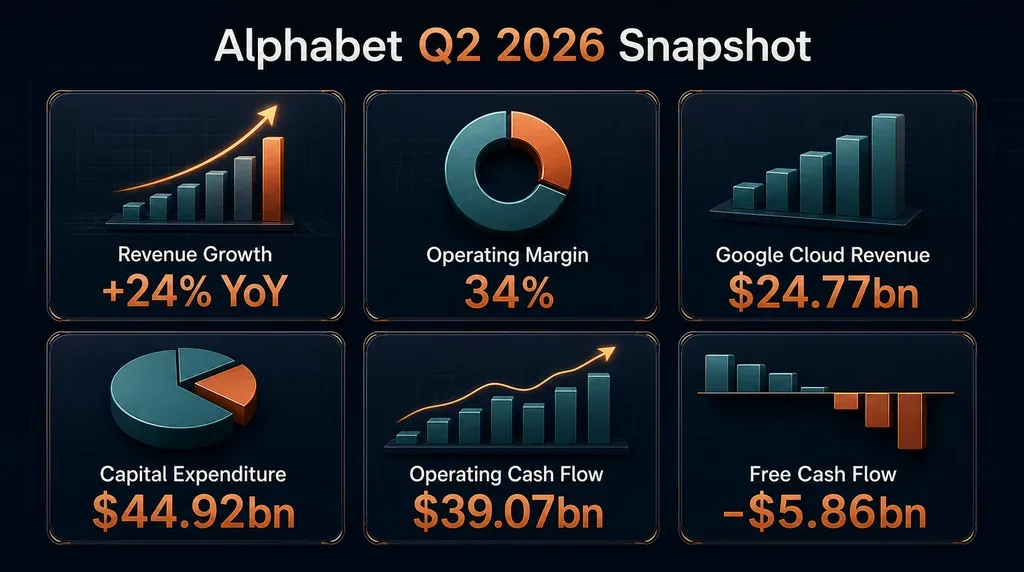
- Alphabet’s Q2 2026 revenue increased 24% year over year to $119.80 billion, while Google Cloud revenue rose 82% to $24.77 billion.
- Reported diluted EPS reached $9.11, but Alphabet said gains on equity securities added $6.26 per share, so the headline figure was not a clean measure of recurring operating performance.
- Quarterly capital expenditure reached $44.92 billion, exceeding $39.07 billion of operating cash flow and producing negative free cash flow of $5.86 billion.
- The Google stock forecast depends heavily on whether Search and Cloud growth can justify the scale of AI infrastructure spending without placing prolonged pressure on cash generation.
- GOOGL is Alphabet’s Class A voting stock, while GOOG is its Class C non-voting stock; both represent economic exposure to the same company but can trade at slightly different prices.
Google Stock at a Glance
The following market data were captured from Google Finance after the US market closed on 31 July 2026. (Note: Prices, ranges, market capitalisation, yields, and analyst estimates can change quickly.)1
| Metric | Latest available figure |
| Lead ticker | GOOGL (Alphabet Class A voting shares) |
| Closing price | $356.13 on 31 July 2026 |
| Latest one-day move | +6.73% on 31 July 2026 |
| 52-week range | $187.82–$408.61 |
| Market capitalisation | Approximately $4.35 trillion |
| Latest reported quarter | Q2 2026, released 22 July 2026 |
| Q2 revenue | $119.80 billion, up 24% year over year |
| Q2 diluted EPS | $9.11, including a $6.26-per-share effect from equity-security gains |
| Quarterly common dividend | $0.22 per Class A, Class B, and Class C share |
| Analyst consensus | 29 Buy, five Hold, and no Sell ratings from 34 analysts |
| Average 12-month analyst target | $427.81, with a $350–$515 range |
| Next earnings date | Not officially announced as of 3 August 2026; likely in late October based on the usual reporting cycle |
What Is Google Stock, and Why Is the Company Called Alphabet?
Did you know that Google stock is the retail-market name commonly used for shares in Alphabet Inc., Google’s parent company? Alphabet actually became the listed holding company in 2015, allowing the core Google business and a collection of longer-horizon ventures to be reported within a broader corporate structure.
Alphabet reports three principal operating areas:
- Google Services includes Search, YouTube, Android, Chrome, Google Play, subscriptions, and devices.
- Google Cloud provides cloud infrastructure, data, security, workspace, and AI services to organisations.
- Other Bets includes earlier-stage businesses like Waymo.
The distinction between the consumer brand (Google) and the corporate name (Alphabet) explains why many readers tend to encounter terms like “Google Alphabet stock”, “Alphabet stock”, and “Google stock” when searching for the same listed company. For broader mega-cap context, read Vantage Markets’ guide to the Magnificent Seven stocks.
The business remains meaningfully exposed to advertising.
In Q2 2026, Google advertising generated $81.63 billion of Alphabet’s $119.80 billion in revenue—about 68% of the total. Cloud provides a growing source of diversification, but Search and advertising still have an outsized influence on Alphabet stock earnings and valuation.
What Is the Difference Between GOOG and GOOGL Stock?
The recurring “GOOG vs GOOGL” stock question comes from Alphabet’s three-class share structure. GOOGL is the lead ticker in this article because it’s Alphabet’s publicly traded Class A stock.
| Share class | Ticker | Publicly traded? | Voting rights |
| Class A | GOOGL | Yes | One vote per share |
| Class B | None | No | Ten votes per share; mainly held by founders and insiders |
| Class C | GOOG | Yes | No ordinary voting rights |
Alphabet’s 2026 annual-meeting disclosure confirms that Class A shares carried one vote each and Class B shares carried ten votes each. Alphabet’s certificate of incorporation sets out the rights of the three classes, including the non-voting status of Class C stock.23
GOOGL and GOOG participate in the same underlying company, and Alphabet declares the same common dividend per share across Classes A, B, and C. Their market prices can nevertheless differ slightly because of voting rights, supply, demand, and trading flows.
In essence, if you’re searching for Google stock Class A, use GOOGL. For Google stock Class C, it’s GOOG. Take note that Class B shares are not available on a public exchange.
Google Stock Price Chart and Price History
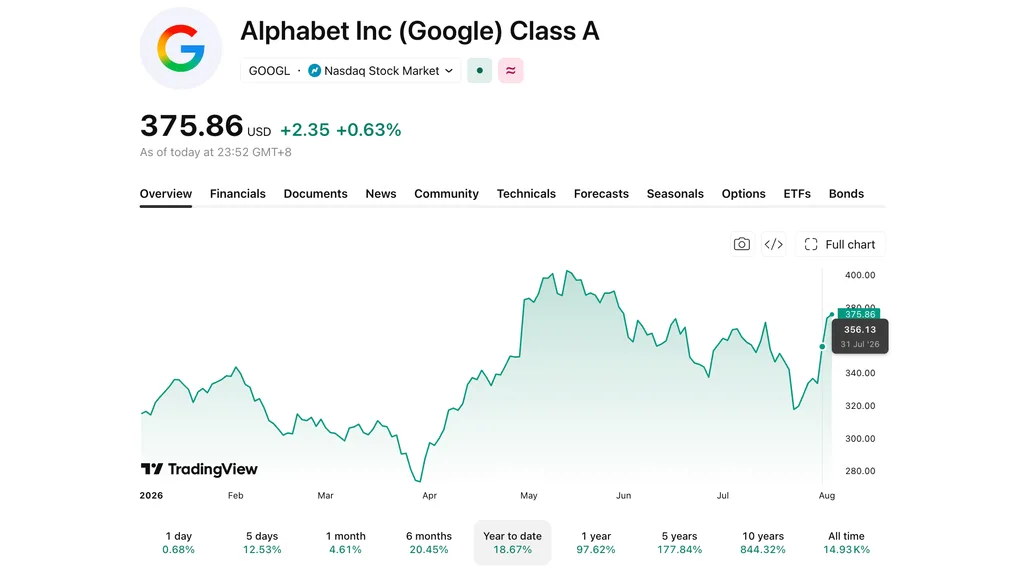
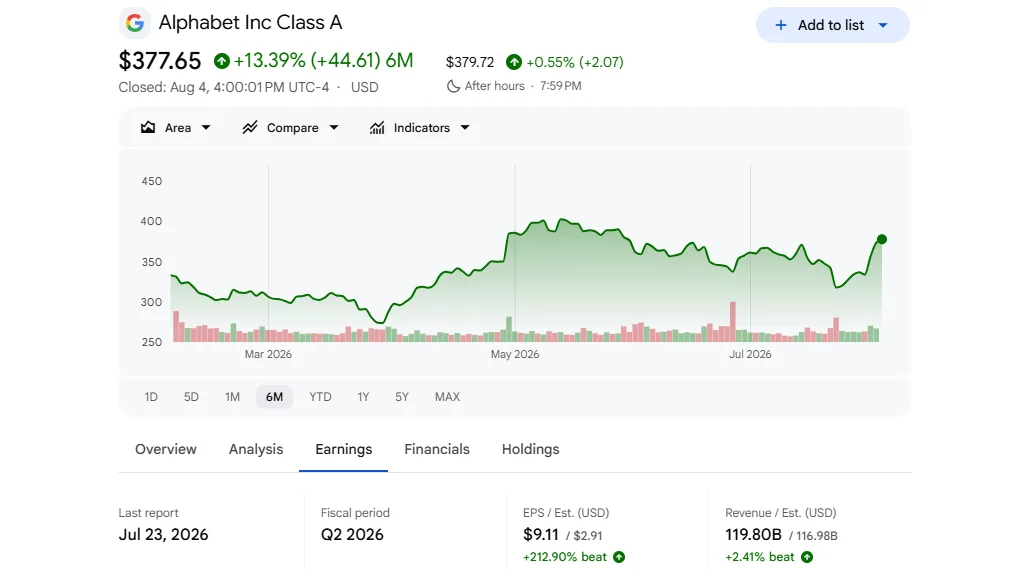
The Google stock price chart shows considerable volatility over the latest 52-week period. GOOGL closed at $356.13 on 31 July 2026, approximately 13% below its $408.61 high and about 90% above its $187.82 low.
Looking further back, Google’s IPO (initial public offering) became effective on 18 August 2004. Back then, the company sold Class A shares to the public at $85 each, according to its SEC offering circular, and trading began the following day.4
The long-term Google stock price history includes the 2014 creation of Class C shares, the 2015 formation of Alphabet as Google’s parent, and the 20-for-1 stock split in July 2022. These events changed the share structure and nominal price, so older quoted prices should be interpreted on a split-adjusted basis.
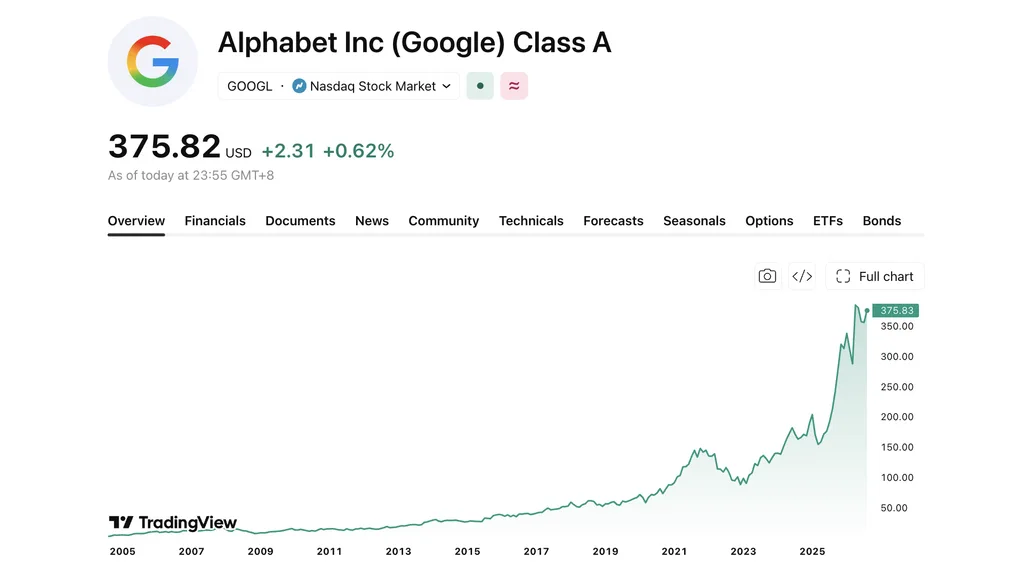
Bear in mind that historical price performance does not establish the direction of the next move. Readers seeking a dated market view rather than this evergreen overview can see Vantage Markets’ 22 July 2026 Google stock analysis.
What Did Alphabet’s Q2 2026 Earnings Show?
The latest Alphabet stock earnings report showed broad revenue growth, improving operating leverage, rapid Cloud expansion, and heavy infrastructure spending. Alphabet’s Q2 2026 earnings release reported the following results.5
| Q2 Metric | 2026 | 2025 | YoY Change |
| Revenue | $119.80bn | $96.43bn | +24% |
| Google advertising revenue | $81.63bn | $71.34bn | +14% |
| Google Search and other revenue | $63.27bn | $54.19bn | +17% |
| YouTube advertising revenue | $11.06bn | $9.80bn | +13% |
| Google Cloud revenue | $24.77bn | $13.62bn | +82% |
| Operating income | $40.77bn | $31.27bn | +30% |
| Operating margin | 34% | 32% | +2 percentage points |
| Diluted EPS | $9.11 | $2.31 | +294% |
| Capital expenditure | $44.92bn | $22.45bn | +100% |
| Free cash flow | -$5.86bn | $5.30bn | Turned negative |
1. Search and Advertising Continued to Grow
Google Services revenue rose 15% to $94.54 billion. Within that total, Search and other revenue increased 17%, YouTube advertising rose 13%, and subscriptions, platforms, and devices increased 15%.
This performance matters because generative AI has raised questions about whether conversational answers could weaken traditional search activity or reduce the space available for advertising. Instead, Google’s Q2 2026 report showed that Search was still growing while Alphabet expanded AI features. While that does not settle the longer-term debate, it does provide current evidence that the core engine remains commercially productive.
2. Google Cloud Accelerated
Google Cloud revenue increased 82% to $24.77 billion, while segment operating income rose to $8.81 billion from $2.83 billion. Alphabet attributed the acceleration to Google Cloud Platform demand across enterprise AI infrastructure, AI solutions, and core services.
Cloud is therefore becoming more important to the Google stock forecast. It can diversify Alphabet beyond advertising and may give the company a direct way to monetise the computing infrastructure, models, and security capabilities developed for AI.
3. Headline EPS Was Distorted by Equity Gains
Alphabet reported diluted EPS of $9.11, but that figure requires context. The company recorded $99.03 billion of gains on equity securities and said the resulting after-tax effect added $6.26 to diluted EPS.
Subtracting that disclosed effect produces roughly $2.85 per share. This is a useful analytical comparison, but it’s not an Alphabet-reported adjusted EPS measure. The distinction prevents the unusually high headline EPS from being mistaken for recurring operating earnings.
4. CapEx Exceeded Operating Cash Flow
Operating cash flow was $39.07 billion, while purchases of property and equipment reached $44.92 billion. Consequently, Alphabet reported negative quarterly free cash flow of $5.86 billion, even though trailing-12-month free cash flow remained positive at $53.27 billion.
Alphabet also raised $49.6 billion through common and mandatory convertible preferred stock in June 2026 and issued $20.3 billion of senior unsecured notes during the quarter. These transactions strengthened liquidity for AI infrastructure, but they also introduced questions about dilution, financing costs, and the amount of capital required before the investment cycle produces consistent cash returns.
Is Google Stock Up or Down?
Readers asking “Why is Google stock down?” are usually seeing the interaction of several factors rather than one permanent explanation. The same variables can support the share price when expectations improve and pressure it when results or guidance disappoint.
As of early August 2026, Google stock has recovered from its brief decline over concerns about its AI infrastructure-related expenses.
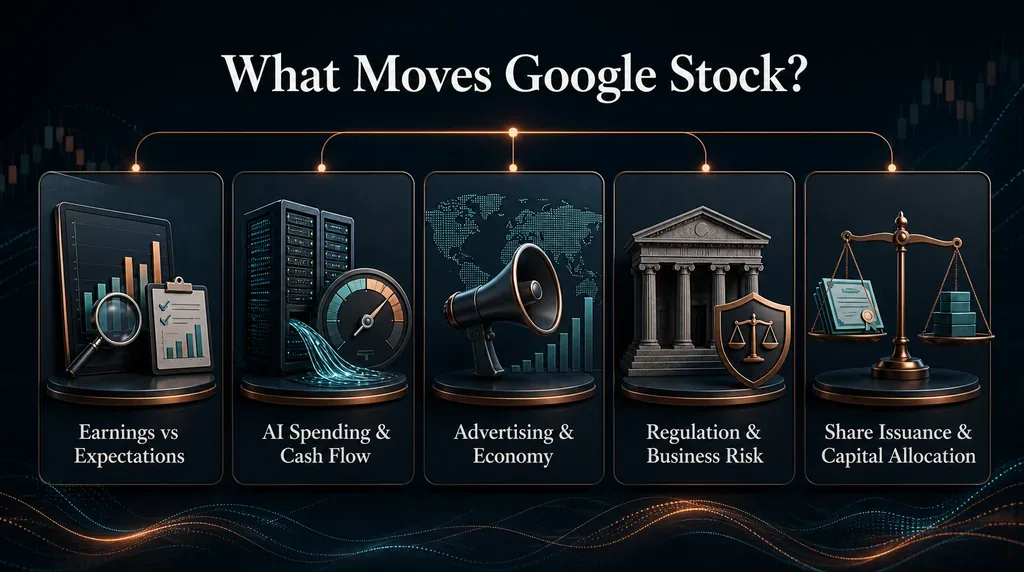
1. Earnings Versus Expectations
A company can report rising revenue and still see its shares decline if the market expected more. For Alphabet, investors often compare Search growth, Cloud growth, operating margin, EPS, and capital expenditure with analyst forecasts rather than judging the figures in isolation.
The Q2 release also demonstrates why earnings quality matters. The $9.11 reported EPS was substantially affected by unrealised equity gains, so market participants may focus more heavily on operating income, cash flow, and an estimate of underlying earnings.
2. AI Spending and Free Cash Flow
Artificial intelligence (AI) can potentially create new revenue for Google through its Search, Cloud, Gemini, and related products. However, data centres, servers, networking equipment, energy, and specialised chips require substantial capital before their commercial returns are fully visible.
When capex rises faster than operating cash flow, the Alphabet stock price may become more sensitive to evidence of utilisation and pricing. A stronger pipeline of enterprise contracts could support the shares, while delayed returns or excess capacity could place pressure on valuation.
3. Advertising and Economic Conditions
Google advertising represented about 68% of Q2 revenue. Advertising demand can be influenced by:
- Consumer activity
- Business confidence
- Competition
- Foreign-exchange movements
- Changes to measurement or privacy practices
This concentration means even rapid Cloud growth may not fully offset a material slowdown in Search or YouTube advertising. Conversely, firm advertising demand might provide the cash flow needed to fund Alphabet’s newer businesses.
4. Regulation, Litigation, and Business-Model Risk
Alphabet continues to face antitrust and regulatory proceedings involving Search, advertising technology, Android, Google Play, privacy, and the use of AI. Its Q1 2026 Form 10-Q states that possible remedies may include fines, product changes, alterations to business practices, or structural measures amounting to about $15.5 million.6
The outcome and timing of these cases remain uncertain. A favourable ruling can reduce an overhang, while a restrictive remedy may alter distribution agreements, economics, or product design.
5. Share Issuance and Capital Allocation
Alphabet issued new Class A and Class C shares in Q2 2026 and paused stock repurchases during the quarter. New equity can fund expansion, but it can also dilute each existing share’s claim on future earnings if the capital does not generate adequate incremental value.
Dividend declarations, future repurchases, debt issuance, acquisitions, and the pace of equity compensation may therefore influence how the market assesses the stock price of Alphabet.
What Could Drive the Google Stock Outlook Next?
Five areas are likely to shape the next phase of the Google stock outlook. Each depends on execution, competition, and market conditions.
1. AI Features in Search
Alphabet says AI features are supporting Search query growth. In its Q2 2026 earnings remarks, management said the Gemini app had reached 950 million monthly active users and Gemini models were processing “approximately 22 billion API tokens per minute”.7
The key commercial question is whether AI-enhanced Search can protect user engagement and advertising economics while managing the additional cost of generating answers. Higher query activity, effective ad formats, and stable margins would support the case; weaker monetisation or higher serving costs would complicate it.
2. Google Cloud’s Growth and Margins
Cloud delivered the strongest growth of Alphabet’s main segments in Q2. Future quarters should show whether its 82% pace can remain elevated as comparisons become harder and whether operating income continues to scale alongside infrastructure spending.
Demand for enterprise AI infrastructure, AI solutions, cybersecurity, and core cloud services could broaden Alphabet’s revenue mix. Investors may also watch customer concentration, pricing, capacity utilisation, and the cost of long-duration data-centre commitments.
3. YouTube, Subscriptions, and Devices
YouTube advertising and subscriptions, platforms, and devices both grew at double-digit rates in Q2. Continued monetisation through advertising, subscriptions, connected television, and creator tools could add resilience outside Search.
These businesses also face competition for attention and content costs. Revenue growth matters most when it’s accompanied by disciplined spending and durable user engagement.
4. Waymo and Other Bets
Other Bets generated $382 million of Q2 revenue and an operating loss of $1.80 billion. Waymo may provide meaningful longer-term optionality if autonomous ride-hailing scales across more markets, but the segment remains small relative to Alphabet’s core operations and continues to consume capital.
Readers should avoid assigning a precise value to early-stage projects without considering regulatory approval, safety, competition, unit economics, and the time required to reach commercial scale.
5. The Q3 2026 Earnings Update
As of 3 August 2026, Alphabet had not formally announced its next earnings date. Based on its usual reporting cycle, Q3 results are likely in late October, but readers should verify the date on Alphabet Investor Relations before relying on it.8
The next report should provide more evidence on Search growth, Cloud demand, capital expenditure, free cash flow, equity issuance, and the relationship between reported EPS and non-operating gains.

What Are the Main Risks to Alphabet Stock?
The following risks should be considered alongside the potential catalysts. They can affect both the operating business and the valuation placed on Alphabet stock.
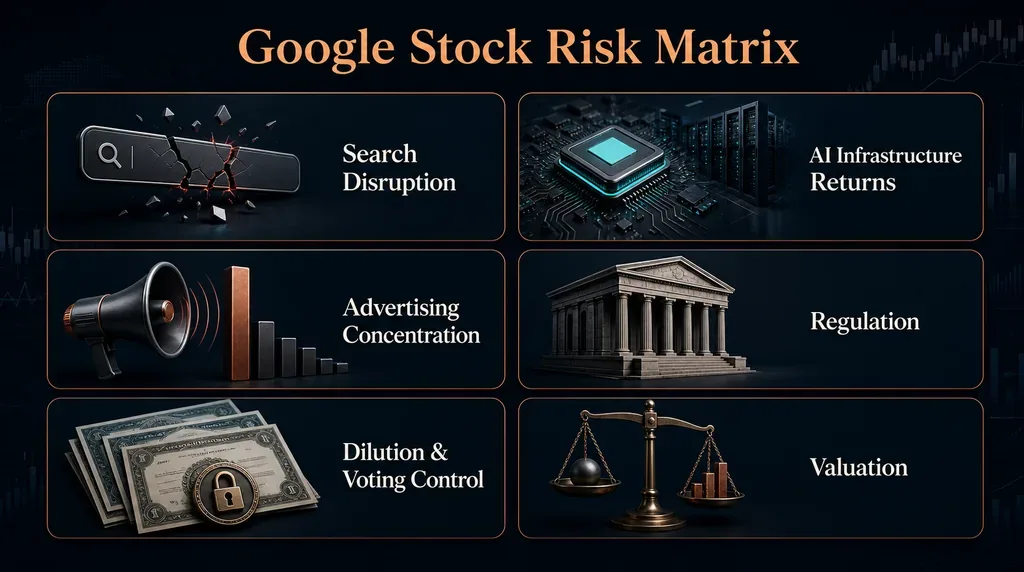
1. AI Could Change Search Economics
Generative AI may increase engagement, but it may also change how users interact with links and advertising. If AI-generated answers reduce commercial clicks or require materially more computing resources per query, Search margins could come under pressure even if usage remains high.
Competition from other search engines, AI assistants, social platforms, and specialist applications may also fragment user attention. Alphabet must innovate without weakening the economics of its largest business.
2. Infrastructure Spending May Not Produce Adequate Returns
Alphabet’s Q2 capital expenditure doubled from the prior year and exceeded operating cash flow. Large infrastructure commitments can support future growth, but they can also create depreciation, financing, energy, and maintenance costs before utilisation reaches an efficient level.
The company’s own SEC filing warns that AI and infrastructure investments may not be commercially viable or may fail to generate an adequate return of capital. Negative quarterly free cash flow makes this risk more visible.
3. Advertising Remains Concentrated
Advertising still generated roughly two-thirds of Q2 revenue. A downturn in marketing budgets, weaker ad pricing, privacy changes, or competitive pressure could have a material effect on Alphabet even as Cloud expands.
Search is also a high-margin source of funding for AI, Cloud, and Other Bets. Slower advertising growth could therefore affect both current earnings and the capacity to finance future initiatives.
4. Regulation Could Change Products or Distribution
Alphabet faces legal proceedings across multiple jurisdictions. Potential remedies can range from fines to restrictions on distribution agreements, data sharing, product design, and parts of the advertising-technology business.
These matters are difficult to value because their timing, scope, and appeal outcomes are uncertain. They may also require management attention and create costs even when Alphabet ultimately prevails on some issues.
5. Equity Issuance and Voting Control May Limit Outside Influence
The Q2 capital raise increased the share count, and the company’s at-the-market programme could permit additional issuance. Dilution may be acceptable if new capital earns attractive returns, but it can reduce per-share participation if outcomes disappoint.
Alphabet’s Class B shares also carry ten votes each, giving founders and insiders substantial influence. Public GOOGL holders receive one vote per share, while GOOG holders generally have no voting rights.
6. Valuation Can Reset Quickly
GOOGL’s wide 52-week range shows how rapidly expectations can change. A strong company result does not necessarily produce a higher share price if the outcome falls short of what was already reflected in the valuation.
Interest rates, market risk appetite, earnings estimates, and the valuation of comparable technology companies can all affect GOOGL even without a major change in Alphabet’s operations.
What Is the Google Stock Forecast and 12-Month Price Target?
As of 31 July 2026, Google Finance displayed 29 Buy ratings, five Hold ratings, and no Sell ratings from 34 analysts covering GOOGL. The average 12-month target was $427.81, with individual targets ranging from $350 to $515.1
Compared with the $356.13 closing price, the average target represented approximately 20% potential upside. The low target implied a decline of about 2%, while the high target implied an increase of roughly 45%.
These Google stock predictions are not promises. Analyst targets depend on assumptions about revenue, operating margins, capital expenditure, non-operating gains, share issuance, and valuation multiples. Targets can change immediately after new information becomes available.
Hypothetical Bull Case
- Search and YouTube maintain double-digit revenue growth while AI features support engagement and monetisation.
- Cloud continues to grow quickly and converts its infrastructure demand into higher operating income.
- Capex remains high but operating cash flow rises enough to restore positive quarterly free cash flow.
- Regulatory outcomes are manageable, and the market maintains a premium valuation for Alphabet’s growth.
Hypothetical Base Case
- Revenue continues to grow, but Cloud growth moderates from its unusually high Q2 rate.
- AI spending keeps depreciation and cash expenditure elevated, limiting near-term free-cash-flow expansion.
- Advertising remains resilient, while investors wait for clearer evidence of returns from the infrastructure programme.
- The stock trades around a valuation range consistent with other mega-cap technology companies.
Hypothetical Bear Case
- Search growth slows as competition and changing user behaviour pressure advertising economics.
- Infrastructure spending remains above operating cash flow for longer than expected.
- Equity issuance, legal remedies, or weaker margins reduce per-share earnings expectations.
- The market assigns a lower valuation multiple as uncertainty around cash returns increases.
Can Google Stock Reach $500?
Google stock reaching $500 is possible as a scenario, but it’s definitely not a fixed destination. From the $356.13 closing price on 31 July 2026, GOOGL would need to rise approximately 40% to reach that price target.
| Hypothetical Calculation | Figure |
| Starting GOOGL price | $356.13 |
| Hypothetical target | $500.00 |
| Required price increase | Approximately 40% |
| Current market capitalisation | Approximately $4.35 trillion |
| Approximate market capitalisation at the same price ratio | Approximately $6.1 trillion |
Note: This is a hypothetical illustration, assumes the relationship between GOOGL’s price and Alphabet’s total market capitalisation remains broadly stable, and does not represent a forecast of client performance.
A sustained move towards $500 would probably require continued Search growth, large and profitable Cloud expansion, more visible returns from AI infrastructure, and a supportive valuation. Share issuance or a lower valuation multiple would raise the operating-performance hurdle.
Is Google a Good Stock to Buy in 2026?
Whether Google stock is a good stock to buy depends on the reader’s objectives, time horizon, valuation discipline, and tolerance for volatility. The latest results provide credible evidence for both an optimistic and a cautious interpretation.
| Factors That May Support a Buy Rating | Factors That May Support a Sell Rating |
| 24% Q2 revenue growth | Q2 capex doubled year over year |
| 82% Google Cloud revenue growth | Quarterly free cash flow turned negative |
| 34% operating margin | Headline EPS was heavily affected by unrealised gains |
| Continued Search and YouTube growth | Advertising remains concentrated |
| Growing enterprise AI demand | Equity issuance can dilute existing shareholders |
| Quarterly dividend across all common share classes | Antitrust, regulatory, and execution risks remain material |
The central issue is not whether Alphabet owns strong businesses—it does. The harder question is whether future operating cash flows can compensate for the scale, timing, and financing of its AI investment cycle at the valuation paid for the shares.
Google Stock: Buy or Sell Considerations
- Time horizon: A longer-term view may be more tolerant of near-term infrastructure spending, while a short-term position may be dominated by earnings volatility.
- Evidence threshold: Readers can monitor Search revenue, Cloud growth, operating margin, capital expenditure, free cash flow, and the share count.
- Share-class choice: GOOGL provides one vote per share, while GOOG generally provides no voting rights; their prices and liquidity should be compared before a decision.
- Valuation: A lower share price does not automatically make a stock inexpensive because the earnings, cash-flow, and dilution outlook also matter.
- Concentration: Exposure to one company, sector, or earnings event can increase portfolio risk.
- Scenario risk: Bull, base, and bear cases should all be considered rather than relying on one analyst target.
Vantage Tip: A Google stock buy or sell decision should be based on a repeatable process rather than one earnings move, headline EPS figure, or analyst rating. Vantage Markets’ guide to risk management techniques provides additional context on defining exposure and loss capacity.
Does Google Stock Pay a Dividend?
Yes, Google stock pays a dividend. Alphabet’s Q2 2026 earnings release states that the board declared a quarterly cash dividend of $0.22 per Class A, Class B, and Class C share in July. The common dividend was scheduled for payment on 14 September 2026 to shareholders of record on 7 September.5
At a $356.13 share price, four quarterly payments at that rate would equal $0.88 per year and an indicative yield of approximately 0.25%. This calculation is backward-looking, and future dividend declarations could differ.
Alphabet began paying a common dividend in 2024. The Google stock dividend yield remains modest, so the case for owning the shares is still tied more closely to earnings growth, cash generation, valuation, and capital allocation than to dividend income.
Google Stock Split History
Alphabet’s official Additional Information page provides the tax documentation for its share-class changes and 2022 split. The key events are summarised below.9
| Date | Event | Practical effect |
| 3 April 2014 | Class C distribution | Existing holders received non-voting Class C shares; Class A shares later used GOOGL, while Class C used GOOG. |
| 27 April 2015 | Class C adjustment payment | Eligible holders received a small additional Class C distribution under the settlement arrangement. |
| 15 July 2022 | 20-for-1 stock split | Each pre-split share became 20 shares of the same class, and the nominal price adjusted proportionally. |
The split changed the number and nominal price of shares but did not by itself change Alphabet’s total market value. Vantage Markets’ stock-split explainer covers how forward splits generally work, while this article retains only the Alphabet-specific history.
How Can Traders Access GOOGL Through Share CFDs?
Vantage Markets’ clients may be able to gain exposure to movements in the GOOGL stock price through share contracts for difference (CFDs), subject to entity, account, and jurisdictional availability. A share CFD allows a trader to take a long or short position on price movements without owning the underlying Alphabet share.
This flexibility introduces material risk. CFDs use leverage, so potential gains and losses can both be magnified relative to the capital committed. Spreads, commissions, overnight financing, price gaps, execution risk, and stop-out risk should be considered before trading.
Readers can explore Vantage Markets’ US share CFDs for more information. Availability, trading symbols, costs, and contract specifications should be confirmed on the relevant platform before a position is opened.
A Vantage Demo Account can help readers become familiar with order entry and platform behaviour using virtual funds. Demo results are hypothetical and don’t replicate every condition or emotional factor present in live trading. Meanwhile, experienced traders who understand the risks can consider opening a Vantage Live Account.
What Should Readers Watch Next?
Alphabet’s Q2 report showed a company growing quickly while committing exceptional amounts of capital to AI and global compute. Search, YouTube, and Cloud expanded, and operating margin improved, but free cash flow turned negative because capex exceeded operating cash flow.
The next phase of the Google stock outlook therefore rests on two connected questions: How durable is the revenue growth, and how quickly can the infrastructure programme produce adequate cash returns per share? Q3 Search growth, Cloud revenue, capital expenditure, free cash flow, and the share count should help investors judge the balance.
FAQs on Google Stock
What Is Google’s Stock Symbol?
Google’s parent company, Alphabet, has two publicly traded stock symbols. GOOGL is Class A stock with one vote per share, while GOOG is Class C stock without ordinary voting rights.
Is GOOGL Class A or Class C?
GOOGL is Alphabet’s Class A common stock with one vote each. GOOG is its Class C capital stock without voting rights. Alphabet also has Class B shares with ten votes each, but those shares are not publicly traded.
What Is the Difference Between GOOG and GOOGL Stock?
The primary difference is voting rights: GOOGL generally carries one vote per share, while GOOG generally carries none. Both classes represent economic exposure to Alphabet and receive the same declared common dividend per share, although their market prices can differ slightly.
Are Alphabet and Google the Same Company?
Alphabet is the listed parent company, while Google is its largest operating subsidiary. People commonly use Google stock to refer to Alphabet shares because Google’s products generate most of the group’s revenue and brand recognition.
How Much Is Google Stock?
For readers asking “How much is Google stock?”, GOOGL closed at $356.13 on 31 July 2026. The price changes throughout regular and extended trading hours, and a live share or CFD quote can differ because of timing, spreads, and data sources.
When Did Google Stock Split?
Alphabet completed a 20-for-1 stock split on 15 July 2022. It also used a 2014 distribution to create non-voting Class C shares, which is why the company now has the public tickers GOOGL and GOOG.
Does Google Stock Pay a Dividend?
Yes. Alphabet declared a $0.22 quarterly common dividend for each Class A, Class B, and Class C share in July 2026. Future payments remain subject to board approval.
When Is Alphabet’s Next Earnings Report?
Alphabet had not formally announced its Q3 2026 earnings date as of 3 August 2026. Based on its usual schedule, the report is likely in late October, but readers should verify the date through Alphabet Investor Relations.
RISK WARNING: CFDs are complex financial instruments and carry a high risk of losing money rapidly due to leverage. You should ensure you fully understand the risks involved and carefully consider whether you can afford to take the high risk of losing your money before trading.
Disclaimer: The information is provided for educational purposes only and doesn’t take into account your personal objectives, financial circumstances, or needs. It does not constitute investment advice. We encourage you to seek independent advice if necessary. The information has not been prepared in accordance with legal requirements designed to promote the independence of investment research. No representation or warranty is given as to the accuracy or completeness of any information contained within. This material may contain historical or past performance figures and should not be relied on. Furthermore estimates, forward-looking statements, and forecasts cannot be guaranteed. The information on this site and the products and services offered are not intended for distribution to any person in any country or jurisdiction where such distribution or use would be contrary to local law or regulation.
References
- “Alphabet Inc Class A (GOOGL) Stock Price and Analyst Estimates – Google Finance”. https://www.google.com/finance/beta/quote/GOOGL:NASDAQ. Accessed on 3 August 2026.
- “2026 Annual Meeting of Shareholders – Alphabet Investor Relations”. https://abc.xyz/investor/annual-meeting/default.aspx. Accessed on 3 August 2026.
- “Certificate of Incorporation – Alphabet Investor Relations”. https://abc.xyz/investor/board-and-governance/certificate-of-incorporation/. Accessed on 3 August 2026.
- “Google Inc. Offering Circular – US Securities and Exchange Commission”. https://www.sec.gov/Archives/edgar/data/1288776/000119312504204864/d424b3.htm. Accessed on 3 August 2026.
- “Alphabet Announces Second Quarter 2026 Results – US Securities and Exchange Commission”. https://www.sec.gov/Archives/edgar/data/1652044/000165204426000066/googexhibit991q22026.htm. Accessed on 3 August 2026.
- “Alphabet Q1 2026 Form 10-Q – US Securities and Exchange Commission”. https://www.sec.gov/Archives/edgar/data/1652044/000165204426000048/goog-20260331.htm. Accessed on 3 August 2026.
- “Alphabet Earnings Call Q2 2026: Sundar Pichai Remarks – Google”. https://blog.google/company-news/inside-google/message-ceo/alphabet-earnings-q2-2026/. Accessed on 3 August 2026.
- “Alphabet Investor Relations – Alphabet”. https://abc.xyz/investor/. Accessed on 3 August 2026.
- “Additional Information and Alphabet Stock-Split Tax Forms – Alphabet Investor Relations”. https://abc.xyz/investor/additional-information/default.aspx. Accessed on 3 August 2026.