


 Updated
Leverage is one of the first concepts every new forex trader encounters — and one of the most misunderstood. Used well, it lets you control a larger position than your account balance alone would allow. Used carelessly, it can turn a small market move into a significant loss.
This guide breaks down what leverage actually is, how it works, how the different ratios compare, and how much leverage suits your experience level and account size.
Key Takeaways
- Leverage lets you open a forex position worth many times your deposited capital, using a fraction of that value — margin — as collateral.
- Your profit or loss is calculated on the full position size, not just your margin, so leverage amplifies both gains and losses at the same rate.
- Leverage ratios commonly range from 1:1 (no leverage) up to 1:500 or higher, though regulators in many jurisdictions cap retail accounts (e.g., 1:30 in the UK and EU).
- Leverage isn’t a loan you repay separately — losses and gains hit your account balance in real time, and unmet margin can trigger a margin call or stop-out.
- There’s no single “correct” leverage ratio. The right amount depends on your experience, risk tolerance, and the volatility of what you’re trading.
What Is Margin? The Other Half of Leverage
Leverage and margin are often used interchangeably, but they describe different things:
| Term | What It Means |
| Leverage | The ratio that determines how large a position you can control relative to your capital (e.g., 1:100) |
| Margin | The actual amount of money set aside from your account to open and maintain that leveraged position |
Think of leverage as the multiplier, and margin as the deposit that multiplier is applied to. Higher leverage means a lower margin requirement for the same position size.
You can calculate the margin required for a leveraged position using this formula:
Required Margin = Position Size ÷ Leverage Ratio
Example: For a $50,000 position at 1:200 leverage:
$50,000 ÷ 200 = $250 required margin
How Leverage Works
When you trade with leverage, you’re not borrowing cash in the traditional sense. Instead, your broker allows you to open a position worth many times your deposited capital, provided you set aside a portion of that value — the margin — to cover potential losses.
Example:
Say you want to open a position worth $10,000 in a currency pair, and your broker offers 1:100 leverage. You would only need to put up $100 of your own capital as margin to control that $10,000 position.
This means:
- Your profit or loss is calculated on the full $10,000 position, not just your $100 margin.
- A 1% favourable move nets you $100 — a 100% return on your margin.
- A 1% adverse move loses you $100 — wiping out your entire margin.
This is the core mechanic to understand: leverage doesn’t change how much the market moves. It changes how much that movement is worth to your account, in both directions.
The same mechanic applies beyond currency pairs. For example, on a $20,000 gold CFD position at 1:20 leverage, you’d need $1,000 in margin — but a 1% adverse move in the gold price would still cost you $200, or 20% of that margin.
Leverage Ratios Compared: From 1:1 to 1000:1
Leverage ratios are easier to compare once you group them into tiers. Using a standard 1-lot EUR/USD position ($100,000 notional) as a reference point:
| Tier | Ratio Range | Margin Required | Effect of a 1% Adverse Move | Typical User Profile |
| Low | 1:1 – 1:20 | $5,000 – $100,000 | 1–20% of margin | Regulated retail accounts under UK/EU/Australia caps; conservative traders |
| Moderate | 1:30 – 1:50 | $2,000 – $3,333 | 30–50% of margin | Common global retail default; a reasonable starting point for beginners |
| High | 1:100 – 1:200 | $500 – $1,000 | 100–200% of margin | Experienced traders, typically under non-EU regulation, with tight risk controls |
| Extreme | 1:400+ | Under $250 | 400%+ of margin | High-risk, speculative accounts; generally discouraged for most retail traders |
A useful rule of thumb falls out of the maths: the percentage of your margin at risk from a 1% price move is roughly equal to your leverage ratio. At 1:50, a 1% move swings 50% of your margin. At 1:200, the same 1% move swings 200% of it — more than your entire margin, which is exactly why high-leverage accounts get stopped out so much faster.
In practice, brokers close positions before losses fully consume available margin (see the margin call and stop-out explanation below), so these figures illustrate relative risk exposure rather than a literal wipeout point.
Advantages of Leverage
Used within a clear risk framework, leverage offers a few practical benefits:
- Capital efficiency: You can control a market-standard position size without tying up the full notional value in your account.
- Diversification: The same capital that would otherwise fund one unleveraged position can support smaller, leveraged positions across multiple currency pairs.
- Market access: Leverage lets accounts of more modest size participate in a market where standard lot sizes would otherwise be out of reach.
These advantages come with proportionally amplified risk.
Risks of Leverage
Leverage is a double-edged tool, and understanding the risks is essential before using it:
- Amplified losses: Just as leverage magnifies gains, it magnifies losses at the same proportion — losses can exceed your initial margin in some account types.
- Margin calls: Adverse price movement can trigger a request for additional funds, or automatic closure of your position.
- Increased sensitivity to volatility: Sudden market moves — around news events, for example — can affect leveraged positions more sharply than unleveraged ones.
- Negative balance risk: Depending on your broker and jurisdiction, in extreme market conditions it’s possible to lose more than your deposited funds, unless negative balance protection applies to your account.
It’s worth keeping the scale of this risk in view. Regulatory reviews carried out by the European Securities and Markets Authority (ESMA) into retail CFD trading found that roughly 74–89% of retail accounts lose money overall — one of the reasons regulators in the UK, EU, and elsewhere cap leverage for retail clients. Figures like this vary by broker and by market, but they’re a useful reminder that leverage doesn’t improve your odds of a trade being right — it only changes the size of the outcome either way.
Leverage does not make a trading strategy more likely to succeed. Sound risk management — including position sizing, stop-losses, and only risking capital you can afford to lose — remains essential regardless of the leverage ratio used.
Do You Have to Pay Back Leverage?
This is a common point of confusion. Leverage is not a loan you repay separately — you’re not making repayments the way you would with a bank loan.
Instead, any losses on a leveraged position are deducted directly from your account balance in real time as the trade moves against you. If losses approach your available margin, your broker may issue a margin call, requesting you deposit more funds or reduce your position size. If margin isn’t maintained, the broker may automatically close your position to prevent further loss — this is a stop-out.
In other words: there’s no separate repayment step, but the risk is real and immediate, reflected directly in your account equity.
How Much Leverage Should You Use? A Guide by Account Size
There’s no single “correct” leverage ratio — the right amount depends on your experience, risk tolerance, and trading strategy. That said, a few principles are worth keeping in mind:
- Higher leverage increases both potential gains and potential losses at the same rate. It does not change your odds of a trade being right — it changes the size of the outcome either way.
- Newer traders often benefit from using lower effective leverage than the maximum available, giving trades more room to move before triggering a margin call.
- Volatility matters. Highly volatile pairs can hit stop-losses or margin calls faster at high leverage, even if your directional view is eventually correct.
- Regulatory limits apply in many jurisdictions. For example, retail traders in the UK and EU are subject to leverage caps set by regulators (such as the FCA and ESMA), typically capping major currency pairs at 1:30 for retail accounts. Professional or non-retail classifications may have different limits.
Since the question “what leverage for my account size?” comes up often, here’s a general educational reference point — not a recommendation, since actual risk tolerance and strategy matter more than any single ratio:
| Account Size | Illustrative Max Real Leverage | Example Position Size |
| $100 | 2:1 – 5:1 | $200 – $500 |
| $500 | 5:1 – 10:1 | $2,500 – $5,000 |
| $1,000 | 5:1 – 10:1 | $5,000 – $10,000 |
| $10,000 | 5:1 – 10:1 | $50,000 – $100,000 (≈ 1 standard lot) |
On very small accounts, even conservative real leverage leaves little room before a normal price swing consumes a large share of margin — which is why position sizing and stop-losses matter more on a $100 account than the leverage ratio itself.
Rather than asking “what’s the best leverage ratio,” it’s often more useful to ask “how much of my account am I willing to risk on this position” — and size accordingly.
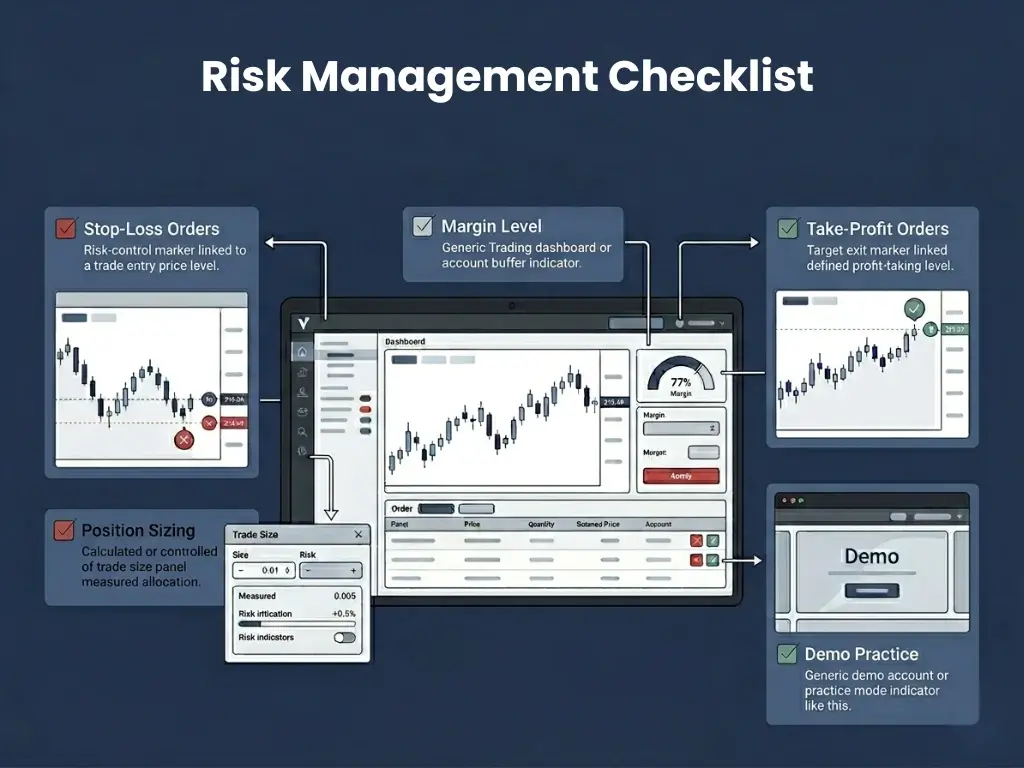
How to Manage Leverage Risk
A few habits go a long way toward keeping leveraged trading within your risk tolerance:
- Size positions to your account, not to the maximum leverage offered. Just because your account allows 1:500 doesn’t mean using it is appropriate.
- Use stop-losses consistently so a single adverse move can’t consume more of your account than you’ve planned for.
- Track your effective leverage, not just your account’s stated maximum — see the Stated vs. Real Leverage section above.
- Set price or margin-level alerts so you’re not caught off guard by a fast-moving market.
- Check required margin before opening a position using a margin calculator.
Bringing It Together
Leverage is a tool that scales outcomes — it doesn’t shortcut the work of finding good trades. The ratio your broker offers is a ceiling, not a goal; what determines your actual risk is the margin formula, your effective leverage, and how you size each position against your account. Understood this way, leverage becomes one input among several — alongside stop-losses, volatility, and account size — rather than the single number that decides how a trade turns out.
Frequently Asked Questions
Can I trade forex without leverage?
Yes. Most brokers allow you to trade at 1:1 (no leverage), meaning your position size is limited to your actual account balance. This reduces both potential gains and potential losses.
What is a good leverage ratio for forex?
There’s no universal answer — it depends on your risk tolerance, experience, and the volatility of what you’re trading. Many newer traders choose to use lower effective leverage than the maximum offered, to allow trades more room before triggering a margin call.
How is leverage calculated in forex?
Divide your total position size by the leverage ratio to find the required margin (Position Size ÷ Leverage Ratio). See the calculation section above for a worked example.
What is account leverage in forex?
Account leverage refers to the maximum leverage ratio your trading account is set to, as offered or approved by your broker, which determines the largest position size you can open relative to your balance.
What does 1:500 leverage mean?
It means you can control a position worth up to 500 times your margin — for example, $500 of margin could open a $250,000 position. Very few traders use the full ratio their account allows; see Stated vs. Real Leverage above.
What leverage is best for a $100 account?
On very small accounts, the leverage ratio matters less than position sizing. A conservative real leverage of 2:1–5:1 (a $200–$500 position) leaves more room for normal price movement than using a high stated ratio at full size.
Does leverage increase profit or just position size?
Leverage increases position size, not your odds of profit. Because profit and loss are calculated on the full position, a larger position means larger gains on winning trades and larger losses on losing ones — in equal proportion.
RISK WARNING: CFDs are complex financial instruments and carry a high risk of losing money rapidly due to leverage. You should ensure you fully understand the risks involved and carefully consider whether you can afford to take the high risk of losing your money before trading.
Disclaimer: The information is provided for educational purposes only and doesn’t take into account your personal objectives, financial circumstances, or needs. It does not constitute investment advice. We encourage you to seek independent advice if necessary. The information has not been prepared in accordance with legal requirements designed to promote the independence of investment research. No representation or warranty is given as to the accuracy or completeness of any information contained within. This material may contain historical or past performance figures and should not be relied on. Furthermore estimates, forward-looking statements, and forecasts cannot be guaranteed. The information on this site and the products and services offered are not intended for distribution to any person in any country or jurisdiction where such distribution or use would be contrary to local law or regulation.