


 Updated
An order type is the instruction you give your broker that sets how, and at what price, a trade is opened or closed. Choose well and you enter close to the price you planned. Choose badly and a fast market can fill you somewhere you did not expect.
In Contracts for Difference (CFDs) trading, the same handful of order types applies across forex, indices, commodities such as gold, and share CFDs. Three families cover almost everything: market orders for speed, limit orders for price control, and stop orders for triggering a trade once price reaches a set level.
Variations such as stop-limit, trailing stop, stop-loss and take-profit sit on top, fine-tuning when a trade fills and how risk is managed.
Key Points
- Order types fall into three core families in CFD trading — market, limit, and stop — each controlling a different trade-off between speed, price, and certainty of execution.
- A market order prioritises speed and fills at the best available price, while limit and stop orders prioritise price by waiting for the market to reach a level you set, which means they may never fill.
- Risk-management orders such as stop-loss and take-profit close a position automatically, but none of them guarantees an exact fill price when markets gap or move quickly.
What Are Order Types in Trading?
An order type tells your broker two things: the price at which you are willing to trade, and the condition under which the order should execute. Trading platforms group them into the same broad categories, so learning the logic once carries across forex, indices, commodity and share CFDs.
The three core families are:
- Market orders: Execute immediately at the best price currently available.
- Limit orders: Execute only at a price you specify or better, waiting until the market reaches it.
- Stop orders: Stay dormant until price hits a trigger level, then convert into a market order.
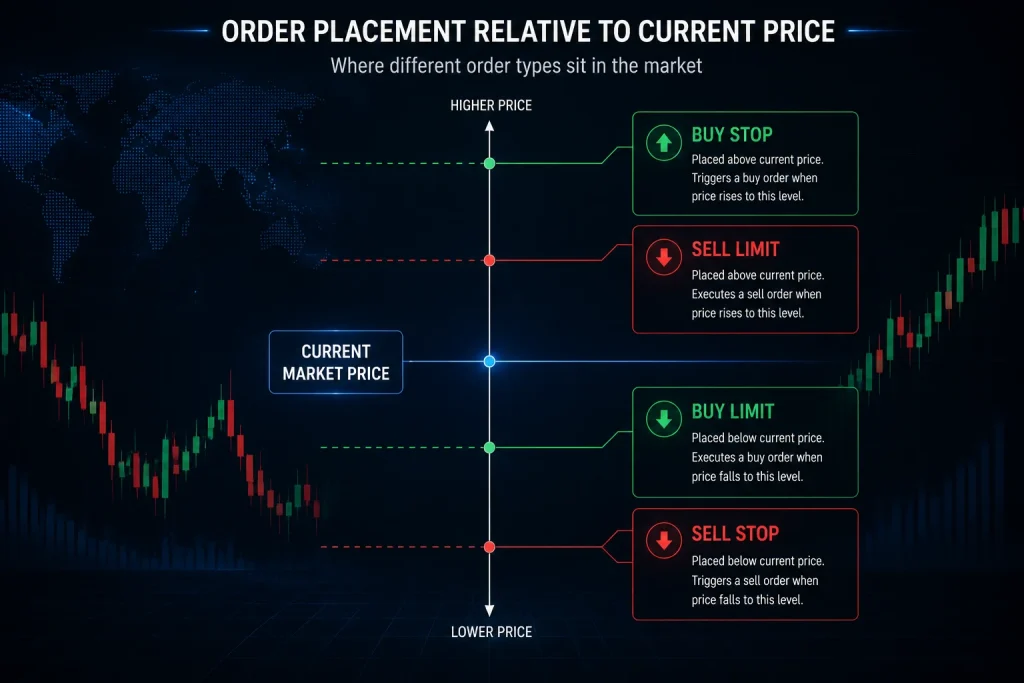
On most platforms these appear on the order ticket as either an instant or market order, or one of four pending order types — buy limit, sell limit, buy stop and sell stop. A guide to placing an order on a trading platform walks through where each option sits.
Market Orders: Fast Execution at the Best Available Price
A market order is an instruction to buy or sell straight away at the best price currently available. It prioritises speed of execution over the exact entry price, which makes it the most common way to move into or out of a position quickly. A buy market order is generally filled at the ask, and a sell market order at the bid.
The trade-off is price certainty. Because the order takes whatever price the market offers, the fill can land a little away from the last quote you saw — an effect known as slippage — which tends to widen in fast-moving or thinly traded conditions. Market orders are often most useful on liquid instruments where the spread is tight and the quoted price is likely to hold.
For reference, brokers generally fill market orders during regular trading hours, which for US shares run from 9:30 a.m. to 4:00 p.m. Eastern Time; an order placed while the market is closed is filled at the next open, which can differ significantly from the previous close [1].
Limit Orders: Setting the Price You Are Willing to Trade
A limit order executes only at a price you specify or better, giving you control over your entry or exit price — though the trade is no longer certain to fill. A buy limit sits below the current price; a sell limit sits above it [2].
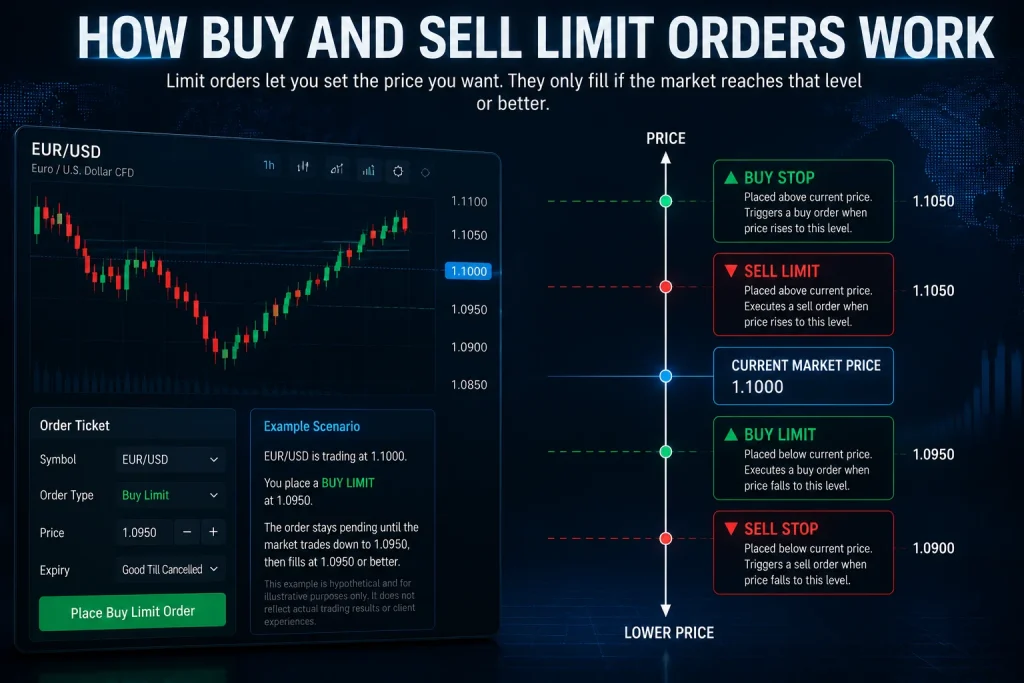
Say a EUR/USD CFD is trading at 1.1000 and you would rather buy on a pullback. A buy limit order at 1.0950 stays pending until the market trades down to that level, then fills at 1.0950 or better. If price never reaches 1.0950, the order simply does not execute.
This example is hypothetical and for illustrative purposes only. It does not reflect actual trading results or client experiences.
That conditionality is the main risk: a limit order can leave you on the sidelines while price runs without you. The mechanics of buy and sell limits are covered in more depth in the guide to buy limit vs sell limit orders.
Stop Orders: Triggering a Trade Once Price Reaches a Level
A stop order stays inactive until price reaches a trigger you set, at which point it becomes a market order and fills at the next available price. A buy stop is placed above the current price; a sell stop is placed below it [2]. Traders often use stop orders to enter on a breakout, or to close a position if the market moves against them.
Because a triggered stop turns into a market order, the fill price is not guaranteed — in a fast move or an overnight price gap it can be worse than the trigger level [1]. Two common variations refine this behaviour:
- Stop-limit order: Combines a stop price with a limit price. When the stop triggers, it places a limit order rather than a market order, so the fill is capped at your limit — but if price gaps straight past that limit, the order may not fill at all [1].
- Trailing stop order: Sets the stop a fixed distance from the current price, such as 50 pips, and moves it automatically as the trade moves in your favour while holding firm if price reverses. It aims to protect open profit without constant monitoring.
Stop-Loss and Take-Profit Orders
Two order types deal with managing an open position rather than opening one. A stop-loss order automatically closes a trade once the market reaches a set loss level, helping to cap how much a position can lose. A take-profit order closes a trade once it reaches a set profit level, locking in gains before the market can reverse.
In CFD trading these matter because positions are leveraged, and leverage magnifies both gains and losses — a modest move against a position can erode margin quickly. A stop-loss does not remove that risk: like any stop, it becomes a market order when triggered and does not guarantee the exact exit price in a fast or gapping market.
Market Execution vs Instant Execution
Order type is separate from execution model, which is how the platform fills your order once you place it. On MetaTrader 4 and MetaTrader 5, the two you will most often meet are instant execution and market execution.
- Instant execution: The order is sent at the price shown on screen. If that price is no longer available when the broker receives it, the platform returns a requote and you choose whether to accept the new price. It suits traders who want to deal at a specific quoted price.
- Market execution: The order is filled at the best price available in the market at that moment, with no requote. The fill is fast, but the exact price is confirmed only after execution, so it can differ slightly from the last quote in volatile conditions.
Neither is inherently better; they simply handle price differently. Across its trading platforms, Vantage offers more than one execution mode alongside the standard market, limit and stop order types, so the choice of execution model sits next to the choice of order type on the same ticket.
Comparing Order Types and When Traders Use Each
Set side by side, the order types divide cleanly by what they prioritise: speed, price, or a trigger condition.
| Order Type | What It Does | Main Benefit | Main Risk | Commonly Used When |
| Market order | Buys or sells immediately at the best available price | Fast, near-certain execution | No price control; slippage in fast markets | You need to enter or exit quickly |
| Limit order | Executes only at a set price or better | Control over entry or exit price | May never fill if the price is not reached | You want a specific price and can wait |
| Stop order | Triggers a market order once a set level is reached | Automates breakout entries and exits | Fill not guaranteed; gaps can worsen the price | You trade breakouts or cap a loss |
| Stop-limit order | Triggers a limit order at a set stop level | Caps the fill price after triggering | May not fill if price gaps past the limit | You want a trigger plus price control |
| Trailing stop | A stop that moves with price by a set distance | Locks in open profit automatically | Can close early on short-term swings | You want to ride a trend with protection |
| Stop-loss order | Closes an open position at a set loss level | Caps downside on a position | Becomes a market order; exact price not guaranteed | You want a defined maximum loss |
| Take-profit order | Closes an open position at a set profit level | Secures gains without monitoring | Exits before any further favourable move | You want to lock in a target |
The right order type tends to follow the goal rather than the market. When speed matters most, a market order fits. When price matters more than certainty of filling, a limit order lets you wait for the level you want. To act on a breakout or to cap a loss, a stop order triggers only once price confirms the move. Many traders combine them, opening with one order type and attaching a stop-loss and take-profit to define the exit in advance.
Matching the Order to the Goal, Not the Market
No single order type is best; each solves a different problem. Market orders buy speed at the cost of price certainty, limit orders buy price control at the cost of a guaranteed fill, and stop orders act on confirmation once a level is reached.
The choice comes down to which of those matters most for a given trade. Because CFDs are leveraged, pairing an entry with a stop-loss is how many traders keep a single position from doing outsized damage. Knowing what each order does, and where it can let you down, is what turns the order ticket from a formality into part of the plan.
Frequently Asked Questions
What Are the 5 Types of Orders?
The five most commonly referenced order types are market, limit, stop, stop-limit and trailing stop. Market orders fill immediately, limit orders wait for a set price, and stop orders trigger once a level is reached. Stop-limit and trailing stop are refinements of the stop order. Stop-loss and take-profit are applications of these same mechanics used to manage an open position.
What Is the Difference Between a Market Order and a Limit Order?
A market order fills straight away at the best available price, prioritising speed over the exact level. A limit order fills only at a price you set or better, prioritising price over certainty of execution. The practical trade-off is that a market order will almost always execute but the price can move, while a limit order controls the price but may never fill.
What Is Instant Execution in Forex and CFD Trading?
Instant execution is an execution model where your order is sent at the price displayed on the platform. If that price is no longer available when the broker receives the order, you receive a requote and can accept or decline the new price. It is common on MetaTrader platforms and suits traders who want to deal at a specific quoted price rather than the next available one.
What Is the Difference Between Market Execution and Instant Execution?
Both describe how an order is filled, not what type of order it is. With instant execution, the platform tries to fill at the shown price and issues a requote if it has moved. With market execution, the order is filled at the best available market price with no requote, so it is confirmed only after the fill. Market execution is generally faster, while instant execution offers more control over the quoted price.
What Is a Stop-Limit Order?
A stop-limit order combines two prices: a stop price that triggers the order, and a limit price that caps where it can fill. Once the market reaches the stop, the order becomes a limit order rather than a market order. This protects against a poor fill, but it also means the order may not execute at all if price gaps straight past the limit level.
Which Order Type Is Best for Fast Execution?
A market order is generally the fastest way to enter or exit, because it fills at the best available price without waiting for a specific level. The trade-off is slippage: in fast or thin markets the fill can differ from the last quoted price. Traders who need speed but want some price protection sometimes use a stop-limit instead, accepting the risk that it may not fill.
RISK WARNING: CFDs are complex financial instruments and carry a high risk of losing money rapidly due to leverage. You should ensure you fully understand the risks involved and carefully consider whether you can afford to take the high risk of losing your money before trading.
Disclaimer: The information is provided for educational purposes only and doesn’t take into account your personal objectives, financial circumstances, or needs. It does not constitute investment advice. We encourage you to seek independent advice if necessary. The information has not been prepared in accordance with legal requirements designed to promote the independence of investment research. No representation or warranty is given as to the accuracy or completeness of any information contained within. This material may contain historical or past performance figures and should not be relied on. Furthermore estimates, forward-looking statements, and forecasts cannot be guaranteed. The information on this site and the products and services offered are not intended for distribution to any person in any country or jurisdiction where such distribution or use would be contrary to local law or regulation.
References
- “Order Types – FINRA” https://www.finra.org/investors/investing/investment-products/stocks/order-types Accessed 18 Aug 2026
- “Types of Orders – Investor.gov (U.S. Securities and Exchange Commission)” https://www.investor.gov/introduction-investing/investing-basics/how-stock-markets-work/types-orders Accessed 18 Aug 2026